
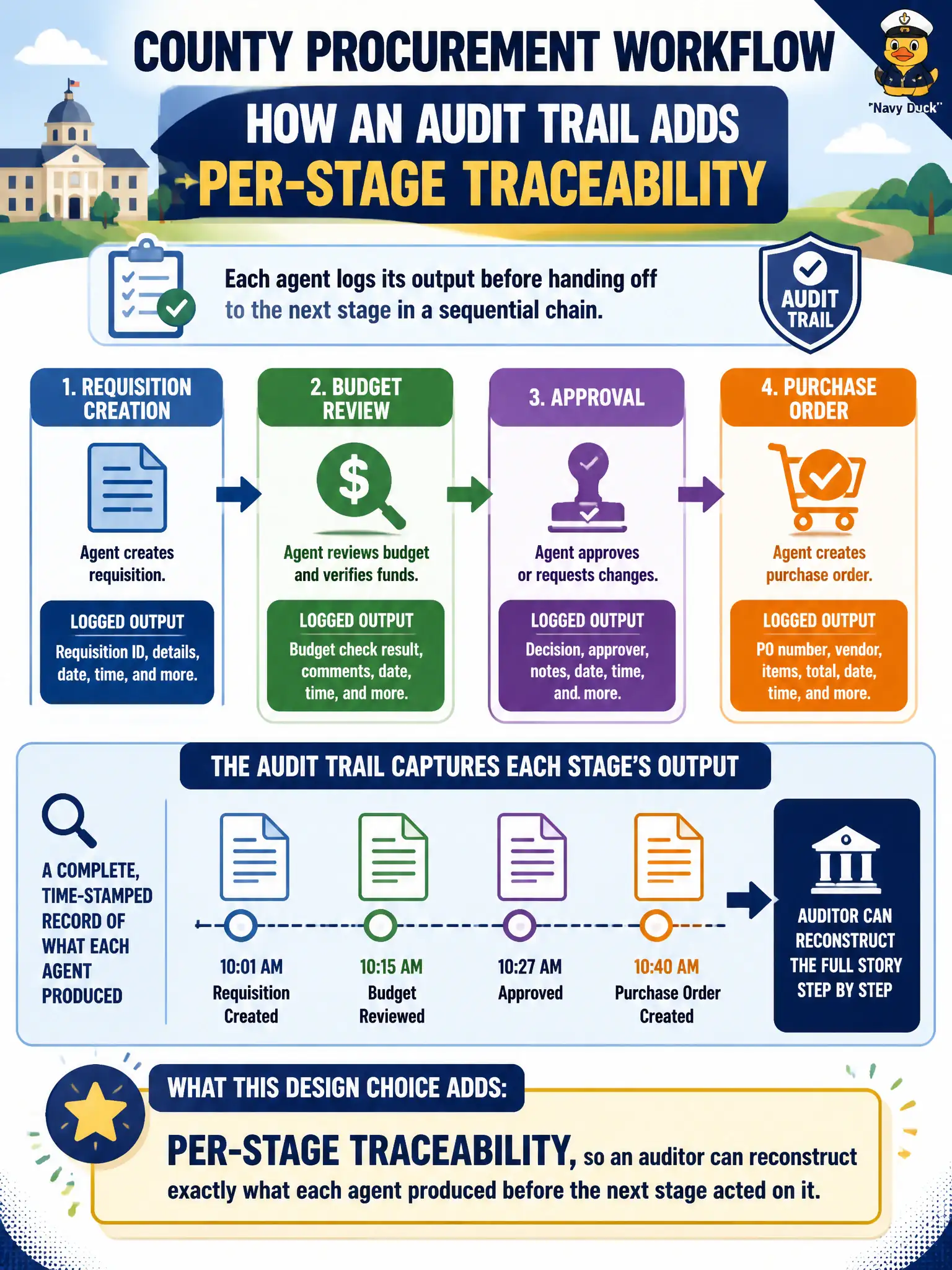
A county procurement workflow enforces an audit trail by having each agent log its output before handing off to the next stage in a sequential chain. What does this design choice add to the workflow?
Select an answer to reveal the explanation.
Short Explanation
An audit trail is like a paper trail through a procurement chain — every stage leaves its own signed record before passing the baton. That per-stage logging is what lets an auditor later reconstruct exactly who decided what, and when.
Full Explanation
Logging each agent's output before handoff creates per-stage traceability: an auditor reviewing the procurement chain later can see precisely what each stage produced and confirm that the next stage acted on that specific, recorded output rather than on some undocumented intermediate state. This doesn't replace the sequential pattern itself — the ordering dependency between stages still exists and still needs to be enforced; logging documents what happened at each step, it doesn't substitute for the structure that made those steps happen in the right order. It also isn't a latency improvement — writing a log entry at each stage adds a small amount of work rather than reducing it, so any latency benefit would have to come from elsewhere in the design, not from the logging itself. And a logged output isn't automatically validated as correct — logging captures what an agent produced, not whether that output was accurate or compliant; correctness checking is a separate evaluation concern that has to be designed in on top of the audit trail, not assumed from its presence. Scope note: audit logging is especially valuable in procurement and other regulated civic processes where after-the-fact review is a compliance requirement, not just a debugging convenience. Operational check: pull the logged output for one procurement case end-to-end and confirm every stage's contribution is reconstructable from the log alone.