
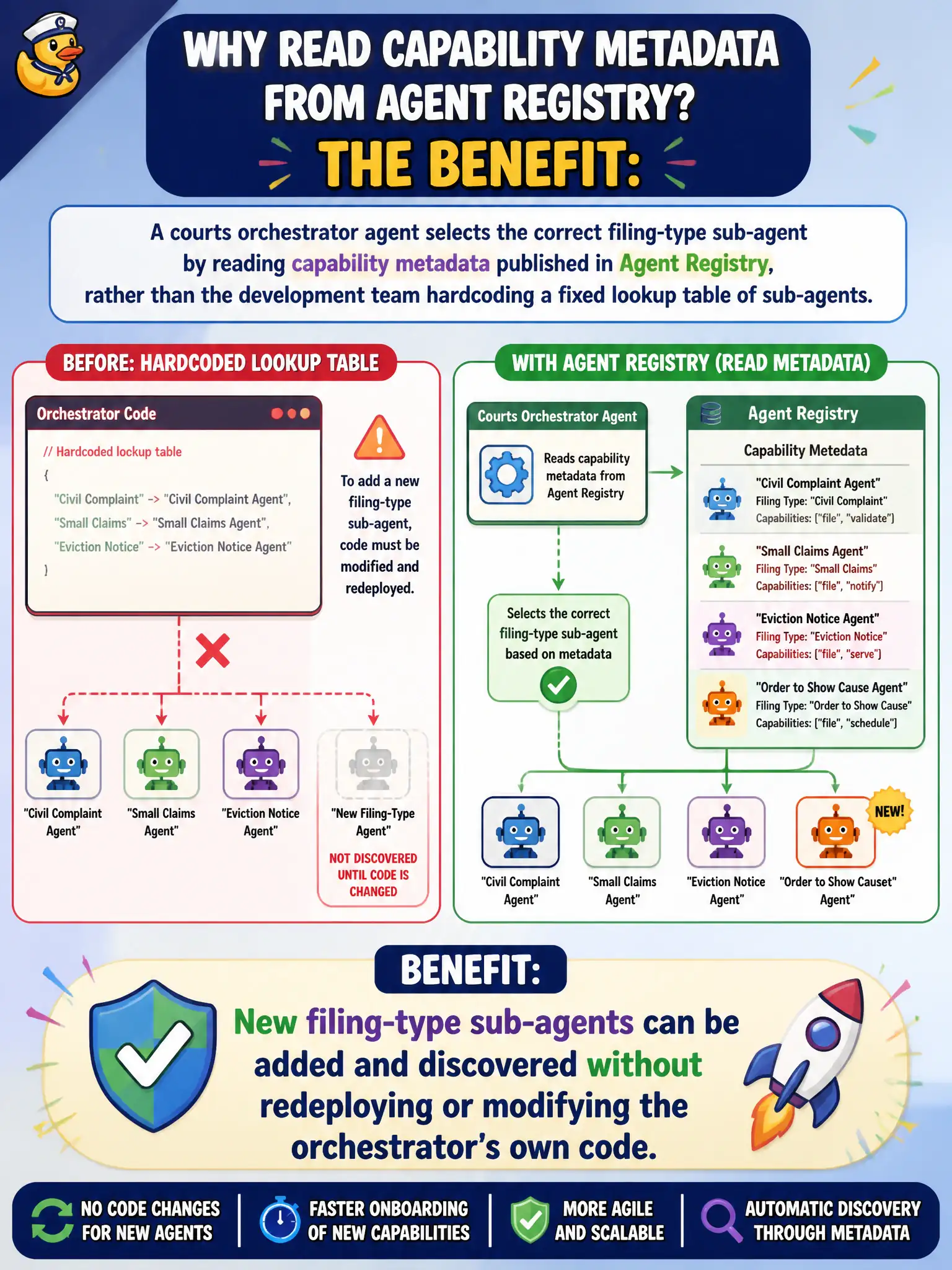
A courts orchestrator agent selects the correct filing-type sub-agent by reading capability metadata published in Agent Registry, rather than the development team hardcoding a fixed lookup table of sub-agents. What benefit does this approach provide?
Select an answer to reveal the explanation.
Short Explanation
A hardcoded lookup table is like a printed map — the second a new road opens, it's out of date. Reading capability metadata from Agent Registry at runtime is more like live navigation: add a new filing-type sub-agent, and the orchestrator finds it without anyone having to touch the orchestrator's own code.
Full Explanation
Dynamic capability discovery through Agent Registry decouples the orchestrator's logic from the specific set of sub-agents that currently exist — as new filing-type sub-agents get published, the orchestrator can find and route to them by reading updated metadata, with no code change or redeployment of the orchestrator itself required. That benefit is specifically about extensibility and reduced coupling, not about security: registry-driven discovery doesn't eliminate the need for permission checks on delegation, since discoverability and authorization remain separate concerns handled by Agent Identity and policy, not by the registry lookup itself. Capability metadata describes what a sub-agent claims to do, but metadata isn't a correctness guarantee — a published sub-agent can still produce a wrong or low-quality output for a given filing type, so evaluation remains necessary regardless of how it was discovered. Being listed in the registry means a capability was published, not that it has passed any particular validation bar for production use — treating registry presence as equivalent to being pre-validated skips the evaluation step this exam guide treats as its own discipline. Scope note: registry-driven routing still benefits from monitoring which sub-agent actually handled each case, to catch a poorly performing or misrouted capability early. Operational check: publish a new filing-type sub-agent to the registry and confirm the orchestrator routes to it correctly without any change to the orchestrator's own deployment.