
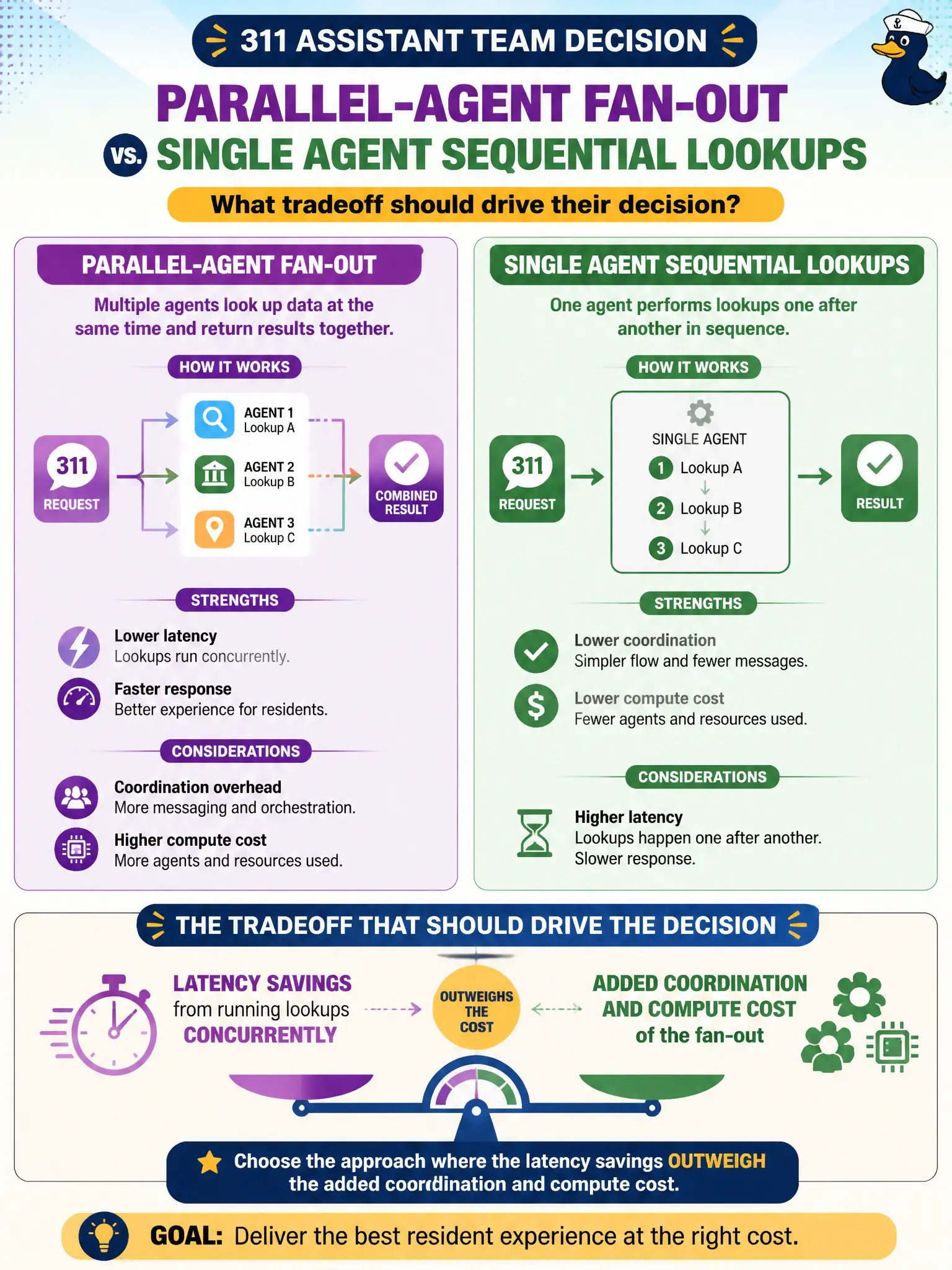
A 311 assistant team is weighing a parallel-agent fan-out against a single agent performing sequential lookups for the same resident request. What tradeoff should drive their decision?
Select an answer to reveal the explanation.
Short Explanation
Fanning work out to run in parallel is a bit like hiring three couriers instead of one runner doing three trips — faster, but you're now paying and coordinating three of them instead of one. The real question is whether that speed gain is actually worth the extra coordination and compute it costs.
Full Explanation
The core tradeoff is latency against overhead: parallel fan-out can cut total response time by running independent lookups concurrently, but it also adds coordination logic, aggregation of results, and typically more compute cost than a single agent working through the same lookups sequentially. The team should weigh whether the workload's lookups are slow or numerous enough that the concurrency savings meaningfully beat that added cost, or whether the request volume is light enough that sequential handling is simpler and cheap enough already. Model recency doesn't bear on this tradeoff — swapping in a newer model changes generation quality, not whether concurrent execution of independent lookups is worth its coordination overhead for this specific workload. Time of day affects request volume, but volume alone doesn't determine which orchestration pattern is architecturally appropriate for a single request's internal lookups — a request from a quiet Tuesday afternoon still has the same lookup structure as one from a busy Monday morning. Instruction length is a configuration-effort concern, not a performance or cost tradeoff, and doesn't reflect the actual runtime behavior difference between fanning out and running sequentially. Scope note: this tradeoff should be reassessed if request volume or the number of independent lookups changes significantly over time. Operational check: benchmark end-to-end latency and per-request compute cost for both patterns against representative traffic before committing to one.