
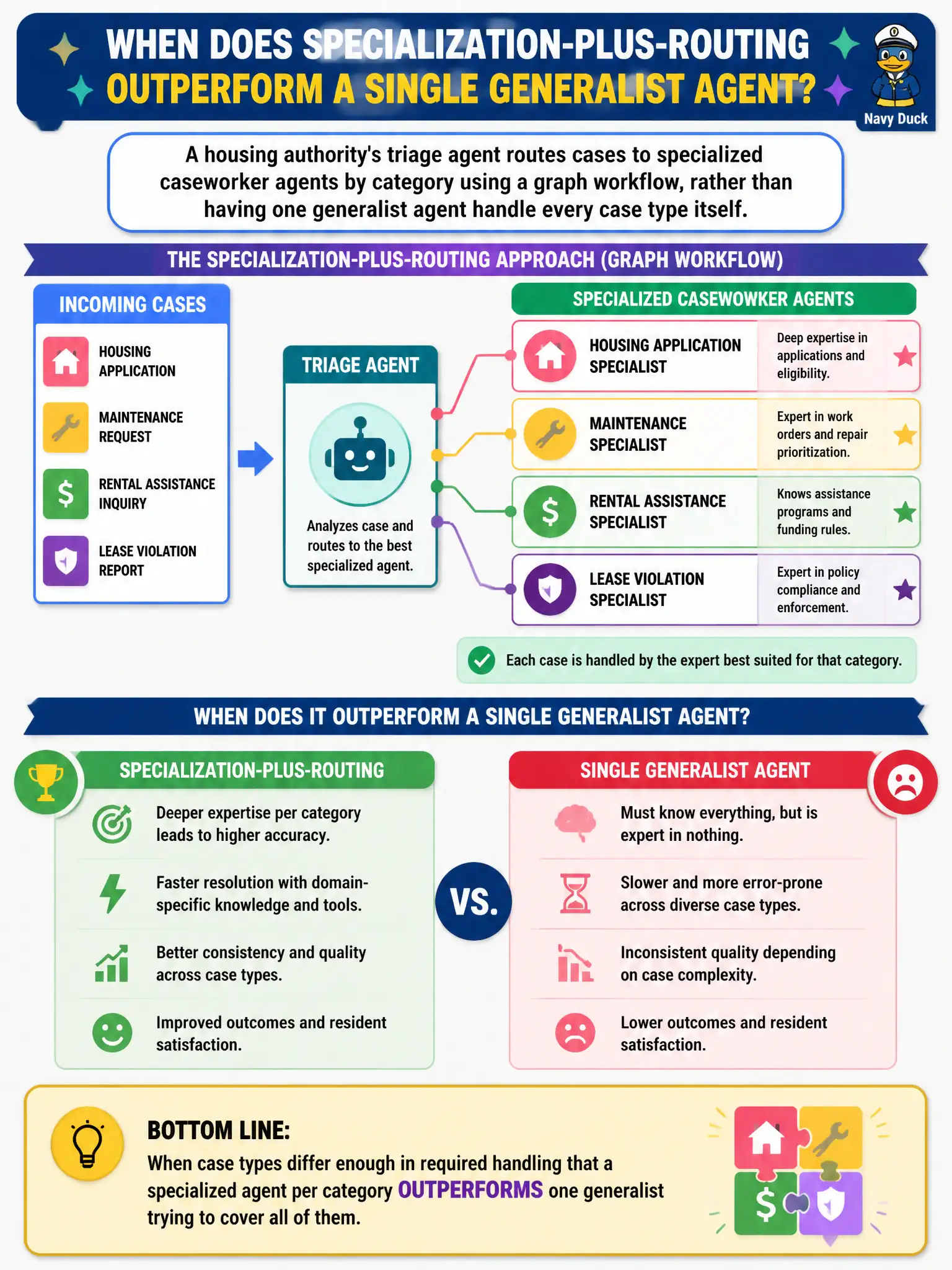
A housing authority's triage agent routes cases to specialized caseworker agents by category using a graph workflow, rather than having one generalist agent handle every case type itself. When does this specialization-plus-routing approach outperform a single generalist agent?
Select an answer to reveal the explanation.
Short Explanation
A generalist doctor can handle a lot, but for something specialized you want the specialist who's seen a thousand of exactly that case. Routing each case to a caseworker agent built for its category beats asking one all-purpose agent to be equally sharp at everything.
Full Explanation
Specialization pays off when case types genuinely differ in the domain knowledge, tools, or reasoning steps they require — a graph workflow's conditional routing sends each case to the caseworker agent best equipped for it, so each agent can be tuned, tested, and improved for its own narrower scope rather than diluted across every case type. If every case type actually required identical handling, there'd be no meaningful distinction for the routing to exploit, and a single agent following one consistent process would be simpler with no accuracy tradeoff — that's precisely the condition under which specialization stops paying off. Minimizing the total agent count is an operational preference, not the reason specialization helps; in fact this pattern usually means running more agents, not fewer, in exchange for better per-category performance. Low case volume speaks to whether a single agent could keep up with throughput, but throughput capacity is a different concern from whether that agent's reasoning is well-suited to every case type it encounters — a generalist can be fast and still be worse at edge cases a specialist would catch. Scope note: the specialization benefit has to be weighed against the added complexity of maintaining more agents and a routing layer; it isn't free. Operational check: compare case-resolution accuracy between the specialized routing setup and a generalist-agent baseline on a sample of varied case types.