
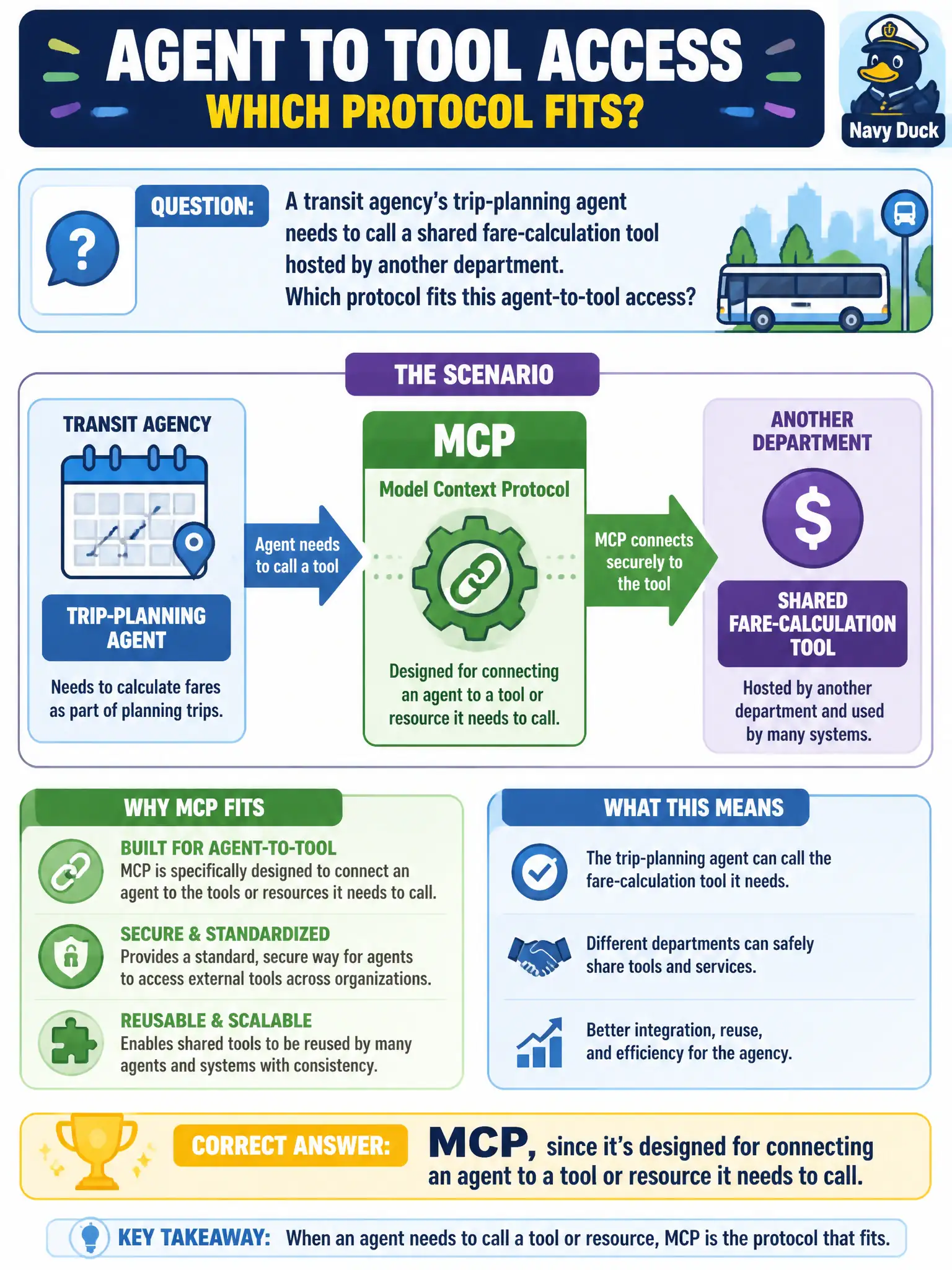
A transit agency's trip-planning agent needs to call a shared fare-calculation tool hosted by another department. Which protocol fits this agent-to-tool access?
Select an answer to reveal the explanation.
Short Explanation
MCP is the plug an agent uses to reach for a tool — like a fare-calculation function — the same way a phone charger fits an outlet, no matter who owns the outlet. A2A is a different plug: that one's for talking to another agent, not calling a tool.
Full Explanation
MCP standardizes how an agent discovers and invokes a tool's capabilities, which is exactly what the trip-planning agent needs to call a fare-calculation function it doesn't own — the tool exposes its interface, and MCP defines how the agent talks to it. A2A is built for agent-to-agent handoffs between peers with their own reasoning, not for calling a tool that simply executes a function and returns a result — using it here would apply the wrong abstraction to a tool-calling problem. A bare authenticated REST call might technically work, but it skips the standardized discovery, capability description, and interoperability that MCP provides, leaving the integration brittle and undocumented for future agents that might want to call the same tool. Agent Registry helps agents discover that the fare-calculation capability exists and where to find it, but discovery isn't the same as the calling protocol itself — the agent still needs MCP (or an equivalent) to actually invoke the tool once it's found. Scope note: Agent Registry and MCP typically work together — registry for discovery, MCP for the call — rather than one replacing the other. Operational check: confirm the fare-calculation tool exposes an MCP-compatible interface before assuming the trip-planning agent can call it directly.