
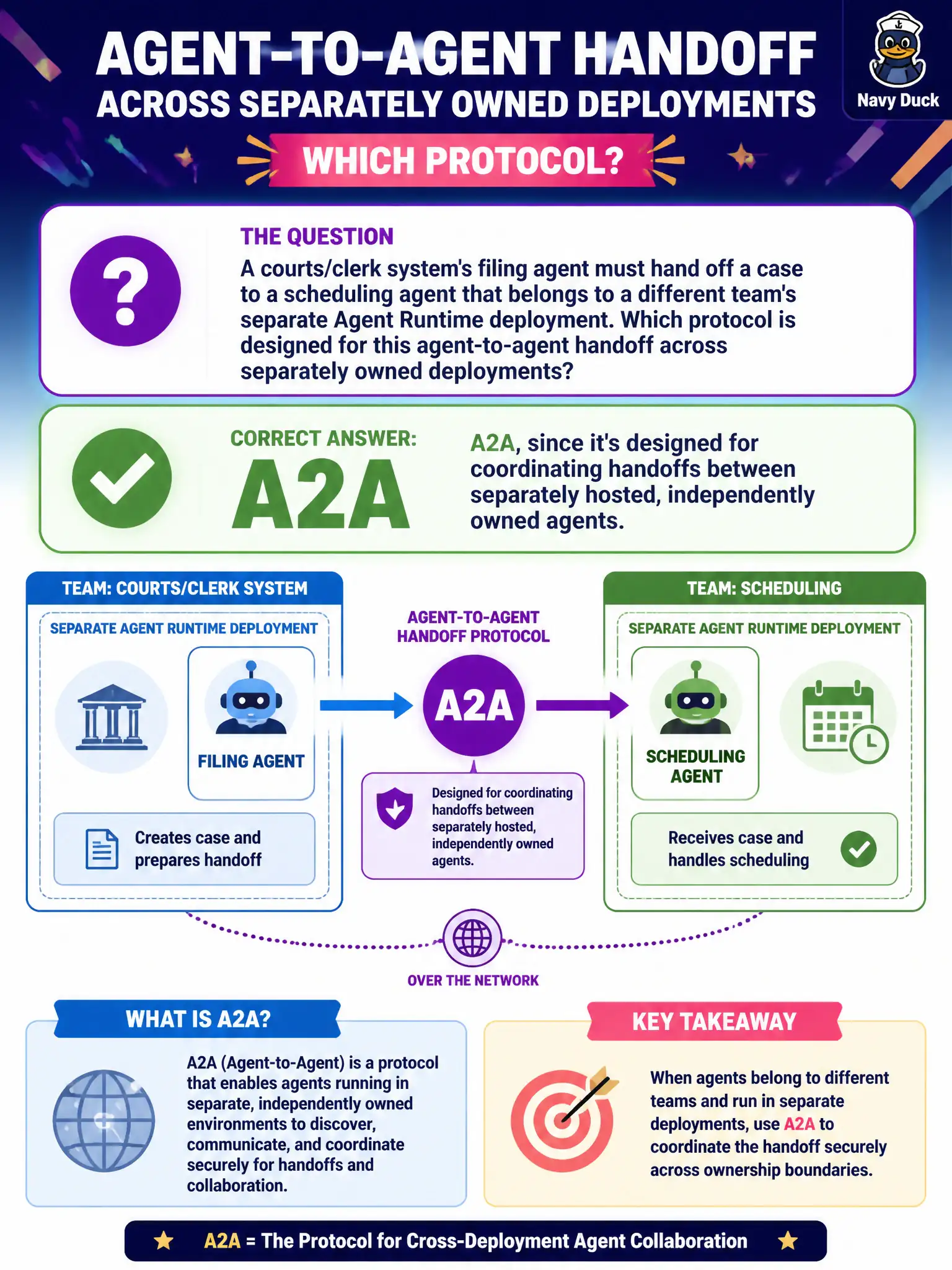
A courts/clerk system's filing agent must hand off a case to a scheduling agent that belongs to a different team's separate Agent Runtime deployment. Which protocol is designed for this agent-to-agent handoff across separately owned deployments?
Select an answer to reveal the explanation.
Short Explanation
Think of A2A as the diplomatic protocol between two separate embassies — it's built for one agent to hand a task to another agent that lives in a completely different deployment. MCP is a different job: that's the protocol an agent uses to reach for a tool, not to talk to a peer agent.
Full Explanation
A2A exists specifically to standardize how independently hosted agents discover each other's capabilities and hand off tasks, which is exactly the filing-to-scheduling handoff described — two agents, two teams, two Agent Runtime deployments. MCP solves a different problem: it's the protocol an agent uses to call tools, data sources, and resources, not to negotiate a task handoff with a peer agent that has its own reasoning and state. OAuth 2.0 handles authentication and authorization for a request, which matters for securing the handoff, but authentication alone doesn't define the message format, capability negotiation, or task-state semantics that make the handoff actually work — it's a piece of the solution, not the whole protocol. Polling a shared database table sidesteps agent-to-agent protocols entirely in favor of a homegrown integration that neither team's agent framework understands natively, losing the standardized discovery and negotiation A2A provides. Scope note: A2A and MCP are typically used together — A2A for agent handoffs, MCP for each agent's own tool access — rather than as competing choices. Operational check: verify the receiving scheduling agent publishes its capabilities in a way the filing agent's A2A client can discover before wiring up the handoff.