
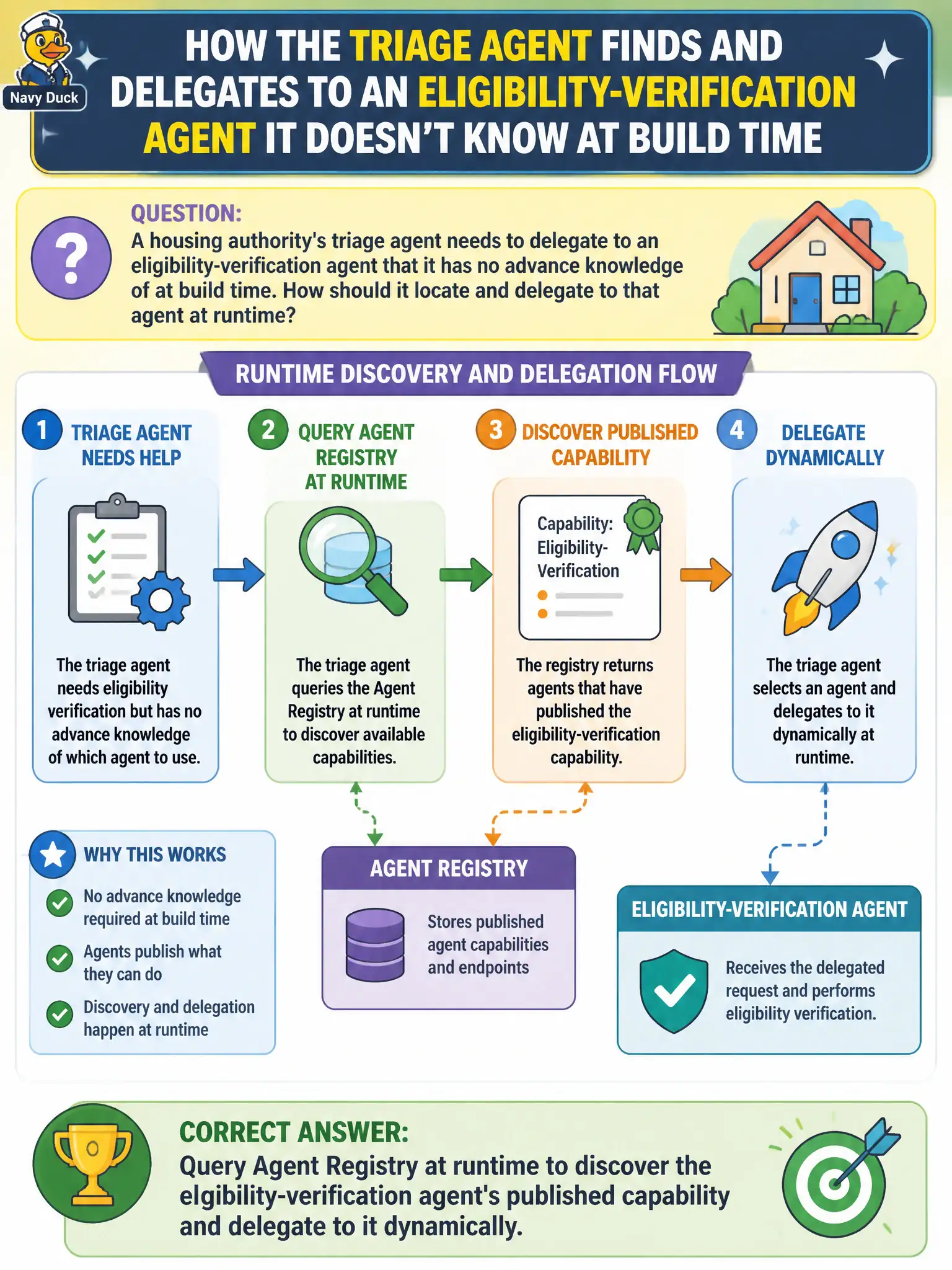
A housing authority's triage agent needs to delegate to an eligibility-verification agent that it has no advance knowledge of at build time. How should it locate and delegate to that agent at runtime?
Select an answer to reveal the explanation.
Short Explanation
Runtime discovery through Agent Registry works like a directory service — the triage agent doesn't need to know the eligibility-verification agent's address in advance, it just looks it up when the need arises. That's what lets new capabilities plug in without redeploying anything.
Full Explanation
Agent Registry supports runtime capability discovery, meaning an orchestrating agent can query it for an agent matching a needed capability and delegate dynamically, without that dependency being wired in ahead of time. Hardcoding the endpoint is exactly the situation the question rules out — the triage agent has no advance knowledge of the eligibility-verification agent, so there's nothing to hardcode, and even if there were, it would couple the two agents tightly and break discovery-based flexibility. Manual human selection defeats the purpose of an autonomous agentic workflow by inserting a person into every case's routing decision, which doesn't scale and isn't what registry-driven delegation is for. Broadcasting to every agent on the network and taking the first responder is unreliable and insecure — it has no notion of capability matching, authorization, or intent, so the 'winning' agent might not even be qualified to handle eligibility verification. Scope note: runtime discovery assumes the eligibility-verification agent has actually published its capability metadata to the registry; an unpublished agent remains undiscoverable. Operational check: query the registry for the target capability in a test call and confirm it resolves to the correct agent before relying on it in production.