
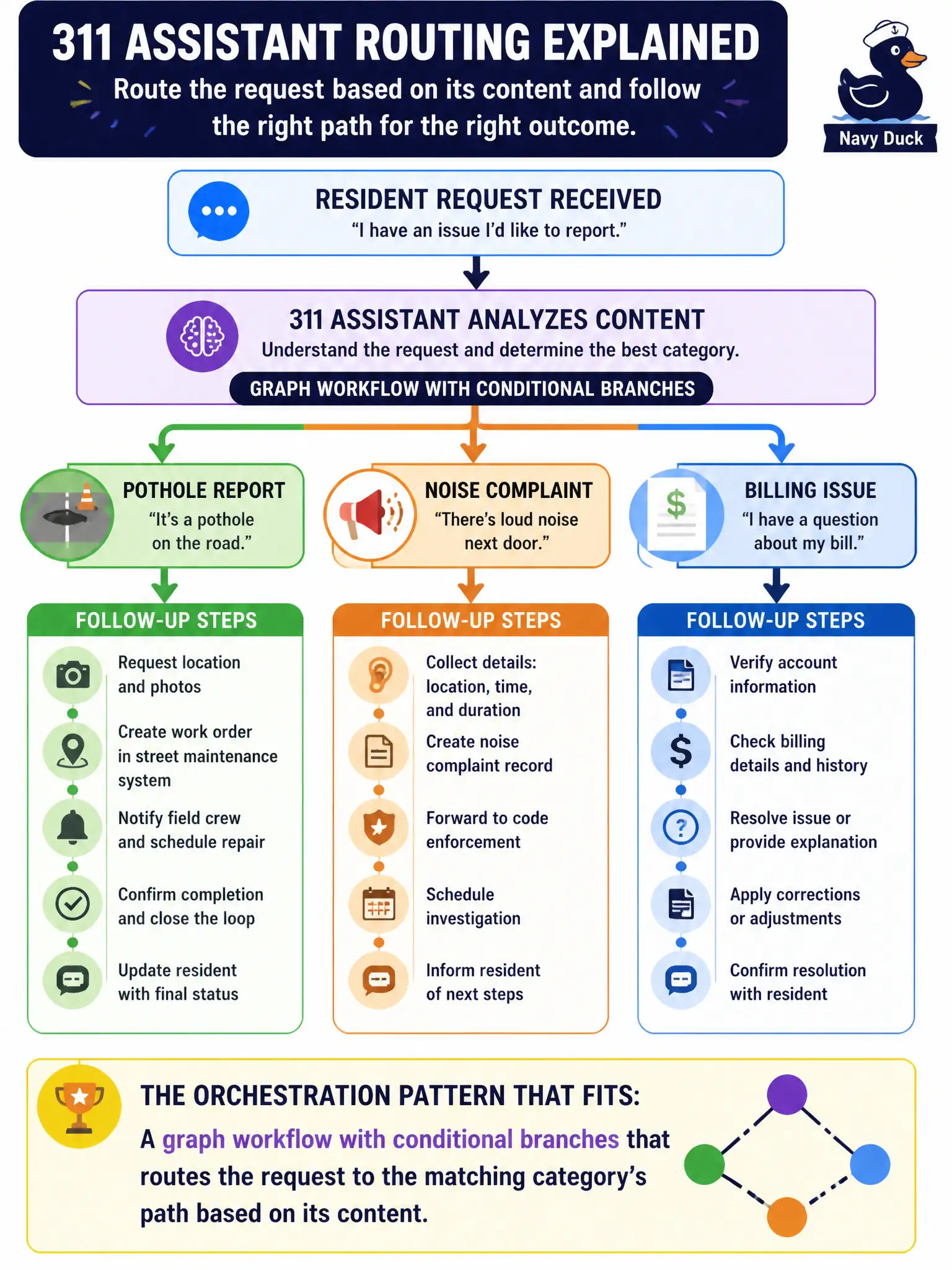
A 311 assistant must route a resident's request differently depending on whether it's a pothole report, a noise complaint, or a billing issue, with different follow-up steps for each path. Which orchestration pattern fits this requirement?
Select an answer to reveal the explanation.
Short Explanation
A 311 assistant is basically a switchboard operator — the pothole call needs a different desk than the billing call. A graph workflow with conditional branches lets the request take the path that actually matches it, instead of walking down every hallway.
Full Explanation
Graph workflows support conditional branching, which is exactly what's needed when a request's category determines its downstream path — the workflow evaluates the request, then routes it to the pothole, noise, or billing branch accordingly. A fixed sequential pattern that runs all three category agents in order regardless of content wastes effort on branches that don't apply to the current request and doesn't reflect the actual conditional structure of the problem. Running all three agents in parallel and discarding the irrelevant results burns compute on work that's thrown away, and still doesn't give the routing logic anywhere to live — it just hides the waste behind concurrency. A single generalist agent handling every category in one shared prompt loses the benefit of specialized handling per category and makes it harder to test, log, or improve one category's logic without touching the others. Scope note: graph workflows are worth the added design complexity specifically when routing logic is conditional; a strictly linear process doesn't need one. Operational check: submit one sample request per category and confirm each is routed to its correct branch without invoking the other two.