
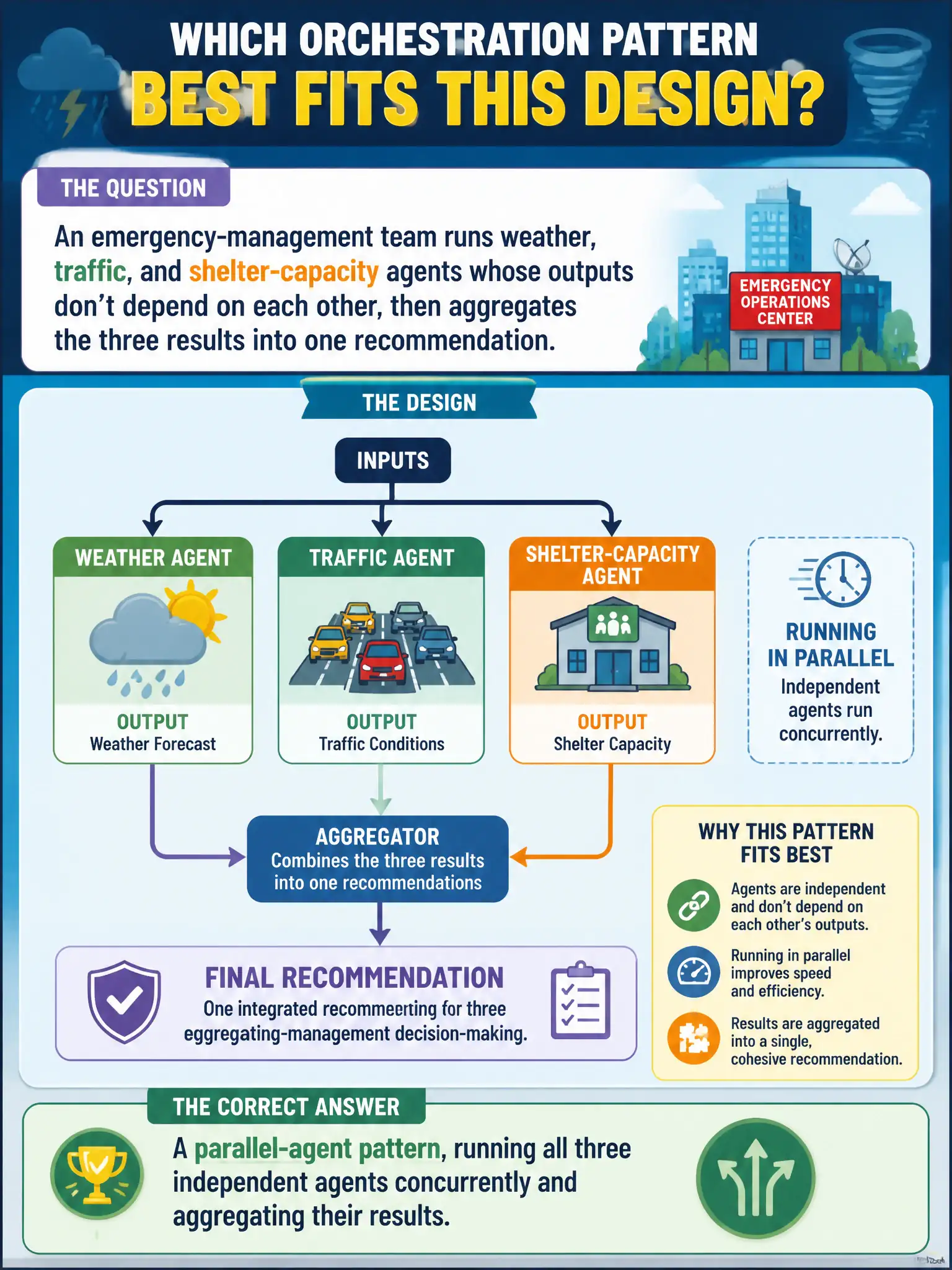
An emergency-management team runs weather, traffic, and shelter-capacity agents whose outputs don't depend on each other, then aggregates the three results into one recommendation. Which orchestration pattern best fits this design?
Select an answer to reveal the explanation.
Short Explanation
When three jobs don't need each other's results, running them one at a time is like waiting in line for three separate cashiers who could all be helping you at once. A parallel pattern lets weather, traffic, and shelter-capacity run side by side and only meets back up when it's time to combine the answers.
Full Explanation
A parallel-agent pattern fits when subtasks are independent — none of the three agents here needs another's output to do its own work, so running them concurrently and aggregating afterward cuts total latency without sacrificing correctness. Sequential execution would force traffic to wait on weather and shelter-capacity to wait on both, adding latency for no benefit since there's no real dependency to respect. A graph workflow with conditional branching is the right tool when routing genuinely varies by case, but here all three agents contribute to the recommendation every time — there's no case where only one of them is relevant, so branching logic is unnecessary overhead. Folding the three lookups into a single agent's internal reasoning loop trades the isolation, parallelism, and independent observability of separate agents for a monolithic process that's harder to scale, debug, or replace one piece of. Scope note: parallel patterns pay off most when subtask latency dominates total response time; trivial subtasks may not be worth the coordination overhead. Operational check: measure end-to-end latency with the three agents run concurrently versus sequentially to confirm the parallel pattern is actually saving time in production.