
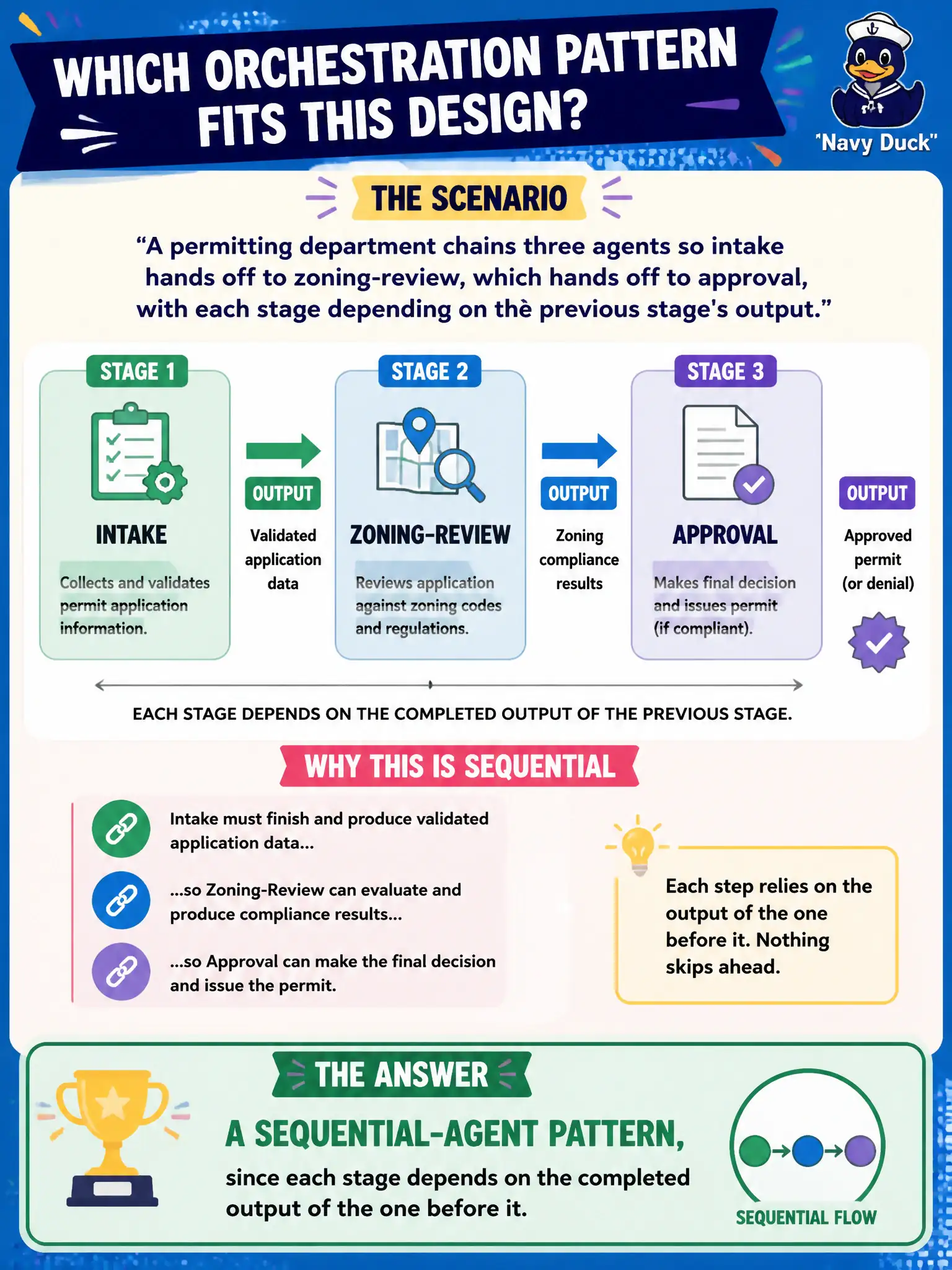
A permitting department chains three agents so intake hands off to zoning-review, which hands off to approval, with each stage depending on the previous stage's output. Which orchestration pattern fits this design?
Select an answer to reveal the explanation.
Short Explanation
Picture an assembly line where each station needs the part the last station just finished — you can't paint a car before it's welded. That's a sequential pattern: strictly ordered stages where each one waits on the last.
Full Explanation
A sequential multiagent pattern models exactly this dependency chain: intake must complete before zoning-review has anything to evaluate, and zoning-review must complete before approval has a decision basis, so each stage runs only after its predecessor finishes. Parallel execution assumes subtasks are independent enough to run concurrently without waiting on each other's output — here they explicitly aren't, so running them in parallel would have approval acting on data that doesn't exist yet. An undefined graph workflow that lets agents negotiate order at runtime adds unnecessary complexity and unpredictability to a process whose order is already fixed by the domain logic, not something that benefits from dynamic routing. Collapsing all three stages into one generalist agent's prompt trades a clear, auditable pipeline for a monolithic step where each stage's reasoning and outputs are harder to isolate, test, and log individually — valuable properties in a permitting audit trail. Scope note: sequential patterns fit strictly ordered dependencies; branch to a graph workflow only when the actual routing logic varies by case. Operational check: trace a single permit request through the pipeline and confirm each stage's logs show it only firing after the prior stage's output is available.