
A housing authority's eligibility-policy retrieval pipeline must choose between a general-purpose embedding model and one tuned to housing-policy language. What consideration should drive the decision?
Select an answer to reveal the explanation.
Short Explanation
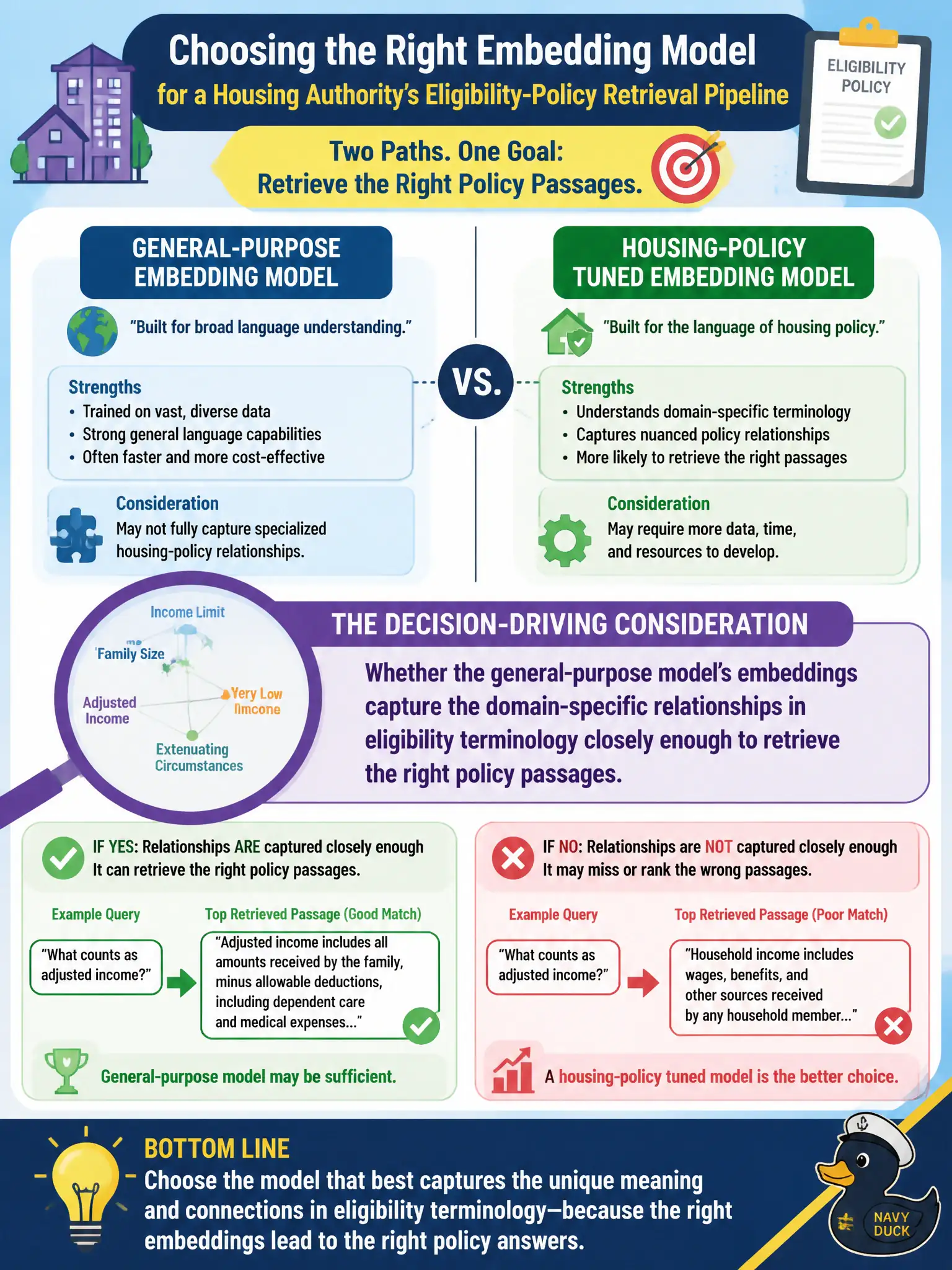
Picking an embedding model is a lot like picking a translator — a generalist does fine with everyday language, but eligibility jargon has its own dialect. The real question is whether the generalist's translation still lands close enough to the right policy passage, or whether you need someone who speaks that dialect natively.
Full Explanation
The deciding factor for embedding-model selection is retrieval quality on the actual domain corpus: do the general-purpose embeddings place semantically related eligibility terms close enough together in vector space to surface the right policy passages, or does the specialized vocabulary get lost in translation? A domain-tuned model earns its complexity only when measured retrieval quality on eligibility queries is meaningfully better — otherwise it's added maintenance for no real gain. Chasing the newest Model Garden entry treats recency as a proxy for fitness, but a newer general-purpose model isn't automatically better suited to specialized terminology than an older domain-tuned one. Worrying about front-end rewrites conflates the retrieval layer with the presentation layer — swapping an embedding model changes how documents are indexed and matched, not how the chat interface renders results. Vector length affecting index speed is a real engineering consideration, but treating shorter-is-better as a blanket rule ignores that retrieval accuracy is the primary requirement here, not latency. Scope note: this tradeoff assumes a representative eligibility-query test set exists to measure against. Operational check: run a retrieval-quality comparison — precision/recall on a labeled query set — before committing to either embedding model.