
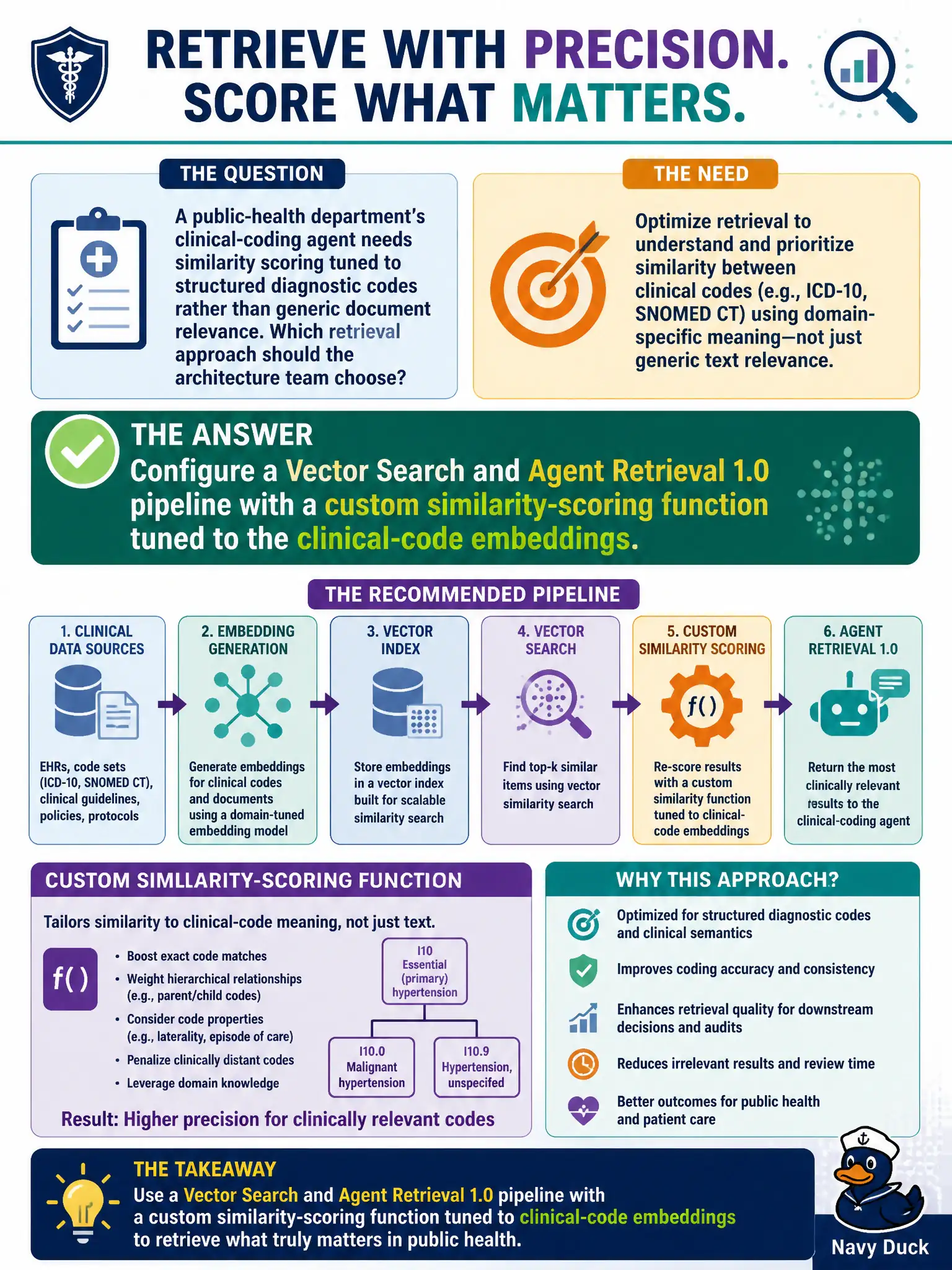
A public-health department's clinical-coding agent needs similarity scoring tuned to structured diagnostic codes rather than generic document relevance. Which retrieval approach should the architecture team choose?
Select an answer to reveal the explanation.
Short Explanation
Think of Agent Search like a great generalist librarian — fantastic at finding documents by topic, but not built to score matches by a custom clinical-coding scheme. When you need that kind of tuned similarity logic, you reach for a customizable retrieval layer instead of the one-size-fits-all option.
Full Explanation
Vector Search and Agent Retrieval 1.0 exist precisely because some retrieval problems need control over the embedding model, the similarity function, and reranking logic — not just a managed search endpoint. Structured clinical codes benefit from a similarity function tuned to how those codes relate to each other, which a general-purpose search product doesn't expose. The keyword-lookup option throws away semantic matching entirely, so related-but-differently-worded codes never surface, even though the data happens to look structured. Fine-tuning the LLM addresses generation quality, not retrieval precision — a mistuned retrieval layer still feeds the model weak context no matter how well the model itself is tuned. Sticking with the default relevance ranking keeps the team inside a managed product's assumptions, which trade configurability for convenience — the wrong tradeoff when the domain has its own scoring logic. Scope note: this decision applies when the domain has structured semantics worth encoding into similarity scoring, not every retrieval task. Operational check: benchmark retrieval precision on a held-out set of code lookups before and after swapping in the custom scoring function.