
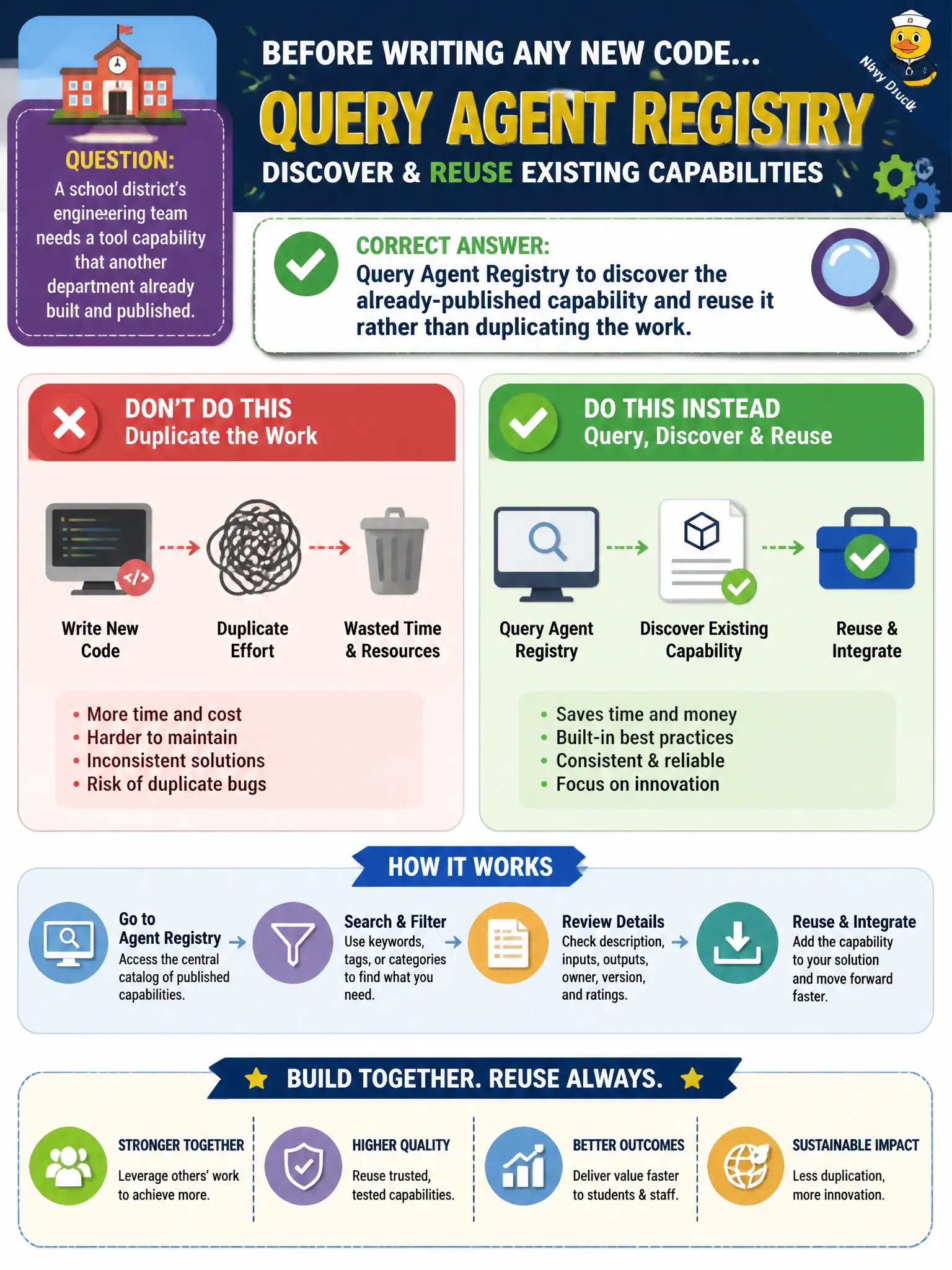
A school district's engineering team needs a tool capability that another department already built and published. What should they do before writing any new code?
Select an answer to reveal the explanation.
Short Explanation
Agent Registry works like a shared toolbox for the whole organization — before you go buy your own hammer, you check whether one's already sitting on the shelf. Discovering and reusing a published capability saves the district from maintaining two copies of the same logic.
Full Explanation
Agent Registry is designed to let teams publish capabilities — tools, agents, integrations — so other teams can discover and reuse them instead of re-implementing the same logic in parallel. That's exactly the scenario here: querying the registry surfaces the existing capability with its metadata, so the district's team can call it directly. Rebuilding from scratch duplicates maintenance burden and risks the two implementations drifting apart over time, even though 'clean ownership boundaries' sounds responsible — reuse through the registry doesn't require merging codebases, just referencing a published interface. Manually copying source code sidesteps the registry entirely and loses versioning, access control, and any updates the owning department pushes later. Building a brand-new MCP server around an already-exposed capability adds an unnecessary integration layer when the original is already discoverable and callable. Scope note: registry-driven reuse assumes the capability's access policy permits cross-department calls — check that before assuming discovery implies authorization. Operational check: query the registry's capability metadata first and confirm the permission scope before wiring in a dependency.