
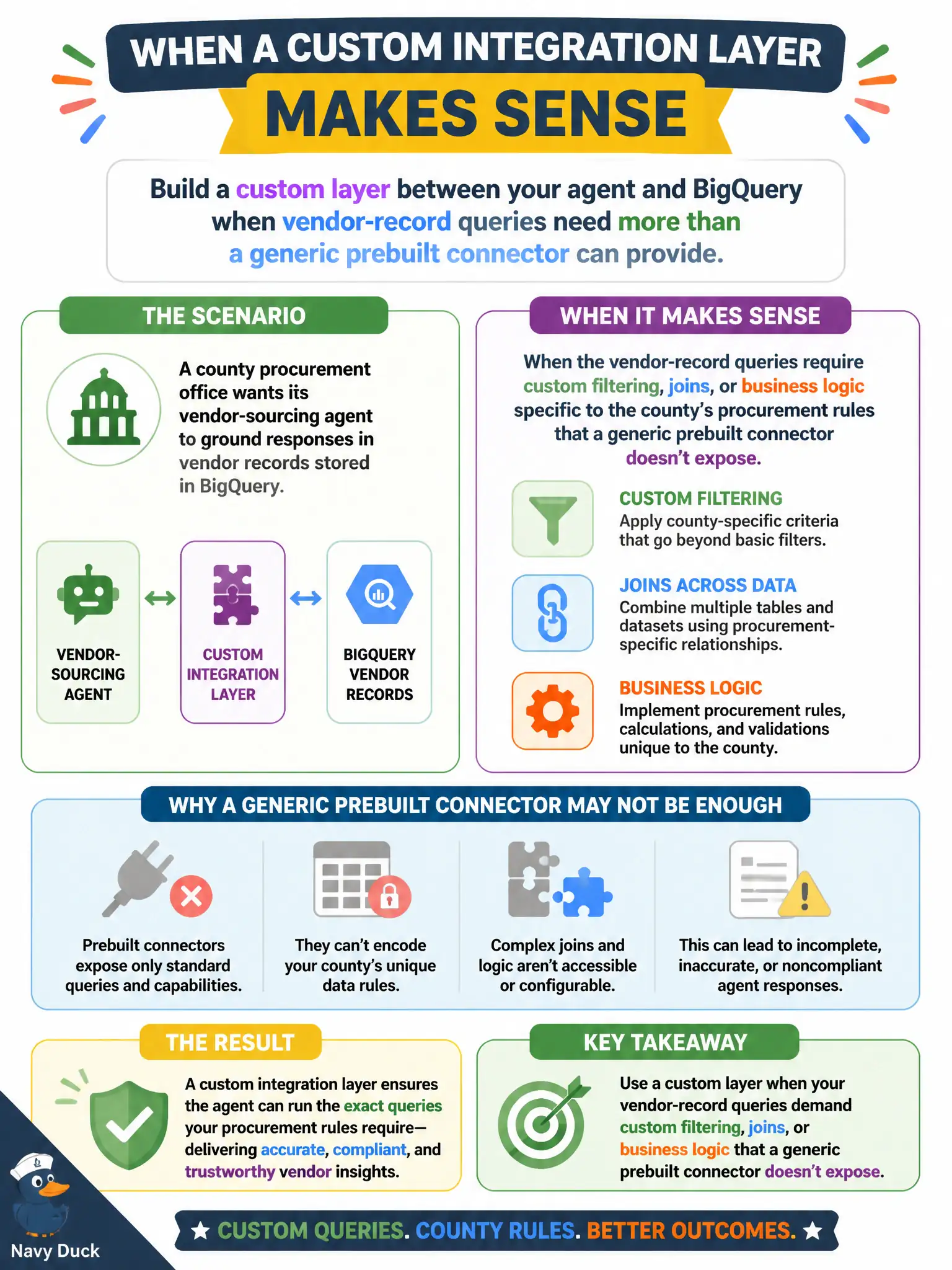
A county procurement office wants its vendor-sourcing agent to ground responses in vendor records stored in BigQuery, but the queries require custom filtering, joins, and business logic specific to the county's procurement rules. The team builds a custom integration layer between the agent and BigQuery rather than using a generic prebuilt connector. When does this custom layer make sense?
Select an answer to reveal the explanation.
Short Explanation
Think of it like an off-the-shelf form versus a custom intake process built around one agency's rules: a generic connector handles the common case, but once procurement rules demand particular filtering, joins, and business logic, that form stops covering what's needed. The custom layer makes sense when county-specific requirements outgrow the connector - not because of data sensitivity, read-versus-write, or BigQuery being involved at all.
Full Explanation
The decision to build a custom integration layer between an agent and BigQuery turns on whether the required queries exceed what a generic prebuilt connector supports: when vendor-sourcing queries need filtering, joins, and business logic specific to the county's own procurement rules, a generic connector - built for broadly common query patterns - typically doesn't expose that level of specificity, which is exactly when a custom layer earns its complexity. It isn't the case that BigQuery data generally requires a custom integration layer as the primary path into a RAG pipeline; many BigQuery-backed retrieval needs are well served by existing connectors, and reaching for custom development by default would be needless overhead. Data sensitivity doesn't determine whether a custom layer is appropriate either - sensitive fields can be protected through proper access controls and tools like Sensitive Data Protection regardless of which integration approach is used. And whether the agent reads from BigQuery versus also writing back is a separate access-scope question from whether the layer itself needs to be custom - a read-only agent could still need custom filtering a generic connector doesn't support. The scope caveat: a custom layer built around today's rules will need maintenance as those rules change, a cost worth weighing against the complexity that justified building it. A concrete check: list the specific filters, joins, and business rules the queries require and confirm none are expressible through the generic connector's supported surface before committing to a custom build.