
A transit agency is indexing its GTFS-derived service documentation for a rider-facing agent and must choose a chunk size for the retrieval corpus. What tradeoff does that chunk-size decision primarily involve?
Select an answer to reveal the explanation.
Short Explanation
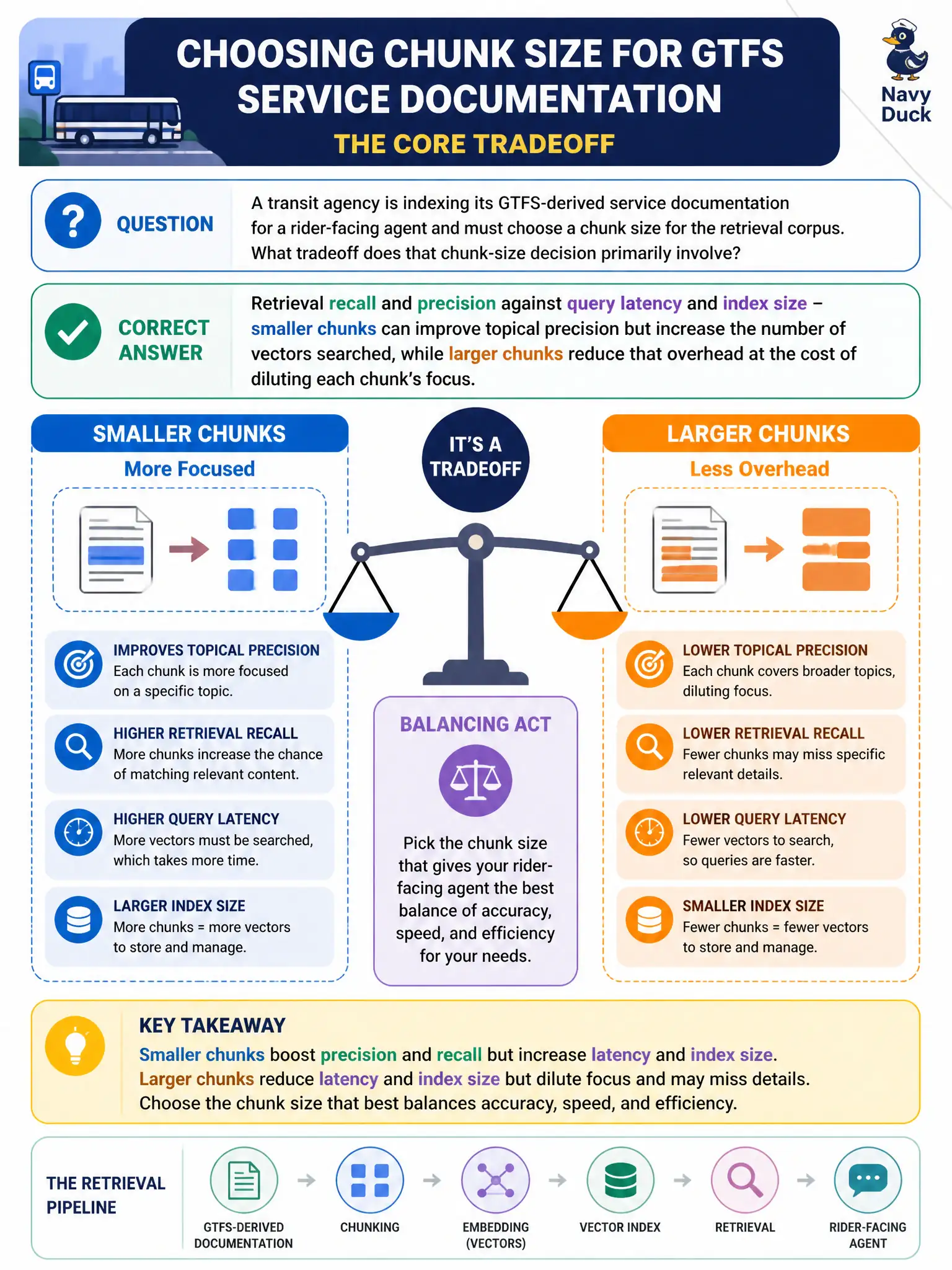
Think of chunk size like slicing a loaf of bread before handing out samples: thinner slices give someone exactly the bite they asked for, but now there are far more slices to search through. Smaller chunks sharpen topical precision at the cost of a bigger index and more vectors to search; larger chunks cut that overhead but dilute how tightly each chunk matches a narrow query - that's the actual tradeoff, not deployment platform or translation needs.
Full Explanation
Chunk size in a RAG pipeline determines the granularity at which source documentation is broken up and embedded, and the core tradeoff it drives is between retrieval quality and system overhead: smaller chunks tend to produce more topically focused embeddings, which can sharpen precision for narrow queries, but they multiply the number of vectors the index has to store and search, increasing index size and query latency; larger chunks reduce that per-query search overhead and index footprint, but each chunk mixes more content together, which can dilute how closely it matches a specific narrow query and hurt recall or precision on pointed questions. Chunk size has no bearing on which compute platform can host the agent - Cloud Run compatibility depends on how the agent service itself is packaged and deployed, not on how its retrieval corpus is chunked. It's also unrelated to translation needs; whether GTFS-derived documentation requires multi-language translation is a content-localization decision made independently of, and typically before, chunking and indexing. And chunk size doesn't govern citation permissions - whether an agent is allowed to cite sources in its responses is a policy or product decision, not a downstream effect of how finely the corpus was chunked. The scope caveat: the right chunk size also depends on the structure of the source documentation itself, such as whether GTFS-derived content already breaks naturally into route- or stop-level sections. A concrete check: benchmark retrieval precision and query latency at two or three candidate chunk sizes against representative rider questions before locking in a value.