
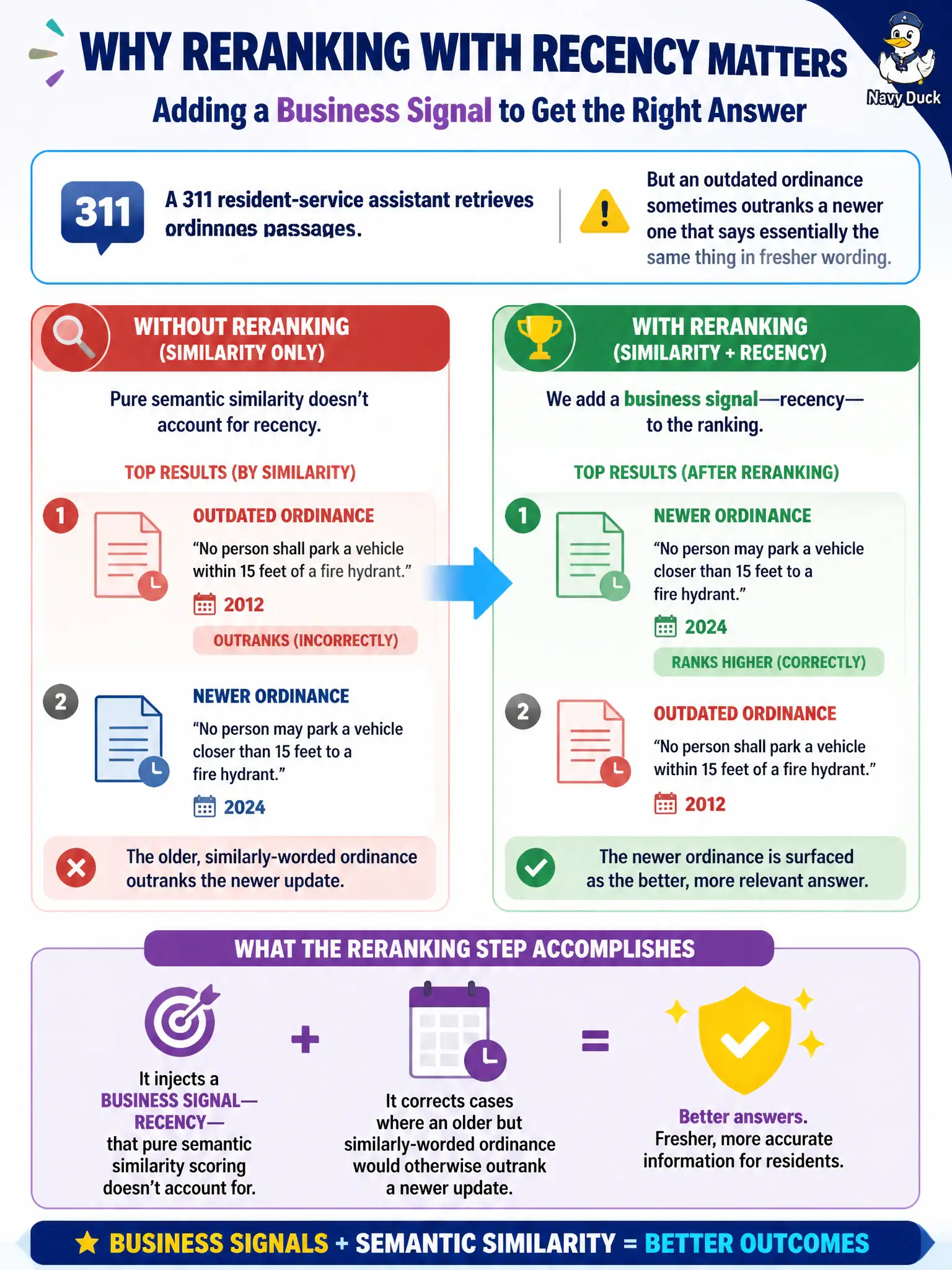
A 311 resident-service assistant retrieves ordinance passages by semantic similarity, but an outdated ordinance sometimes outranks a newer one that says essentially the same thing in fresher wording. The team adds a reranking step that weights recency alongside similarity. What does this reranking step accomplish?
Select an answer to reveal the explanation.
Short Explanation
Think of reranking like a second pass where an editor reorders a stack of similarly-worded articles by which one is actually current, after an initial sort grabbed them all by topic. Pure semantic similarity has no sense of which ordinance is newer - it just measures how close the wording is - so layering recency into reranking corrects exactly the case where an older passage's phrasing happens to score a hair closer to the query than the newer one that superseded it.
Full Explanation
Reranking sits after initial retrieval and reorders the candidate set using additional signals beyond raw similarity score, so weighting recency alongside similarity means the reranker can promote a newer ordinance over an older one even when the older passage's wording scores marginally closer on pure semantic similarity - directly addressing the failure mode described, where outdated but similarly-phrased content outranks its replacement. This doesn't replace similarity-based retrieval outright; the initial retrieval step still uses semantic similarity to assemble the candidate set, and reranking works on top of that set rather than substituting a date-sorted search for it. It also isn't a re-embedding operation - reranking evaluates and reorders already-retrieved candidates using their existing representations plus added signals, it doesn't recompute the corpus's vectors with a newer embedding model on every query, which would be a separate and much more expensive operation. And a recency-aware reranker doesn't guarantee the single most recent ordinance in the whole corpus is always surfaced; it adjusts ranking among the candidates that similarity retrieval already surfaced, so a highly relevant recent passage that never made it into the initial candidate set still won't appear no matter how reranking weights recency. The scope caveat: recency weighting needs a genuine effective-date or publication-date field to key off, and its usefulness depends on how heavily it's weighted relative to similarity - too much weight can surface a recent but only tangentially relevant passage over a highly relevant older one. A concrete check: test the reranked results against a known outdated-versus-current ordinance pair and confirm the newer one now ranks ahead.