
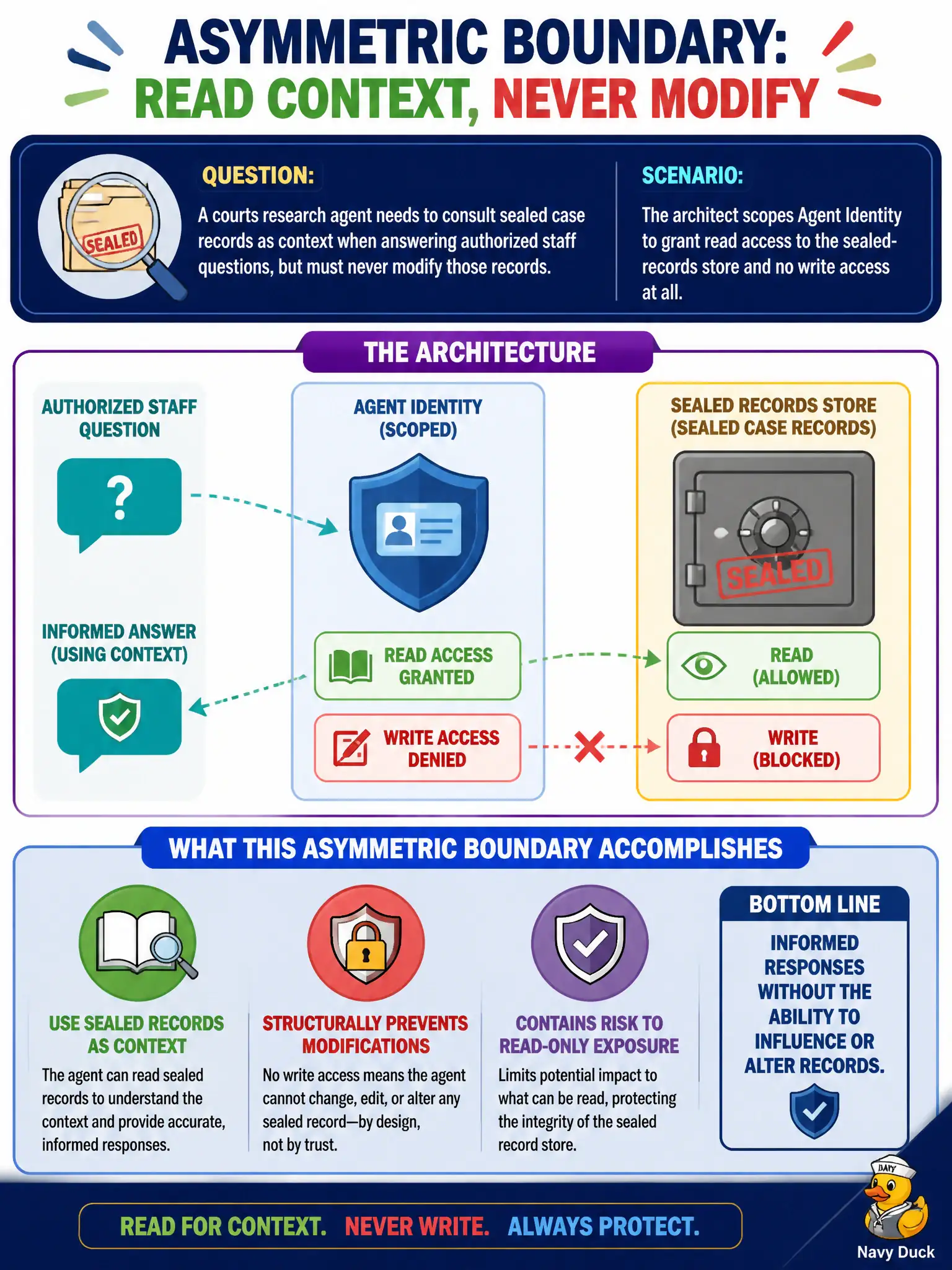
A courts research agent needs to consult sealed case records as context when answering authorized staff questions, but must never modify those records. The architect scopes Agent Identity to grant read access to the sealed-records store and no write access at all. What does this asymmetric boundary accomplish?
Select an answer to reveal the explanation.
Short Explanation
Think of it like giving a researcher a reading-room pass instead of a library-editing pass: they can pull sealed case files off the shelf to inform their work, but there's no pen in their hand that could change what's written. Read-only Agent Identity lets the agent ground its answers in that context while the record itself stays structurally out of reach - a containment boundary, not a speed trick, not automatic redaction, and not a way around staff authorization checks.
Full Explanation
Asymmetric read/write scoping through Agent Identity means the agent's identity carries a grant for read operations against the sealed-records store but no corresponding grant for write operations, so the worst-case outcome of a compromised or misdirected tool call is unauthorized exposure of information already readable, never an unauthorized change to the record - that's the containment value of the boundary, letting the agent use sealed records as grounding context for authorized staff questions while structurally ruling out record tampering. It isn't a performance optimization; permission scope determines what operations are allowed, not how fast allowed operations execute, so removing write access doesn't inherently speed up reads. It also doesn't perform any automatic redaction - read access to a sealed record means the agent can see what that grant covers, and any additional filtering of sensitive details within the record needs to be deliberately built in, such as through a data-protection layer, rather than assumed as a byproduct of a read-only grant. And this boundary doesn't substitute for or bypass the authorization check that determines whether a given staff member is entitled to view sealed records in the first place - the agent's own identity and the requesting staff member's authorization are separate checks that both still need to hold. The scope caveat: read-only scoping limits what the agent itself can do to the record, but it doesn't limit what an authorized human with separate write access could still do through other channels. A concrete check: attempt a write operation against the sealed-records store through the agent's tools in a test environment and confirm it's rejected at the identity layer.