
A housing authority is weighing standing up and operating its own Vector Search index for case-file embeddings against using the managed Agent Retrieval service. Which factor should most influence that decision?
Select an answer to reveal the explanation.
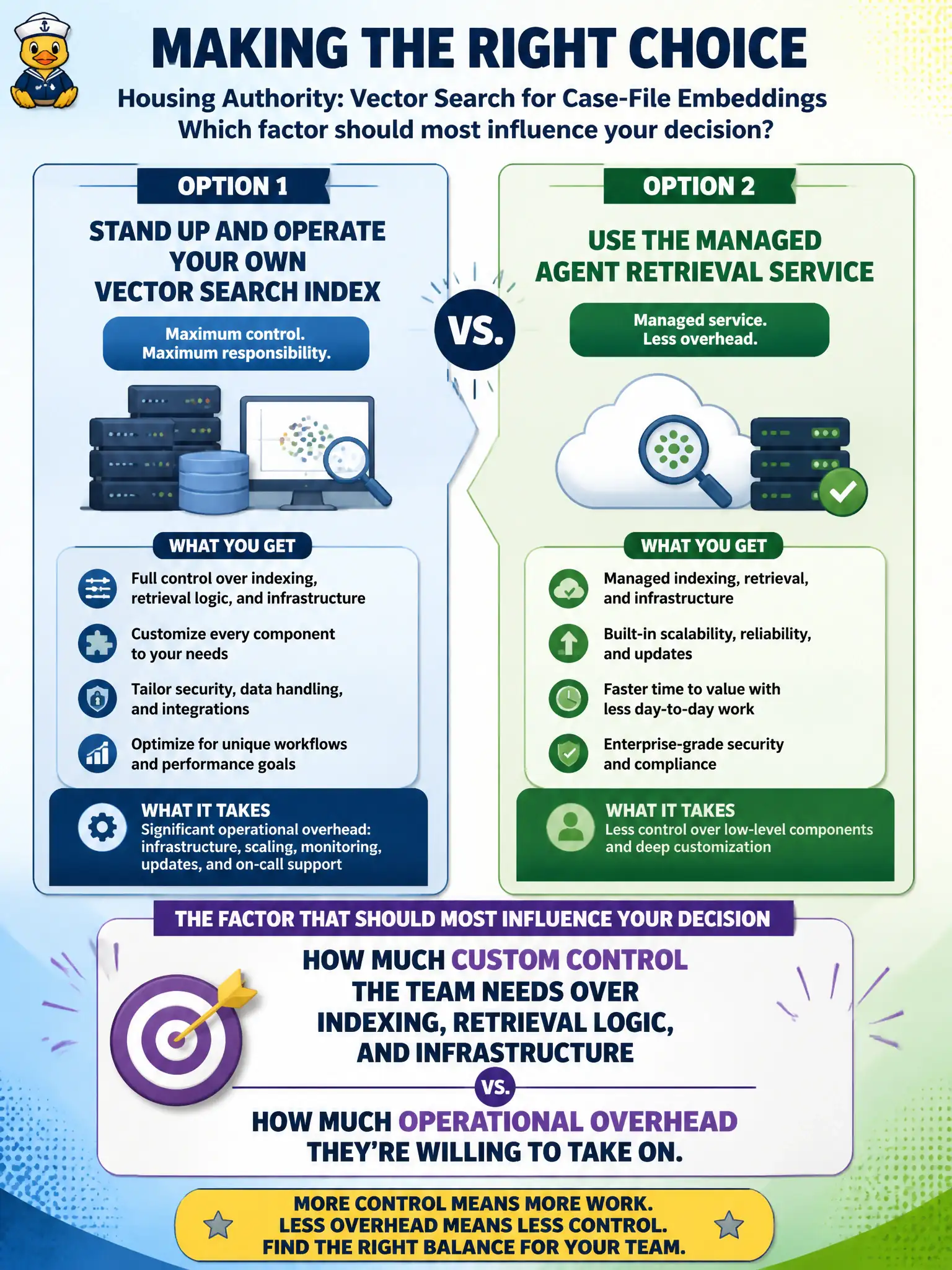
Short Explanation
Think of it like building your own kitchen versus using a catering service: both get dinner on the table, but one hands you control over every ingredient, the other hands you convenience. A self-managed Vector Search index gives more control over indexing and retrieval logic at the cost of running that infrastructure; a managed service like Agent Retrieval trades some control for less operational burden - not a question of data sensitivity, tool count, or where files live.
Full Explanation
The choice between self-managed Vector Search and a managed retrieval service comes down to a control-versus-operational-burden tradeoff: a self-managed index lets a team fully customize embedding models, indexing schedules, and retrieval logic, but the team then owns capacity planning, scaling, and maintenance of that infrastructure; a managed retrieval service absorbs that operational work in exchange for less granular control over the internals. Sensitive data on its own doesn't dictate the choice - both self-managed and managed Google Cloud services can be configured with appropriate access controls and encryption, so security posture depends on how the chosen service is configured, not on which category it falls into by default. Tool count isn't the deciding factor either; how many tools an agent calls is an orchestration question separate from where its retrieval index lives. And source location in Cloud Storage doesn't rule out a managed retrieval service - ingestion pipelines commonly pull from Cloud Storage regardless of which retrieval backend ultimately serves the queries. The scope caveat: this decision should also weigh how quickly the case-file corpus changes, since a self-managed index gives more control over reindexing cadence. A concrete check: estimate the engineering hours needed to operate a self-managed index at the housing authority's expected data volume before committing to it over the managed option.