
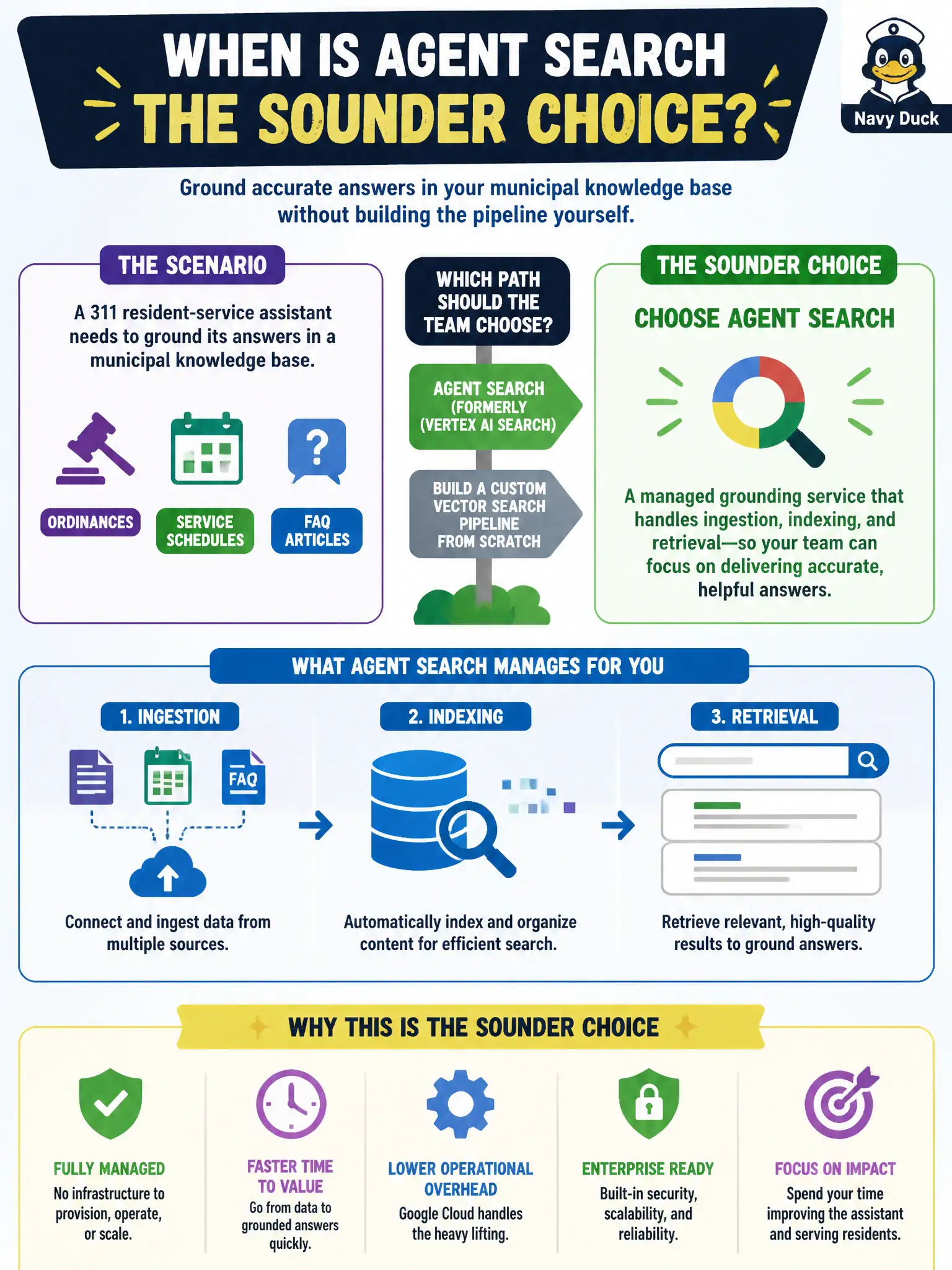
A 311 resident-service assistant needs to ground its answers in a municipal knowledge base of ordinances, service schedules, and FAQ articles. The team chooses Agent Search, formerly Vertex AI Search, over building a custom Vector Search retrieval pipeline from scratch. When is this the sounder choice?
Select an answer to reveal the explanation.
Short Explanation
Think of Agent Search like hiring a research librarian who already knows how to catalog and retrieve documents, instead of building a card-catalog system from scratch. A 311 assistant grounding answers in ordinances doesn't need custom control over every embedding decision - it needs answers grounded reliably, fast. A managed grounding service makes sense when the team wants that pipeline handled for them, not owned in-house.
Full Explanation
Agent Search is a managed grounding service that handles document ingestion, indexing, embedding, and retrieval as a packaged capability, so choosing it over a custom Vector Search pipeline makes sense when the team's priority is getting grounded answers into production without building and operating each stage of that pipeline themselves - exactly the case for a 311 assistant surfacing ordinances and service schedules where the content matters more than bespoke retrieval tuning. Wanting full control over embedding model, chunking, and reranking choices actually argues the opposite way, toward a custom Vector Search build where each stage can be tuned independently. A rapidly changing knowledge base doesn't automatically favor a custom pipeline either - managed services support reindexing on a schedule or via updates, and building a custom pipeline to beat that cadence adds engineering effort that may not be justified. And a requirement limited to structured billing data in Cloud SQL isn't a retrieval-grounding problem at all; that's a database query task better served by direct queries or a database-integration tool than by a document-grounding service built for unstructured or semi-structured content. The scope caveat: a managed service narrows how much retrieval internals can be customized, so a highly specialized ranking requirement might eventually outgrow it. A concrete check: confirm the municipal knowledge base's document formats are ones the managed service can ingest before assuming it covers the corpus.