
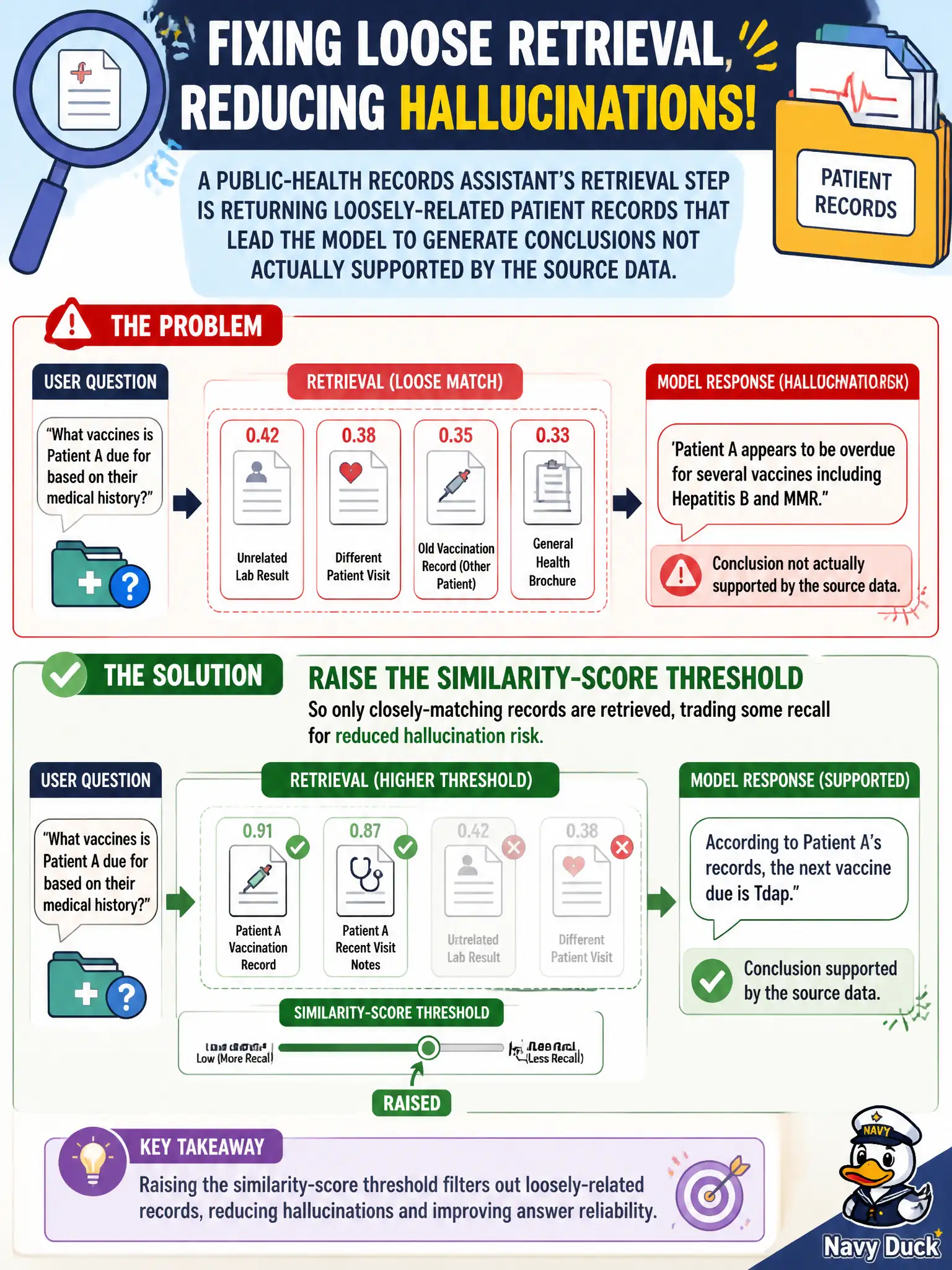
A public-health records assistant's retrieval step is returning loosely-related patient records that lead the model to generate conclusions not actually supported by the source data. What configuration change most directly addresses this failure?
Select an answer to reveal the explanation.
Short Explanation
Think of a similarity threshold like a bouncer's guest list: set it too loose and half the room barely qualifies, giving the model a pile of tenuously related records to draw shaky conclusions from. Raising the threshold tightens the guest list to genuine matches, trading some recall for a real drop in hallucination risk. That's a retrieval-tuning fix, not something a bigger result set or a prompting instruction solves.
Full Explanation
A similarity-score threshold sets the minimum relevance a retrieved record must clear before it's handed to the generation step, so when that threshold is too permissive, loosely-related records slip through and give the model plausible-looking but weakly-grounded material to draw from - which is exactly how a hallucinated clinical conclusion can emerge from a record that only tangentially matches the query. Raising the threshold directly reduces that risk by excluding the weak matches, at the cost of occasionally missing a genuinely relevant record that scored just under the new bar - a recall-versus-precision tradeoff the architect has to tune deliberately. Simply returning more records per query makes the problem worse, not better, since it widens the pool of tenuously related material the model has to synthesize from. Switching to keyword-based full-text search changes the retrieval mechanism entirely rather than tuning the existing similarity threshold, and doesn't address why a semantic match was too loose in the first place. Adding a chain-of-thought instruction shapes how the model reasons over whatever context it's given, but it doesn't fix the input problem - a careful reasoning process over bad source records still produces a conclusion the records don't actually support. The scope caveat: threshold tuning should be validated against a labeled set of known-relevant and known-irrelevant records rather than adjusted by feel. A concrete check: run a held-out evaluation set through the new threshold and confirm the false-positive retrieval rate actually drops without eliminating records the clinical team considers necessary.