
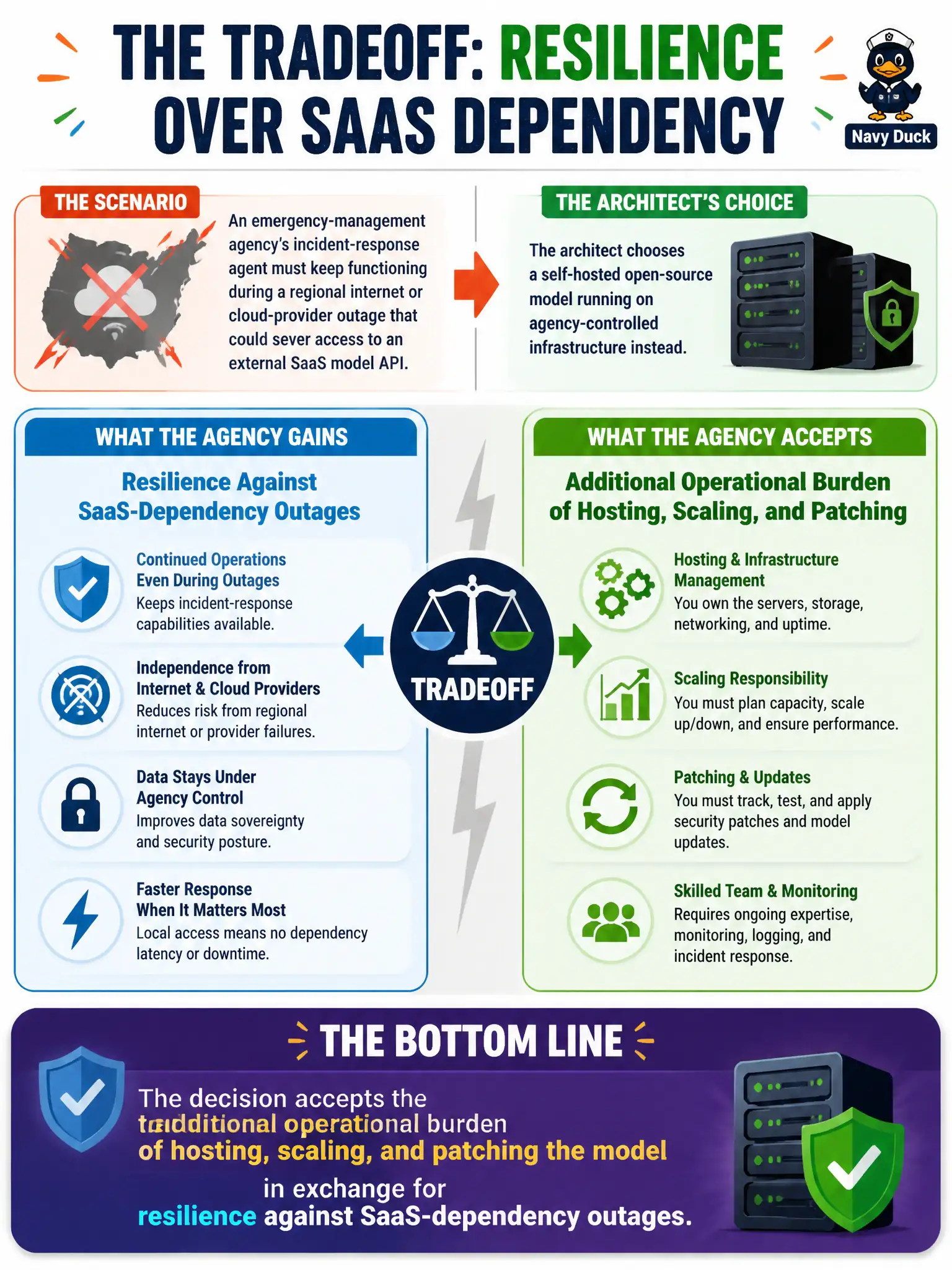
An emergency-management agency's incident-response agent must keep functioning during a regional internet or cloud-provider outage that could sever access to an external SaaS model API. The architect chooses a self-hosted open-source model running on agency-controlled infrastructure instead. What tradeoff does this decision primarily accept?
Select an answer to reveal the explanation.
Short Explanation
Think of it like keeping a generator on-site instead of relying only on the grid: you trade the convenience of someone else maintaining the power supply for the certainty it keeps running when the grid goes down. Self-hosting an open-source model works the same way - the agency takes on the work of running and patching that model itself, in exchange for not depending on a SaaS API that could become unreachable during exactly the kind of outage when the incident-response agent is needed most.
Full Explanation
Self-hosting trades a dependency risk for an operational cost: a SaaS-only model introduces a single point of failure outside the agency's control, so if the provider's API or the network path to it goes down during a regional outage, the agent goes dark at the worst possible moment; running an open-source model on agency infrastructure removes that external dependency but makes the agency responsible for capacity planning, patching, and scaling the serving infrastructure itself. Accuracy on general-knowledge tasks isn't inherently worse for self-hosted open-source models - capability depends on the specific model chosen, not on where it's hosted, so framing this as an accuracy tradeoff misstates the decision. Losing access to Gemini Enterprise's low-code console isn't the driver either; that tooling is a separate configuration layer, and code-based agents built with ADK can still be designed thoughtfully whether the underlying model is self-hosted or SaaS. RAG capability is also independent of hosting location - retrieval pipelines can ground a self-hosted model's responses the same way they ground a SaaS model's. The scope caveat: resilience only materializes if the self-hosted deployment itself has redundancy; a single-zone self-hosted model isn't automatically more available than a well-architected multi-region SaaS API. A concrete check: verify the self-hosted serving infrastructure spans multiple zones or sites before counting on it during a regional event.