
A school district builds a tutoring agent by writing code with the Agent Development Kit (ADK), explicitly defining its system instruction and the exact set of tools it may call. A colleague asks why this wasn't configured instead in a low-code console like Gemini Enterprise's Agent Designer. What distinguishes the ADK approach for this use case?
Select an answer to reveal the explanation.
Short Explanation
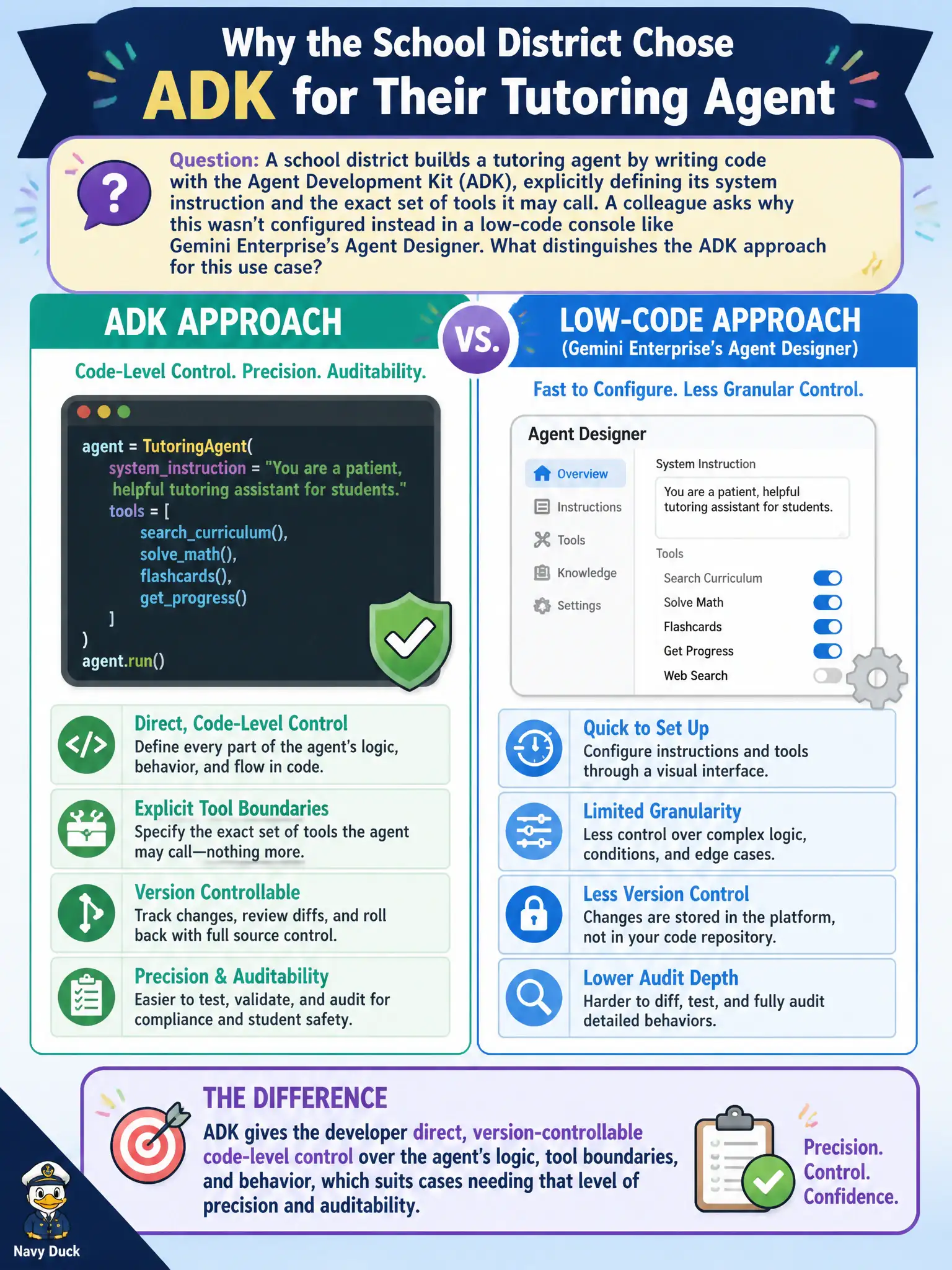
Think of low-code tools like a paint-by-numbers kit and ADK like a blank canvas with real brushes: both can produce a tutoring agent, but one gives full control over every line. ADK code means the instruction and tool boundary live in source files you can diff and review - handy when a district needs precise, auditable control. That's the tradeoff, not that low-code somehow can't do prompts or data connections.
Full Explanation
Code-based ADK development and low-code Gemini Enterprise configuration both let a developer set a system instruction and restrict which tools an agent may call - the exam guide lists both as ways to build agentic behavior - so the real distinction is where that logic lives and how precisely it can be controlled, not whether either path is capable. Building in ADK means the instruction text, tool allowlist, and orchestration logic sit in source code that can be reviewed, diffed, and put through the same change-management process as any other application code, which matters when behavior needs to be reproducible and auditable. The claim that low-code tools don't support prompt configuration is wrong on its face - Agent Designer and CX Agent Studio explicitly support system instructions and few-shot or chain-of-thought templates in-console. The claim that Agent Designer can't reach enterprise data sources misstates its purpose, since connecting Gemini Enterprise to proprietary data is a named low-code capability. And deployment target isn't the distinguishing factor either - it doesn't track cleanly with which authoring approach was used. The scope caveat: choosing code over low-code is a maintainability and control decision, not a capability gate - either can technically build a working tutoring agent. A concrete check: ask whether the team needs the agent's exact prompt and tool logic under source control and code review before defaulting to the low-code console.