
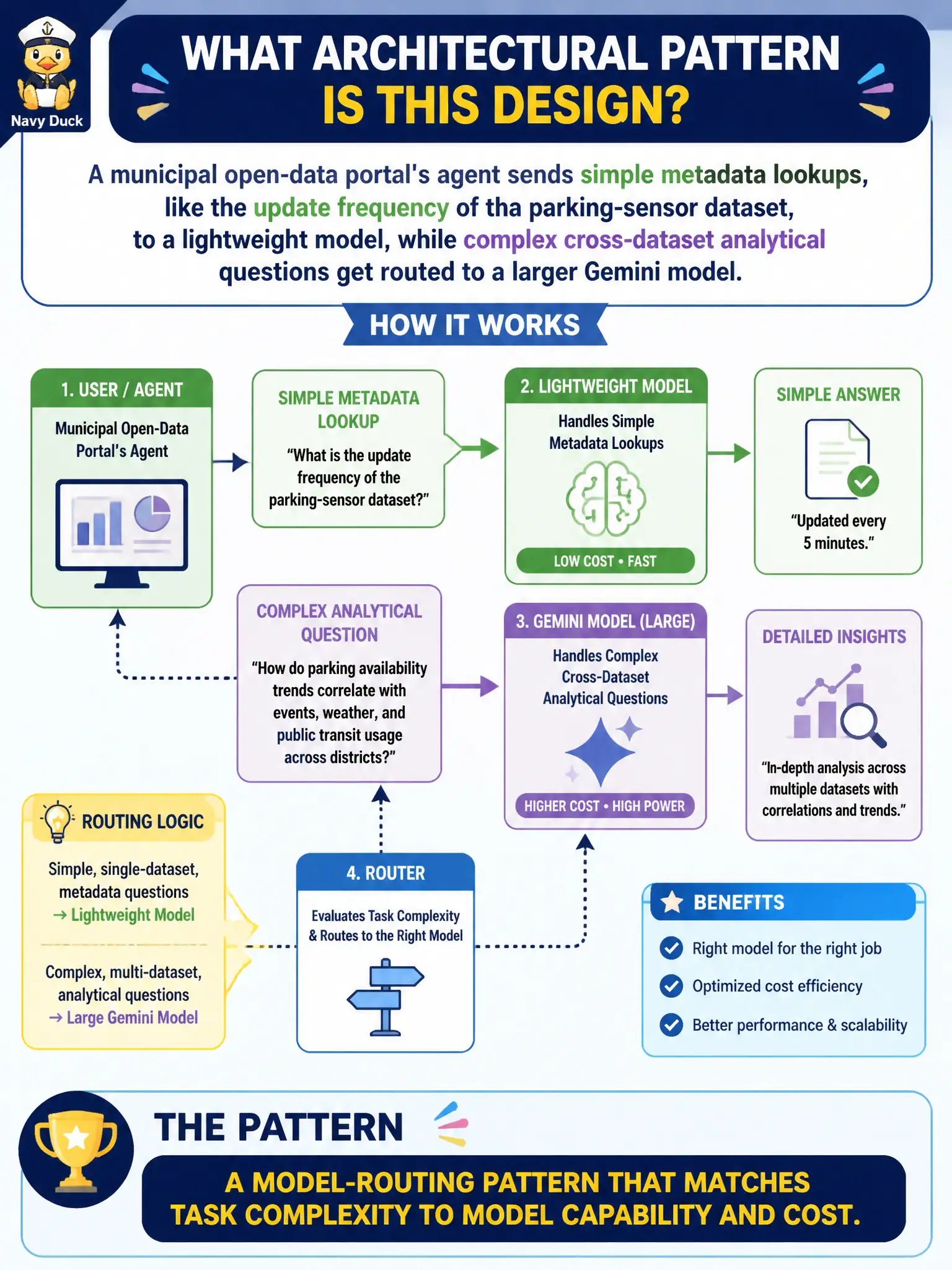
A municipal open-data portal's agent sends simple metadata lookups, like the update frequency of the parking-sensor dataset, to a lightweight model, while complex cross-dataset analytical questions get routed to a larger Gemini model. What architectural pattern does this design represent?
Select an answer to reveal the explanation.
Short Explanation
Think of it like triage in an ER: not every patient needs the trauma surgeon, so you route simple cases to whoever's fastest and save the expensive specialist for what actually needs them. That's model routing - sending easy metadata lookups to a cheap, fast model and saving the larger Gemini model for genuinely complex cross-dataset analysis. It's a deliberate architecture decision, not something the platform does for you by default.
Full Explanation
Model routing works by classifying each incoming request - often with a lightweight classifier or simple heuristics on the query itself - and directing it to the model whose capability matches the task's difficulty, so the agent only pays for large-model inference when the reasoning actually demands it. This differs from a fallback pattern, where the smaller model attempts the task first and the larger model only engages after an explicit failure or low-confidence signal; fallback reacts to failure, routing anticipates difficulty up front. It also isn't a RAG concern: reranking retrieved records improves which documents ground an answer, but it doesn't decide which model generates that answer, so it addresses a different stage of the pipeline. And it isn't a multiagent handoff over A2A, which coordinates separate autonomous agents passing a task between them rather than one agent selecting among candidate models for a single response. The scope caveat: routing adds classification overhead and a second failure mode - a misrouted complex question sent to the small model can produce a confidently wrong answer rather than an honest failure, so misroute rates need monitoring. A concrete check: log which model handled each request alongside a complexity label and periodically audit misroutes where the small model answered a question outside its intended scope.