
An emergency-management office wants an internal agent trained on its disaster-response training videos so staff can quickly retrieve procedural answers during an incident. What should the team configure?
Select an answer to reveal the explanation.
Short Explanation
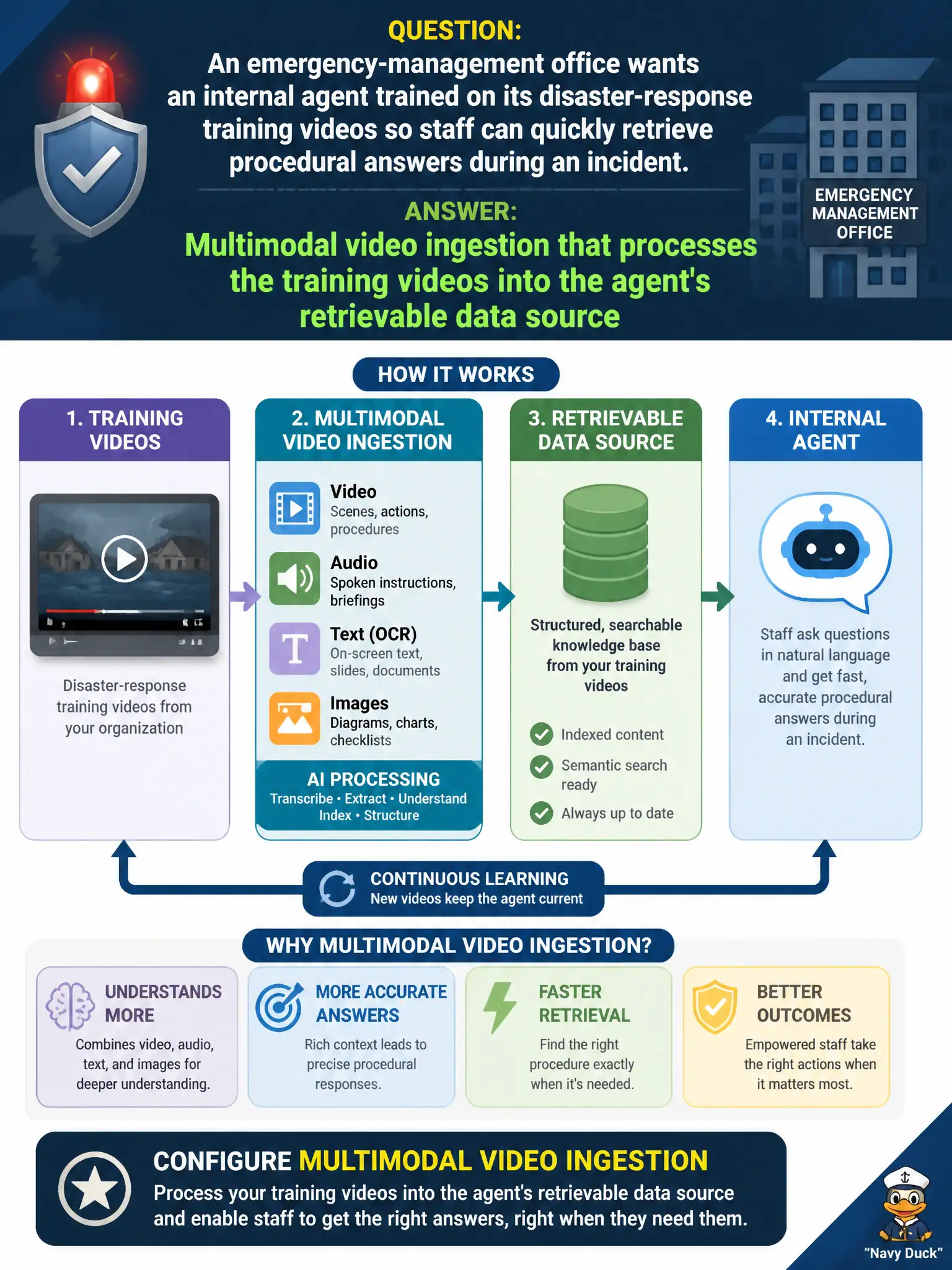
During an active incident, staff need the answer in seconds, not a link to go find and rewatch a training video themselves. Multimodal video ingestion processes those videos ahead of time so the actual procedural content is already sitting there, retrievable the moment someone asks.
Full Explanation
Multimodal video ingestion processes disaster-response training videos, extracting their procedural content so it becomes part of the agent's retrievable data source, which is what lets staff get a direct answer during an active incident rather than searching through raw footage themselves. A chain-of-thought instruction summarizing each video's title only captures a label, not the actual step-by-step procedures contained within the video, so it couldn't answer a specific procedural question. A no-match event handler that links out to the video file library only engages after a failed match and still leaves staff to locate and watch the relevant video manually, which is far too slow during an active incident. A transition route dedicated to each training video organizes conversational navigation, not video content extraction, and doesn't make the procedures inside those videos independently searchable. Scope caveat: training videos should be re-ingested whenever procedures are updated, since outdated video content could surface stale guidance during a real incident. Operational check: ask the agent a specific procedural question drawn from one training video and confirm the retrieved answer traces back to that video's actual content within seconds.