
A library's summer-reading-program agent works well with Agent Search over its program catalog, but the team expects data variety and volume to keep growing. At what point should the architect conclude the low-code ingestion path is no longer sufficient?
Select an answer to reveal the explanation.
Short Explanation
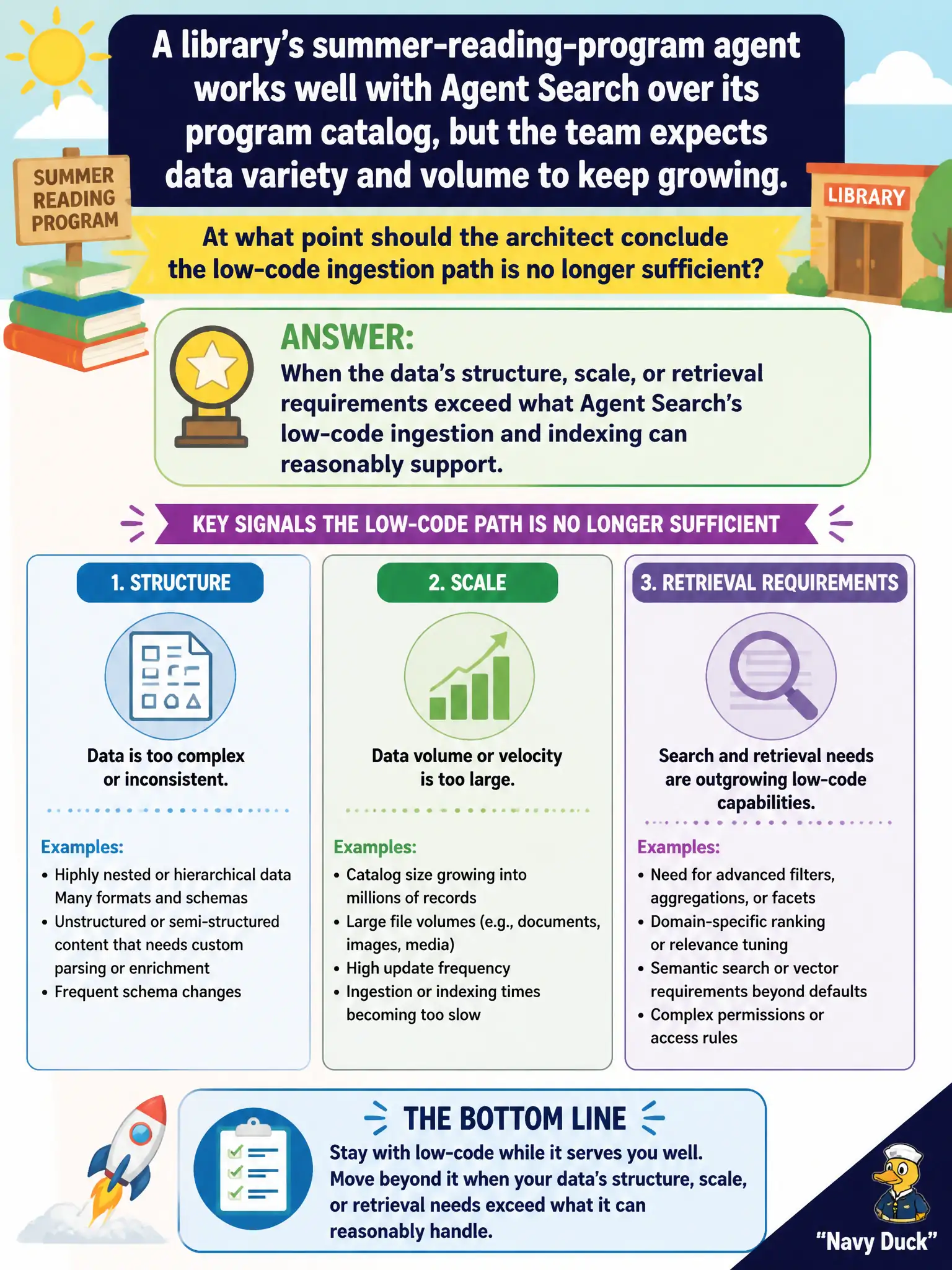
There's no single tripwire that forces a rebuild here — it's a judgment call about whether the actual structure, scale, or retrieval needs have genuinely outgrown what Agent Search's low-code path can comfortably handle. As long as it keeps up, there's no reason to reach for something heavier.
Full Explanation
The threshold for moving beyond low-code ingestion isn't a fixed trigger but a judgment about whether the data's structure, scale, or retrieval requirements have exceeded what Agent Search's built-in indexing can reasonably support, which is the same complexity-versus-capability reasoning that governs choosing custom development over low-code tooling elsewhere in agent design. Multiple file formats alone don't force a rebuild, since Agent Search's ingestion already handles a range of unstructured and multimodal content types as part of its normal low-code capability. The presence of few-shot examples in the prompt template is unrelated to data ingestion capacity entirely — few-shot examples shape response behavior, not how catalog data gets indexed for retrieval. Claiming Agent Search's indexing capacity automatically keeps pace with any growth ignores that real-world systems do eventually hit structural or scale limits, and assuming otherwise risks the team being caught flat-footed when retrieval quality degrades. Scope caveat: this judgment should be revisited periodically as the catalog grows rather than decided once and forgotten. Operational check: monitor retrieval accuracy and latency against the growing catalog and treat a sustained decline as the signal to reassess the architecture.