
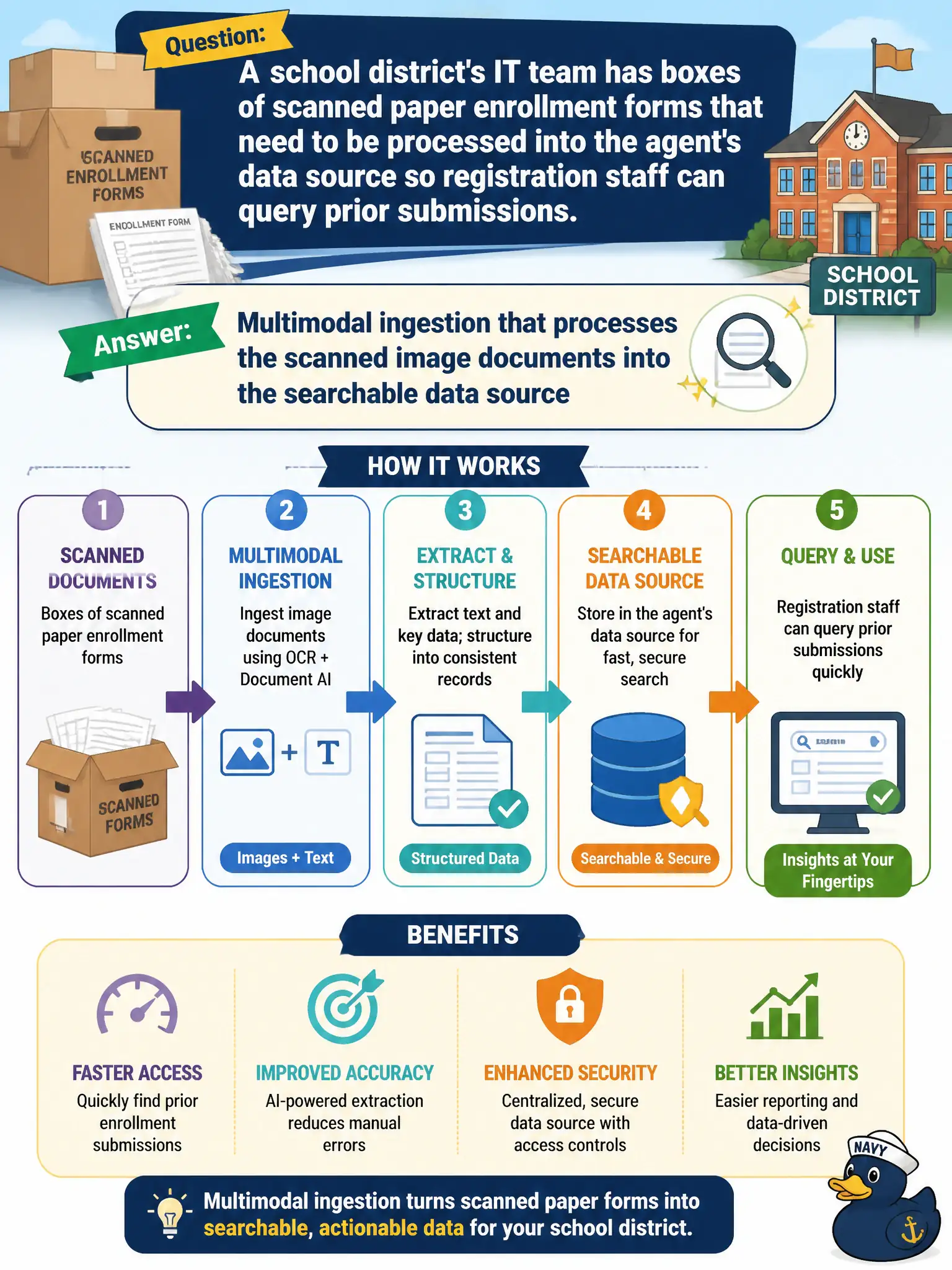
A school district's IT team has boxes of scanned paper enrollment forms that need to be processed into the agent's data source so registration staff can query prior submissions. What should they configure?
Select an answer to reveal the explanation.
Short Explanation
Boxes of scanned paper forms are just images until something actually reads them into a searchable form, the way a filing clerk digitizing paper records makes them findable for the first time. Multimodal ingestion is that digitizing step for the agent, turning the scans into a real, queryable data source.
Full Explanation
Multimodal ingestion processes scanned image documents like paper enrollment forms, extracting their content into the agent's searchable data source, which is the necessary step for registration staff to query prior submissions instead of manually digging through physical boxes. A transition route that files each scanned form under its own page misapplies a conversational navigation construct to document storage; routes organize dialogue steps, they don't hold or index a backlog of scanned records. Few-shot examples describing what a typical enrollment form contains illustrate a generic pattern but can't reflect the specific data on each individual scanned submission, so staff querying a particular student's prior form wouldn't get an answer grounded in the actual record. A system instruction listing common enrollment-form fields from memory tells the agent what fields to expect in general but provides no access to the actual filled-in values sitting in the scanned documents. Scope caveat: scan quality and handwriting legibility affect ingestion accuracy, so a sample of digitized forms should be spot-checked against the originals. Operational check: query the agent about a specific known enrollment submission and confirm the retrieved details match that student's actual scanned form.