
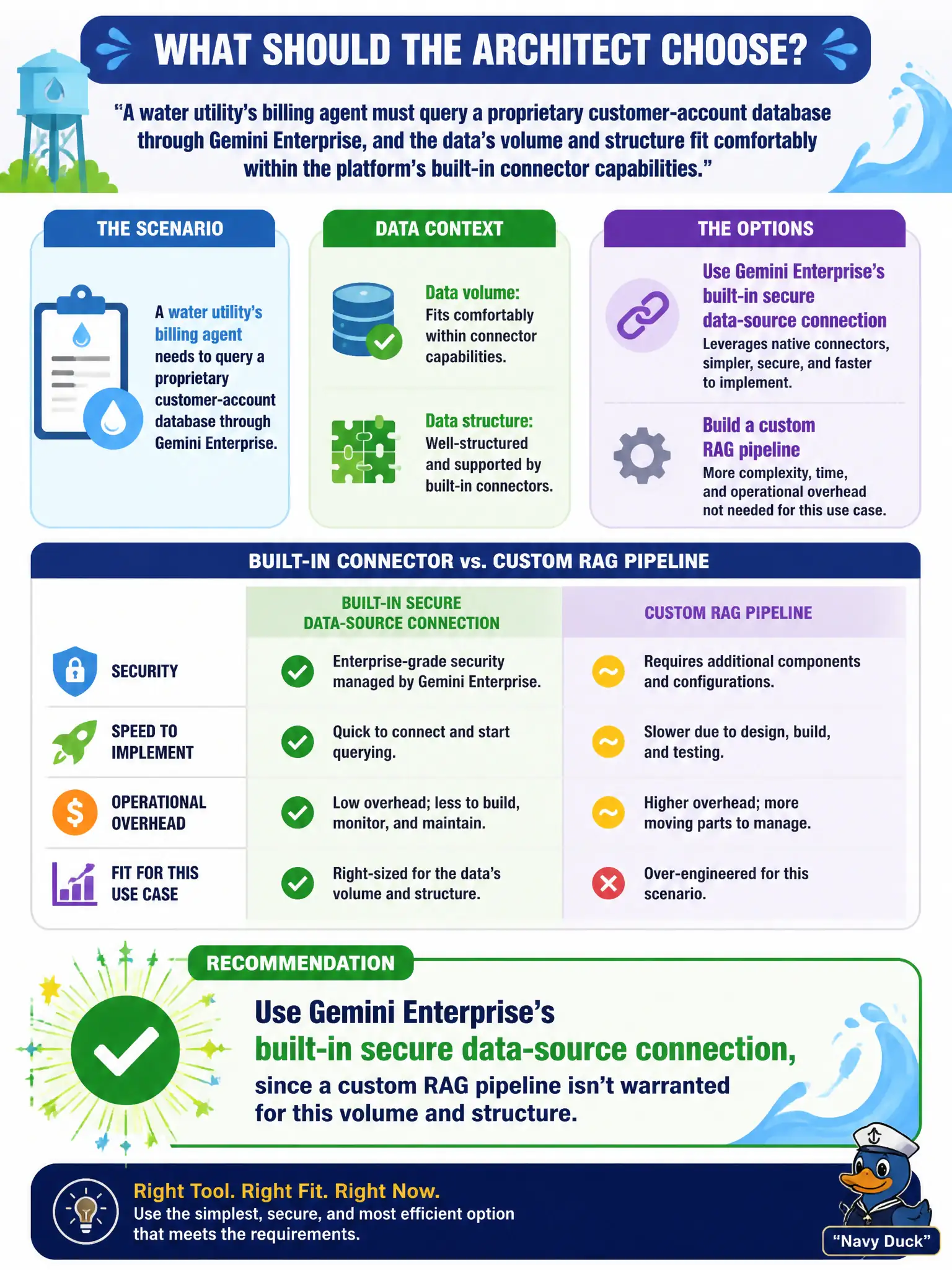
A water utility's billing agent must query a proprietary customer-account database through Gemini Enterprise, and the data's volume and structure fit comfortably within the platform's built-in connector capabilities. What should the architect choose?
Select an answer to reveal the explanation.
Short Explanation
When the data's already a good fit for the built-in connector, reaching for a custom RAG pipeline is like hiring a contractor to hang a picture frame — the platform already has a tool sized right for this job. Gemini Enterprise's built-in secure connection handles it without the extra engineering overhead.
Full Explanation
The right architectural choice matches tooling complexity to actual need, and when a proprietary source's volume and structure sit comfortably within Gemini Enterprise's built-in connector capabilities, its secure data-source connection is the appropriate choice rather than building and maintaining custom infrastructure. Treating any proprietary source as automatically requiring a custom RAG pipeline ignores the platform's built-in capability and adds unnecessary engineering and operational burden, like standing up a dedicated vector database, when the built-in connector already handles the volume and structure described. Ingesting a structured customer-account database as unstructured multimodal content discards its structure and forces the agent to work with degraded, less reliable representations of data that was already queryable in its native form. Routing billing queries to a human agent by default through a no-match handler abandons automation entirely rather than addressing how the agent should actually connect to the account data. Scope caveat: if the account database's volume or complexity grows well beyond the built-in connector's comfortable range, that's the point to revisit a custom pipeline. Operational check: run a representative billing query through the built-in connection and confirm response latency and accuracy meet the utility's service expectations.