
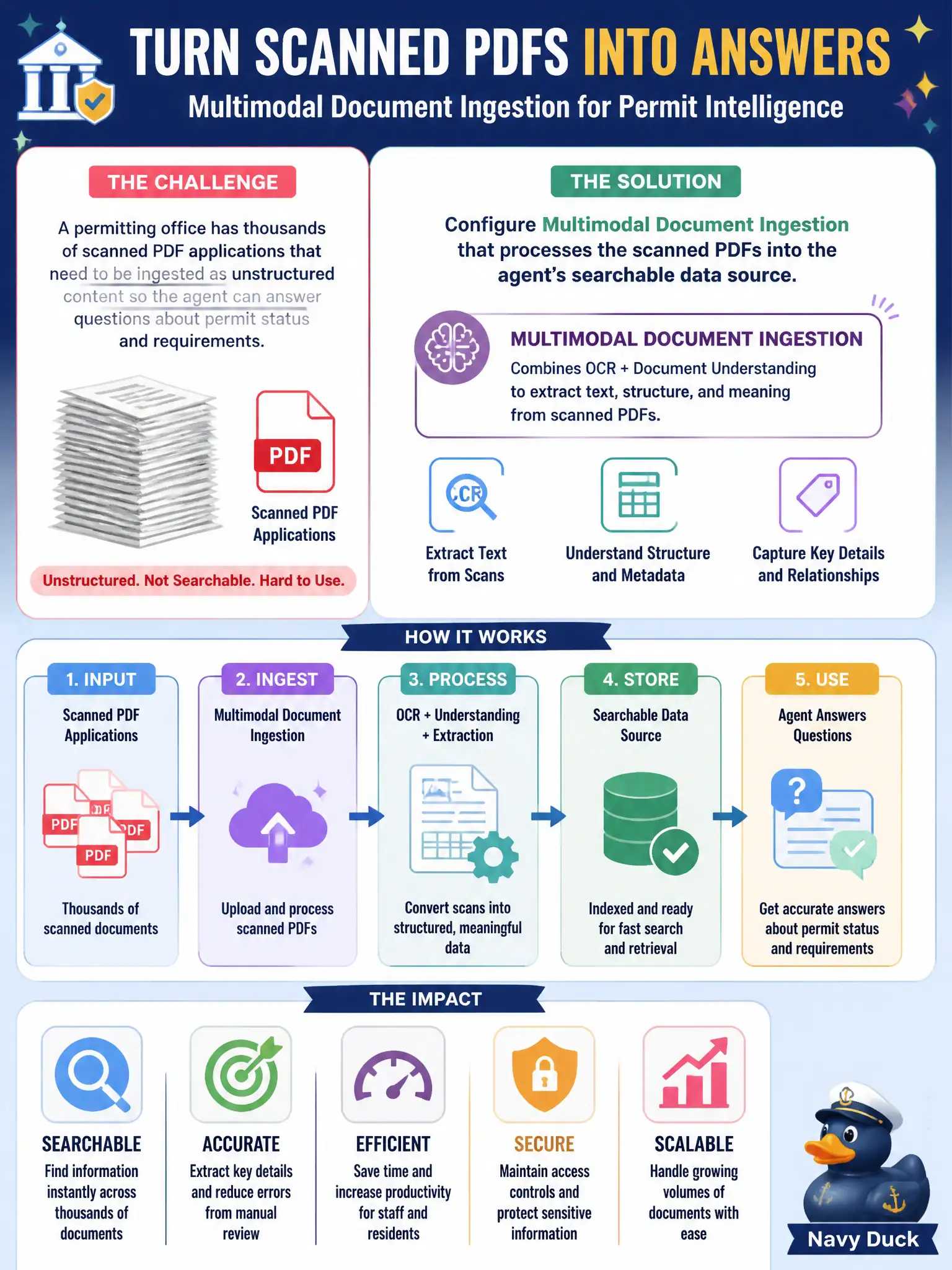
A permitting office has thousands of scanned PDF applications that need to be ingested as unstructured content so the agent can answer questions about permit status and requirements. What should the team configure?
Select an answer to reveal the explanation.
Short Explanation
Thousands of scanned PDFs are a document problem before they're anything else, and the fix is getting that content into the agent's searchable index, not describing it or routing to it. Multimodal document ingestion reads the actual scanned pages and turns them into something the agent can look up.
Full Explanation
Multimodal document ingestion processes scanned PDFs directly, extracting their content so it becomes part of the agent's searchable data source, which is the mechanism built for turning bulk unstructured documents like scanned permit applications into something the agent can actually reference when answering questions. A chain-of-thought instruction reasoning over PDF file names never touches the actual content inside the scans, so it can't answer substantive questions about permit requirements buried in the documents. A transition route opening each PDF as a separate page confuses conversational navigation with document storage; pages structure a dialogue, they don't hold or index thousands of scanned files. Few-shot examples pairing questions with generic answers might sound plausible for common cases but can't reflect the specific status or requirements sitting inside each individual scanned application, so they'd produce answers untethered from the actual records. Scope caveat: ingestion quality depends on scan legibility, so poorly scanned or handwritten forms may need review before they're reliably searchable. Operational check: query the agent about a specific permit application known to be in the scanned batch and confirm the answer reflects that document's actual content.