
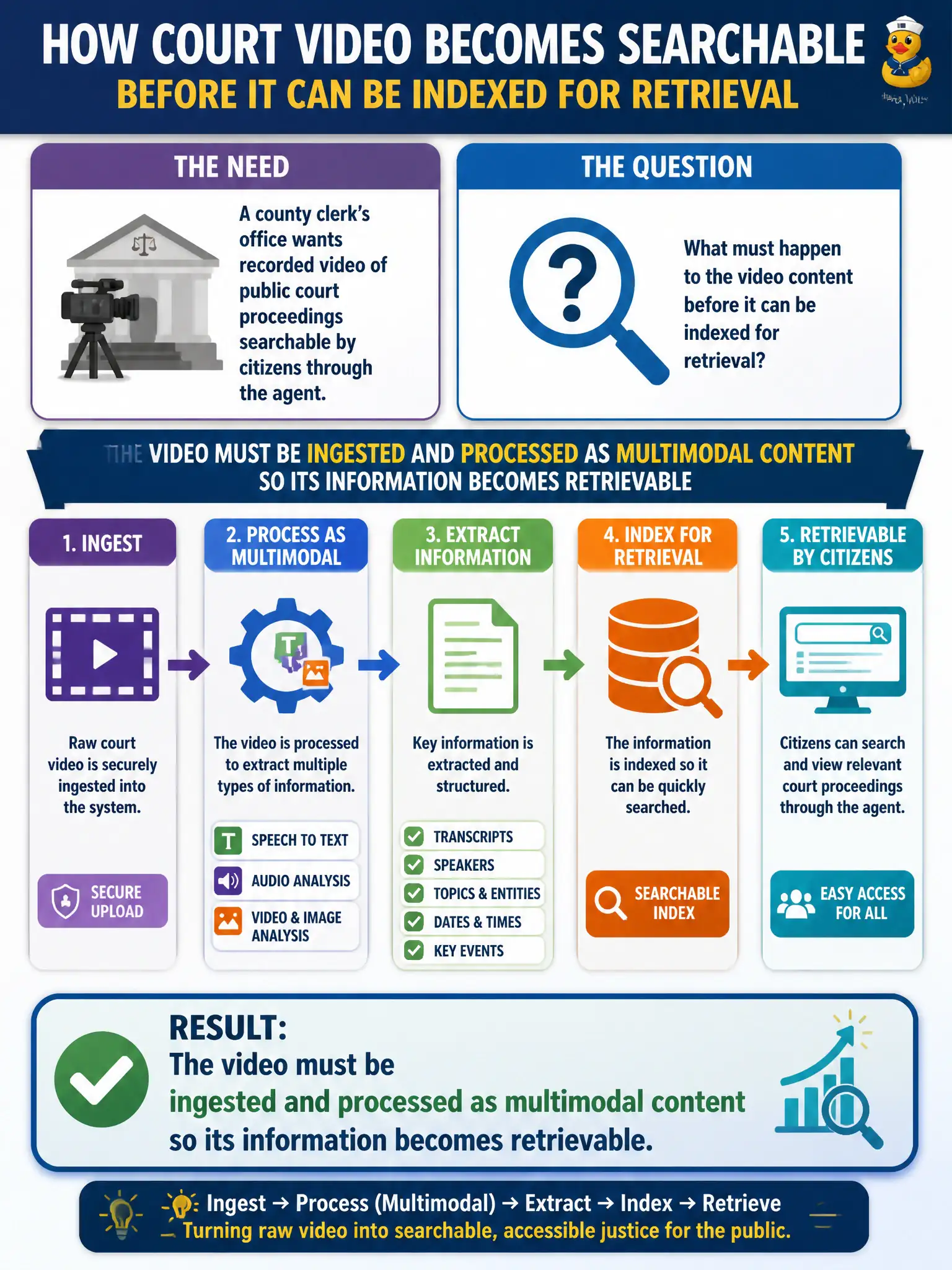
A county clerk's office wants recorded video of public court proceedings searchable by citizens through the agent. What must happen to the video content before it can be indexed for retrieval?
Select an answer to reveal the explanation.
Short Explanation
A video recording is just a wall of raw footage until it's actually processed into something an agent can search, the way a court reporter's transcript makes a hearing findable long after the recording sits untouched on a shelf. Multimodal ingestion is that processing step, turning the video's content into retrievable information.
Full Explanation
Multimodal ingestion processes video content — extracting and indexing what's said and shown — so that its information becomes part of the agent's retrievable data source, which is the necessary step before any recorded court proceeding can be searched by citizens asking questions. Re-encoding the video as a system instruction describing its contents would require someone to manually summarize hours of footage in the prompt itself, which doesn't scale and inevitably loses detail compared to processing the actual recording. Splitting the video into separate pages per court session confuses conversational navigation constructs with content storage; pages organize dialogue flow, they don't hold or index recorded media. Converting the video into few-shot examples of question-answer pairs might illustrate a handful of expected queries but can't capture everything a citizen might ask about proceedings that were never explicitly anticipated. Scope caveat: publicly searchable court video should be reviewed for any content that's sealed or restricted before ingestion, since indexing makes it queryable rather than automatically applying legal access restrictions. Operational check: ask the agent a question referencing a specific moment in a proceeding and confirm the retrieved answer traces back to that portion of the video.