
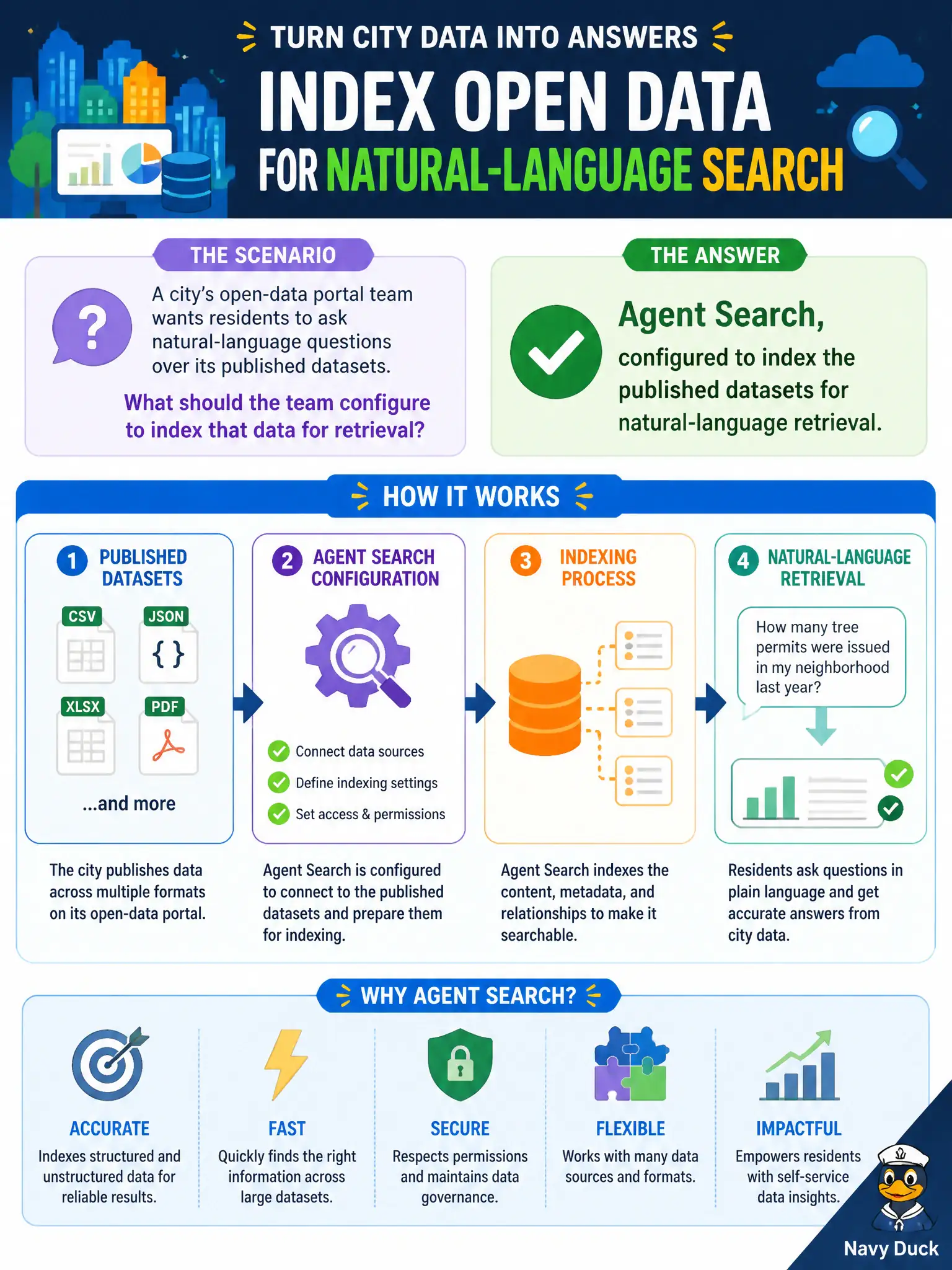
A city's open-data portal team wants residents to ask natural-language questions over its published datasets. What should the team configure to index that data for retrieval?
Select an answer to reveal the explanation.
Short Explanation
Getting a resident's plain-English question to actually find the right row in a published dataset is a retrieval problem, and Agent Search is the tool built to index content for exactly that kind of natural-language lookup. It's the difference between handing someone a filing cabinet and handing them a librarian who already knows where everything is.
Full Explanation
Agent Search is Google Cloud's mechanism for indexing enterprise content — including an organization's own published datasets — so an agent can retrieve relevant results in response to a resident's natural-language question, which is precisely the capability an open-data portal needs. Mapping each dataset to its own page via a transition route organizes conversational navigation, not data retrieval; a resident's question doesn't naturally arrive pre-sorted into the right dataset's page. Listing every dataset's schema directly in system instructions doesn't scale, bloats the prompt, and still leaves the agent without an actual retrieval mechanism to pull matching records rather than just knowing field names exist. A no-match handler that links to raw dataset files only engages on failure and just hands the resident an unindexed file, which defeats the purpose of a natural-language interface in the first place. Scope caveat: indexed datasets should be reviewed for anything not actually meant for public release before configuring the connection, since indexing makes content queryable, not automatically re-classified as public. Operational check: ask a natural-language question that spans two datasets and confirm Agent Search returns results grounded in both rather than only the first matched source.