
A public-health department wants its Gemini Enterprise agent to query a restricted immunization-records data source without exposing the underlying database directly to citizens. How should the team configure this connection?
Select an answer to reveal the explanation.
Short Explanation
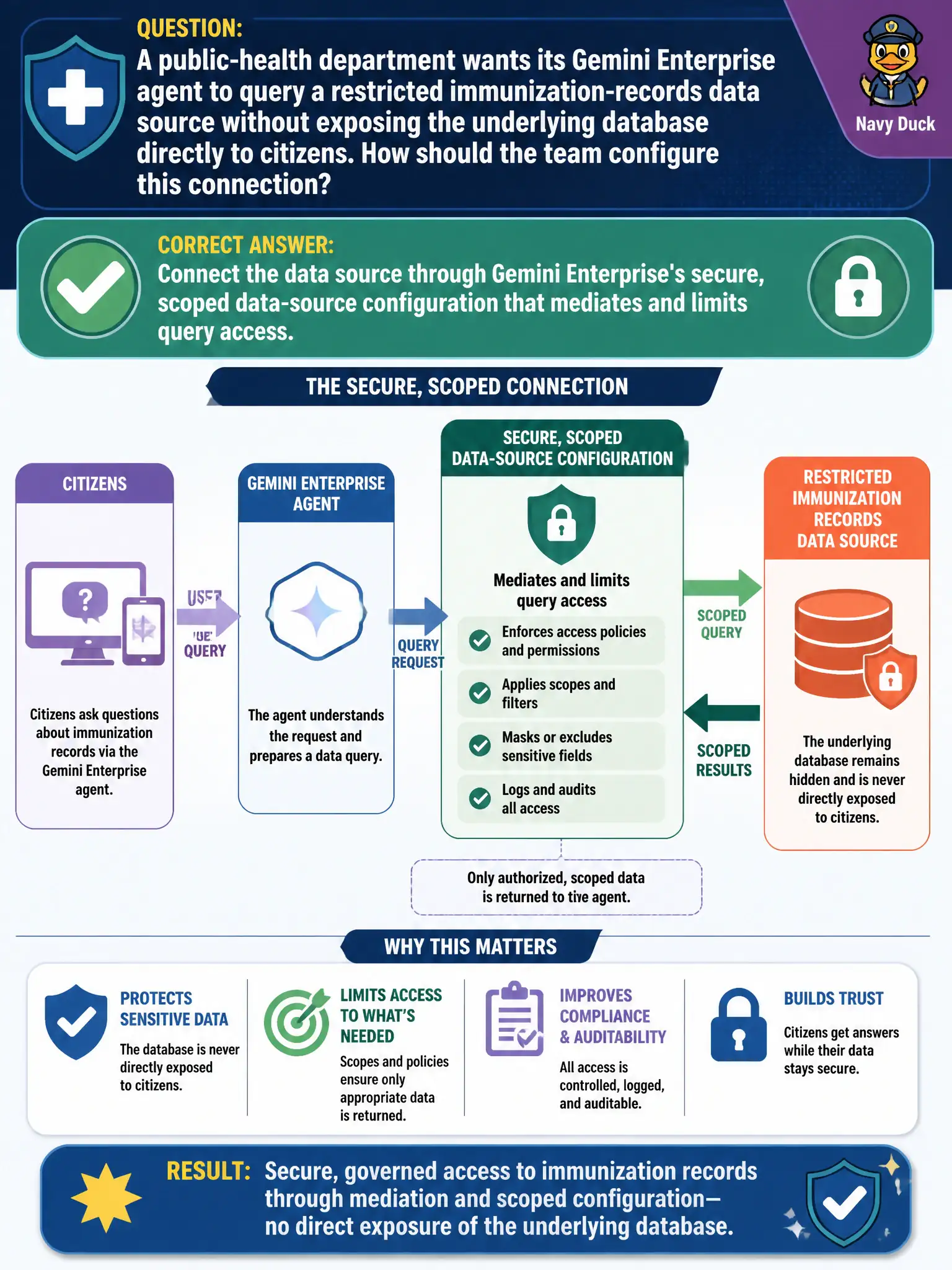
The agent shouldn't have a direct line to the database any more than a front-desk clerk should have root access to city servers — there's a mediated layer in between that controls what gets asked and returned. Gemini Enterprise's scoped data-source connection is that mediated layer, keeping the underlying immunization database itself out of the citizen's reach.
Full Explanation
Gemini Enterprise's enterprise data connections are built to sit between the agent and a proprietary data source, mediating what the agent can query and return rather than exposing the database directly, which is exactly the control a restricted immunization-records source needs when citizens are the ones asking questions. Ingesting the records as unstructured multimodal documents changes the data's format but doesn't provide the access mediation the scenario calls for, and structured records like immunization history rarely belong in that pipeline anyway. Having the agent call the database directly through a system instruction describing the schema would bypass any access controls entirely, effectively giving the agent — and by extension any citizen prompting it — a raw path into a restricted system. Few-shot examples of what not to disclose are a soft behavioral nudge at best; they don't enforce access limits the way a properly scoped data-source connection does at the infrastructure level. Scope caveat: the connection's scoping should be reviewed whenever the underlying immunization dataset's access policy changes. Operational check: attempt to query a record class outside the configured scope and confirm the connection itself declines the request rather than relying on the agent's judgment.