
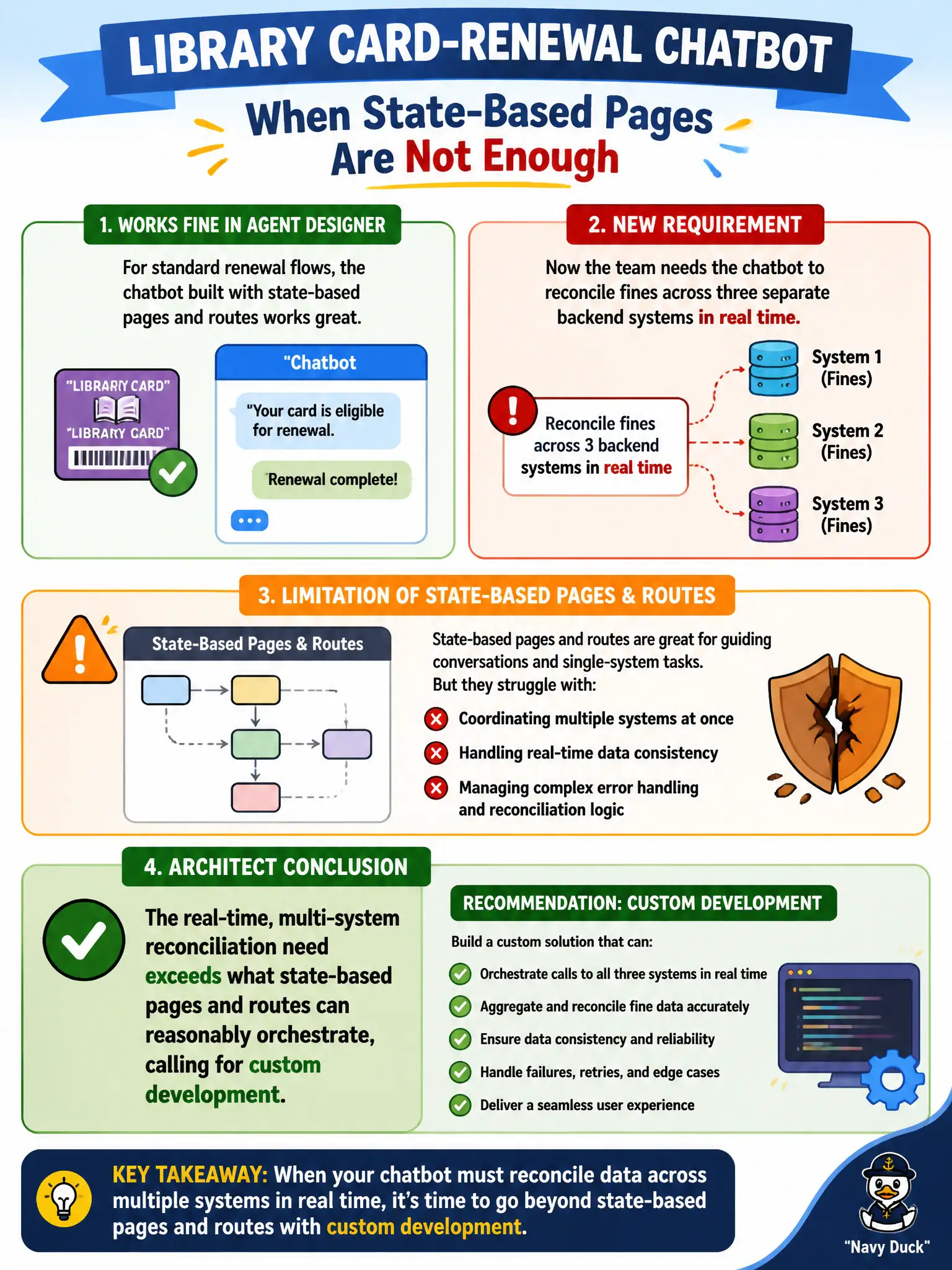
A library card-renewal chatbot works fine in Agent Designer until the team wants it to also reconcile fines across three separate backend systems in real time. What should the architect conclude?
Select an answer to reveal the explanation.
Short Explanation
Pages and transition routes are built for moving a conversation forward, not for stitching together three live backend systems and reconciling numbers across them in real time. Once the hard part of the job is that backend orchestration, it's time to hand it to custom code instead of trying to wire it up out of more pages.
Full Explanation
Low-code pages and transition routes model conversational state and navigation, not multi-system real-time data orchestration; reconciling fines across three separate backend systems requires coordinated calls, error handling, and consistency logic that belongs in custom-coded integration logic, typically invoked as a tool or service from within a properly architected agent. Adding a transition route per backend system misapplies a navigation construct to what is really a backend integration problem — routes decide which page comes next, not how three systems' data gets reconciled. Chain-of-thought system instructions can improve how the agent reasons about a response once data is in hand, but reasoning text can't perform the actual API calls and reconciliation logic needed across systems. CX Agent Studio offers more pages than Agent Designer for organizing flow, but page count doesn't address the underlying limitation, since both tools share the same configuration-first model rather than general-purpose integration code. Scope caveat: the conversational front end can often remain low-code even after the reconciliation logic moves to custom development behind it. Operational check: time how long a manual three-system fine reconciliation takes today and use that as the baseline the custom integration needs to beat.