
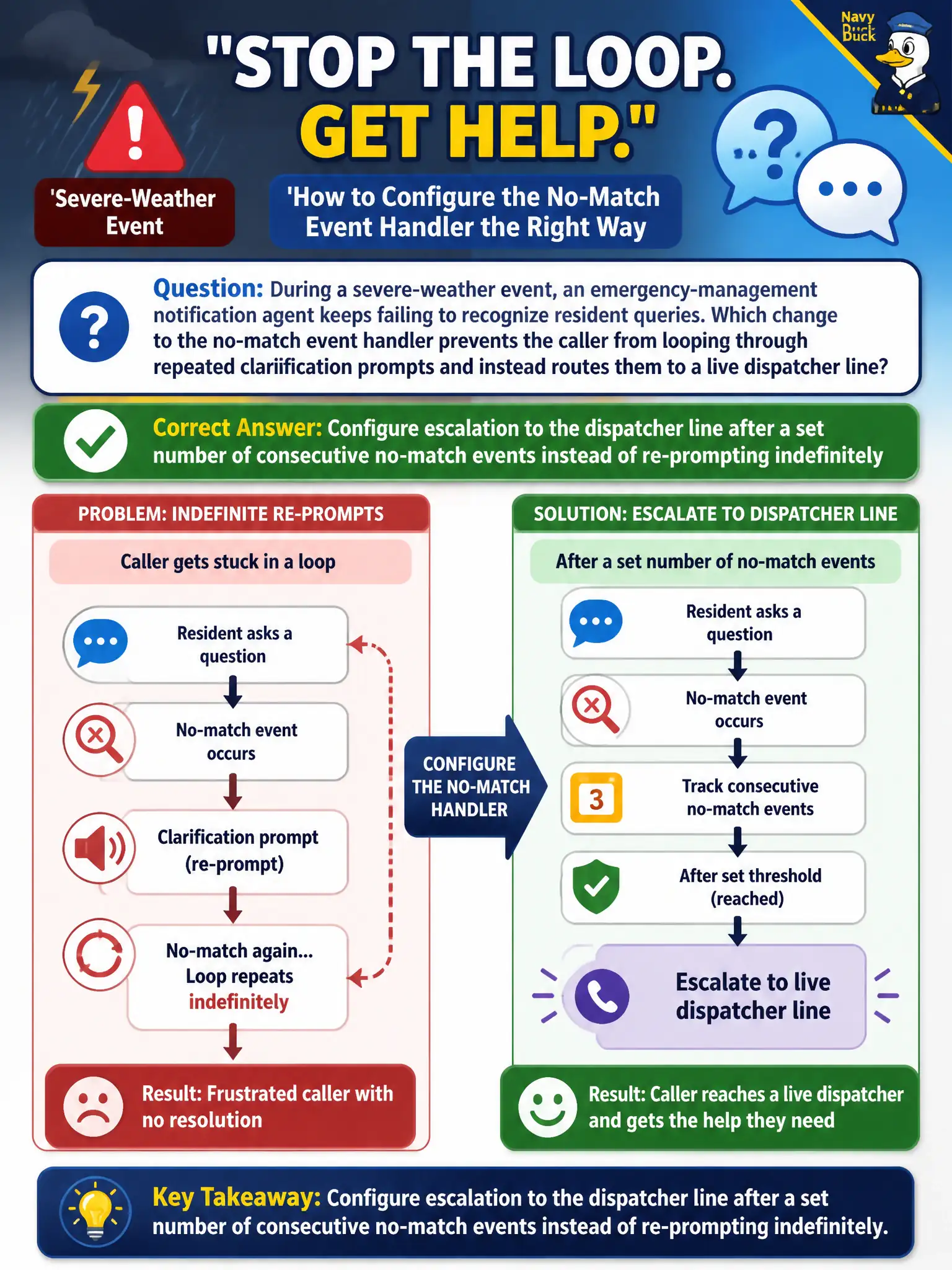
During a severe-weather event, an emergency-management notification agent keeps failing to recognize resident queries. Which change to the no-match event handler prevents the caller from looping through repeated clarification prompts and instead routes them to a live dispatcher line?
Select an answer to reveal the explanation.
Short Explanation
A no-match handler that just keeps saying "say that again" during an emergency is the conversational equivalent of a phone tree that never lets you reach a person. Counting repeated no-match events and escalating after a couple of tries gets the resident to a dispatcher instead of trapping them in a loop.
Full Explanation
A no-match event handler can be configured with escalating fulfillment behavior across repeated occurrences on the same page: the first miss re-prompts for clarity, but a following miss should switch to routing the caller to the dispatcher line rather than repeating the same clarification indefinitely, since a caller who fails twice is unlikely to succeed a third time under stress. Adding more few-shot examples might reduce how often no-match fires in the first place, but it can never guarantee zero misses, so it doesn't solve the looping problem once a miss does occur. Swapping in a no-input handler targets a different failure mode entirely — silence, not unrecognized speech — and a shorter timeout wouldn't even trigger for a caller who is actively speaking but not being understood. A chain-of-thought instruction changes how the agent reasons about a matched intent; it does nothing when intent detection has already failed to match anything. Scope caveat: the escalation threshold should be tuned lower during declared emergencies than in routine use, since patience for repeated prompts drops under stress. Operational check: simulate two consecutive unrecognized inputs and confirm the second one routes to the dispatcher line rather than re-prompting a third time.