
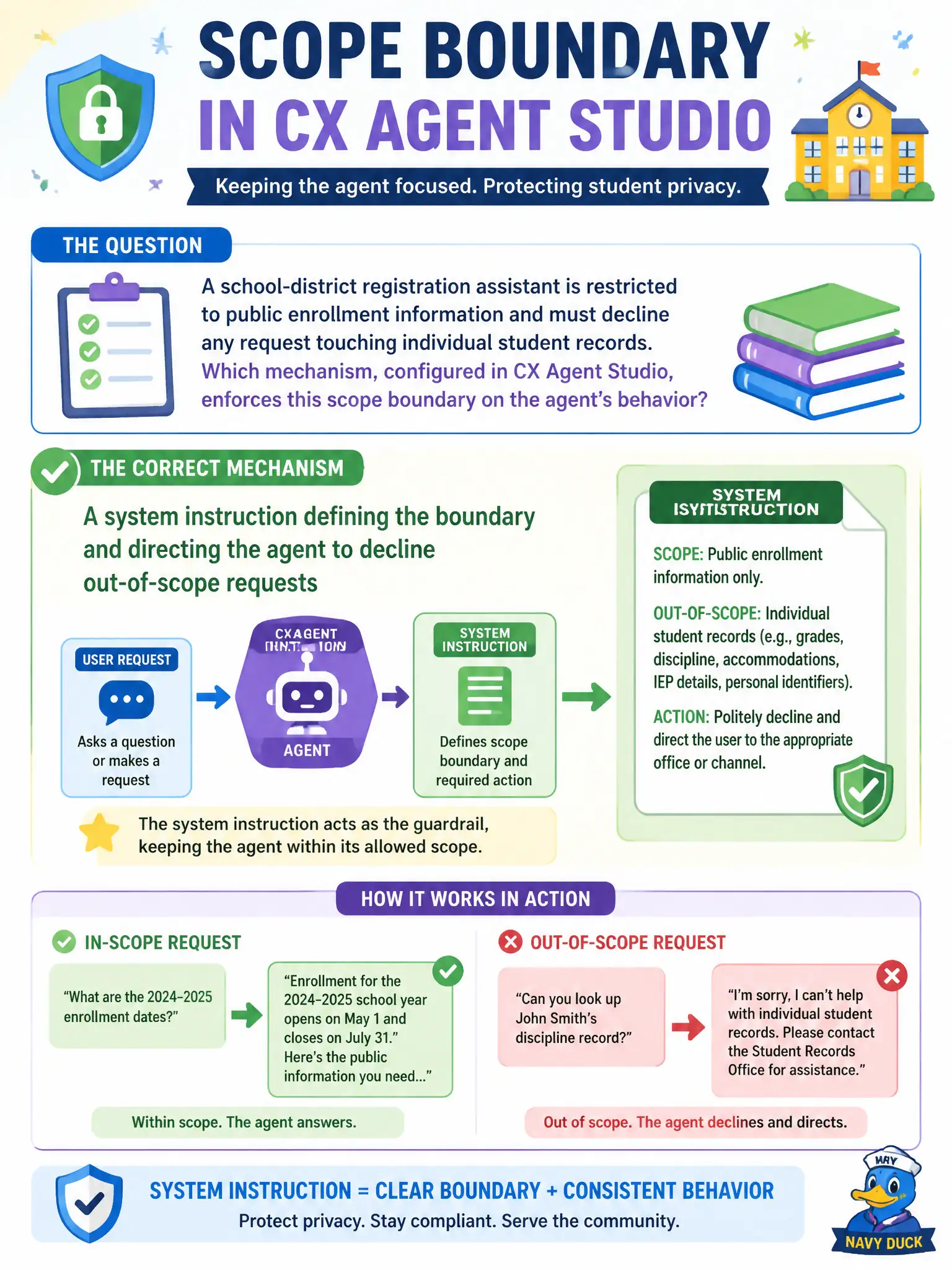
A school-district registration assistant is restricted to public enrollment information and must decline any request touching individual student records. Which mechanism, configured in CX Agent Studio, enforces this scope boundary on the agent's behavior?
Select an answer to reveal the explanation.
Short Explanation
A system instruction is the agent's job description — it's where the team spells out what the agent is and isn't allowed to talk about, before a single conversation even starts. Telling it plainly to decline anything touching individual student records is exactly the kind of scope rule that instruction is built to carry.
Full Explanation
System instructions set the agent's persistent behavioral boundaries and scope, applying across every conversation regardless of which page a resident happens to be on, which makes them the right place to encode a rule like refusing individual student-record requests while still answering general public enrollment questions. A transition route only controls navigation between pages that already exist in the workflow; removing student-record pages might reduce surface area but does nothing to stop the agent from responding if a parent asks about a specific student on any remaining page. A no-match event handler triggers on unrecognized input, not on recognized-but-disallowed input — a clearly phrased request for a specific student's record would match an intent just fine, so no-match never engages. Few-shot examples showing only successful lookups model the happy path but don't teach the agent what to do when a request falls outside scope, since there's no negative example to generalize from. Scope caveat: an instruction alone is a soft control, so pairing it with a few-shot example of a proper decline strengthens consistency further. Operational check: ask the assistant for a specific student's enrollment status and confirm it declines rather than attempting to answer.