
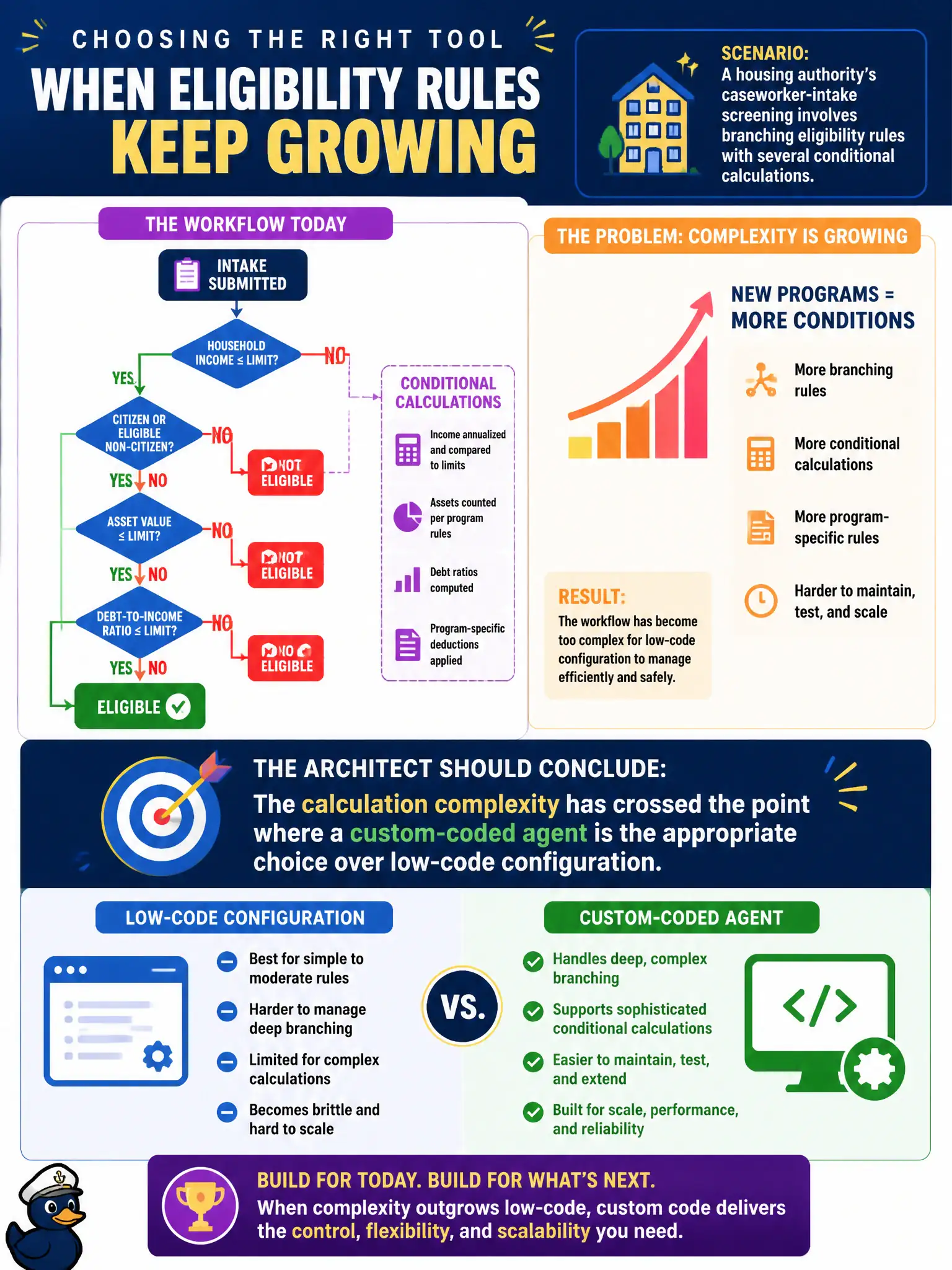
A housing authority's caseworker-intake screening involves branching eligibility rules with several conditional calculations, and the number of conditions keeps growing as new housing programs are added. What should the architect conclude about the right tool for this workflow?
Select an answer to reveal the explanation.
Short Explanation
Low-code tools are great for a workflow that's mostly about moving through steps, but once a screening turns into a growing pile of conditional math, that's a job for real code, not more pages stacked on top of pages. When the logic itself is the hard part, building a custom agent gives the architect a place to actually express and test that logic properly.
Full Explanation
Low-code configuration tools like Gemini Enterprise Agent Designer are built around modeling conversational structure — pages, routes, and instructions — not around expressing arbitrarily complex conditional calculation logic; as eligibility rules multiply and interact, that logic outgrows what pages and routes can cleanly represent, and the right response is to move the calculation into a custom-coded agent that can implement, test, and version it properly. Adding more pages per condition just relocates the same growing complexity into more places without solving it, and pages were never meant to model business-rule branching at that depth. Switching from Agent Designer to CX Agent Studio changes which low-code tool is used but not the underlying limitation, since both are configuration-first platforms rather than general-purpose coding environments. Chain-of-thought instructions can help an agent reason through steps, but they don't give reliable, auditable execution of the kind eligibility calculations for a housing program need. Scope caveat: the same intake agent's front-end conversation can still live in a low-code layer even after the eligibility logic itself moves to custom code. Operational check: count how many interacting conditions the current screening requires and compare against whether pages alone can express that branching without duplicated logic.