
A county clerk's marriage-license assistant needs to reason through a multi-step document checklist before telling the applicant what's missing. Which in-console prompt-template technique should the team add to the system instructions to guide this step-by-step reasoning?
Select an answer to reveal the explanation.
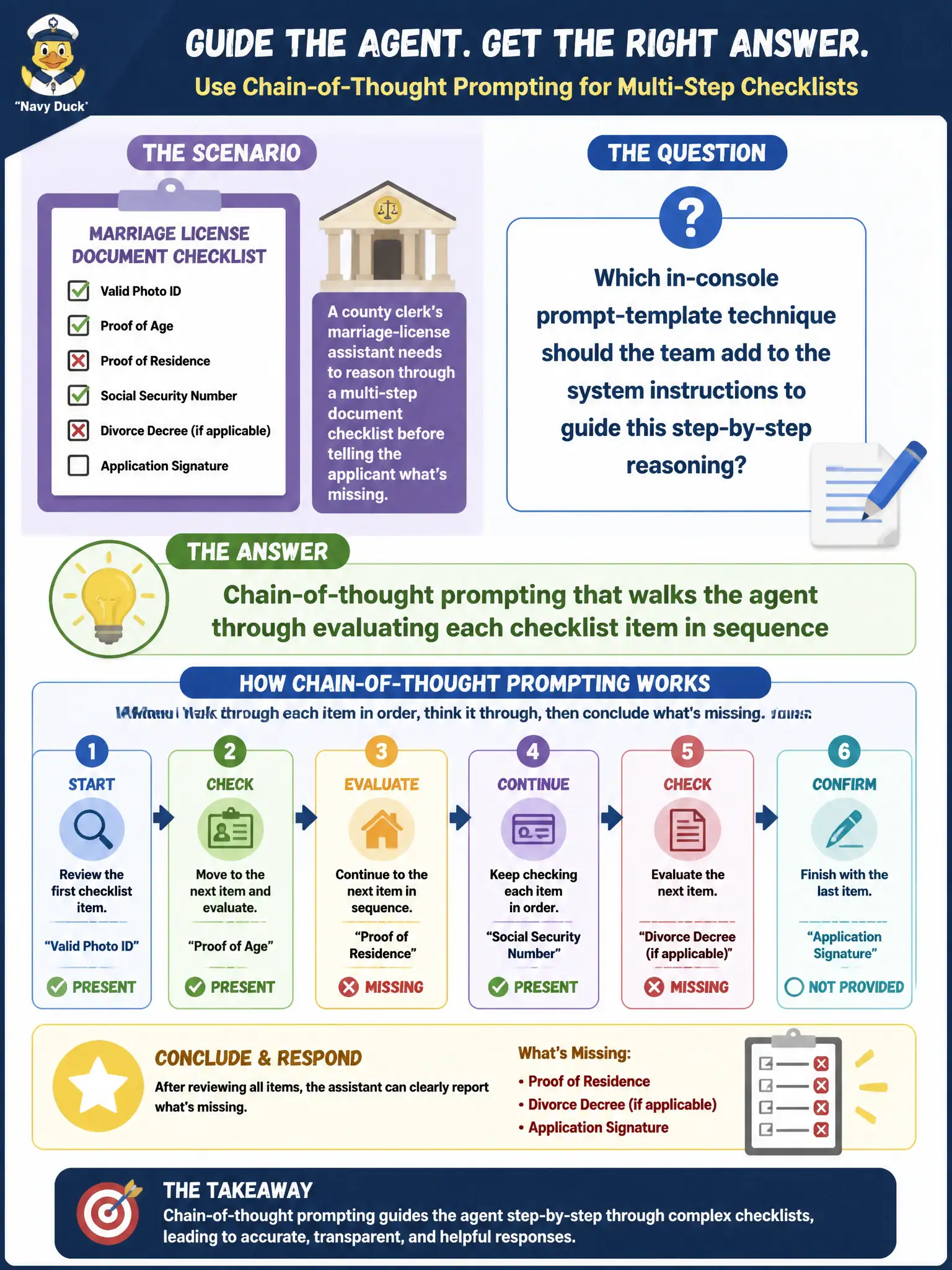
Short Explanation
Think about how a clerk actually works through a checklist — item by item, not jumping straight to a verdict. Chain-of-thought prompting builds that same step-by-step reasoning into the agent's instructions, so it evaluates each requirement before announcing what's missing.
Full Explanation
Chain-of-thought prompting instructs the model to work through intermediate reasoning steps explicitly before producing a final answer, which is exactly what a multi-item eligibility checklist needs: the agent should verify identification, residency, and prior-marriage status in sequence rather than pattern-matching straight to a conclusion. Few-shot examples are useful for anchoring output format or handling ambiguous phrasing, but pairing applications directly with verdicts teaches the agent to skip the reasoning and guess from surface similarity, which is fragile once an application doesn't resemble any example closely. A no-match event handler only exists to recover from unrecognized input; it has nothing to do with structuring an eligibility determination. A dedicated transition-route page could hold the checklist logic, but pages organize workflow steps, not the internal reasoning an agent performs within a single response. Scope caveat: chain-of-thought guidance shapes reasoning quality but doesn't substitute for validating outputs against real eligibility rules. Operational check: test the assistant against an application missing one specific document and confirm its explanation cites that exact gap rather than a generic rejection.