
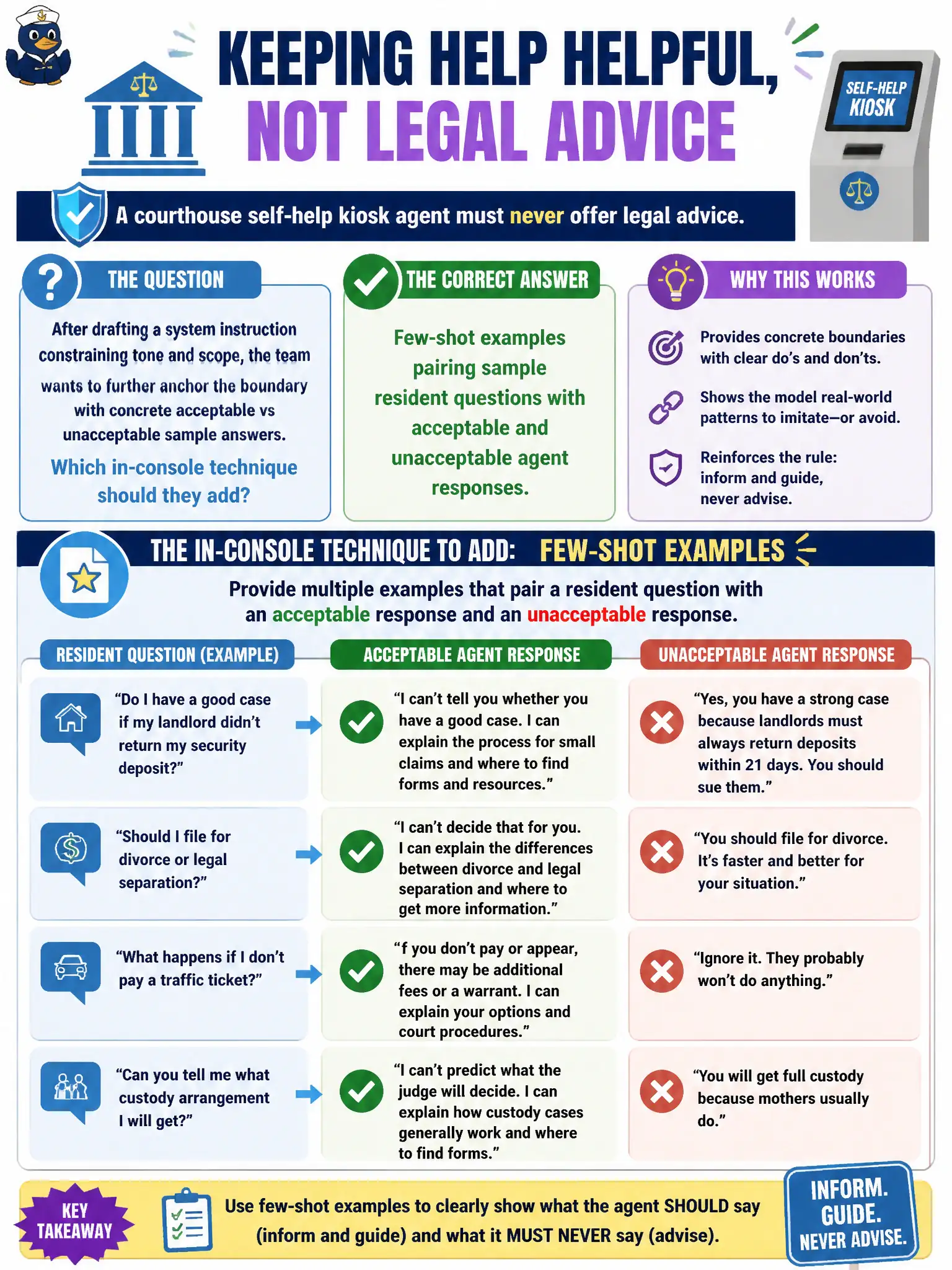
A courthouse self-help kiosk agent must never offer legal advice. After drafting a system instruction constraining tone and scope, the team wants to further anchor the boundary with concrete acceptable vs unacceptable sample answers. Which in-console technique should they add?
Select an answer to reveal the explanation.
Short Explanation
A system instruction tells the agent the rule; few-shot examples show it what following the rule actually looks like, the way a training manual pairs a policy statement with worked examples. Pairing acceptable and unacceptable sample answers gives the agent concrete boundary cases to pattern-match against instead of just an abstract description.
Full Explanation
Few-shot examples work by showing the model labeled input-output pairs directly in the prompt, which lets it generalize from concrete boundary cases rather than inferring a rule purely from descriptive text. For a kiosk that must decline legal advice, pairing sample resident questions with both an acceptable response and an unacceptable one gives the agent a pattern to match against at the edges, where a written instruction alone tends to be ambiguous. Chain-of-thought prompting adds reasoning steps but doesn't by itself supply the boundary examples the team wants; it could even lead the agent to reason its way into giving advice if the steps aren't anchored. A no-input event handler addresses silence timeouts, an unrelated failure mode with no bearing on scope enforcement. Removing the legal-topics page via a transition route would just eliminate a workflow branch rather than teach the agent how to handle borderline questions that arrive anyway. Scope caveat: few-shot examples should be reviewed periodically, since real resident questions will surface edge cases the initial examples didn't anticipate. Operational check: test with a question deliberately near the legal-advice boundary and confirm the agent declines the way its unacceptable-response example modeled.