
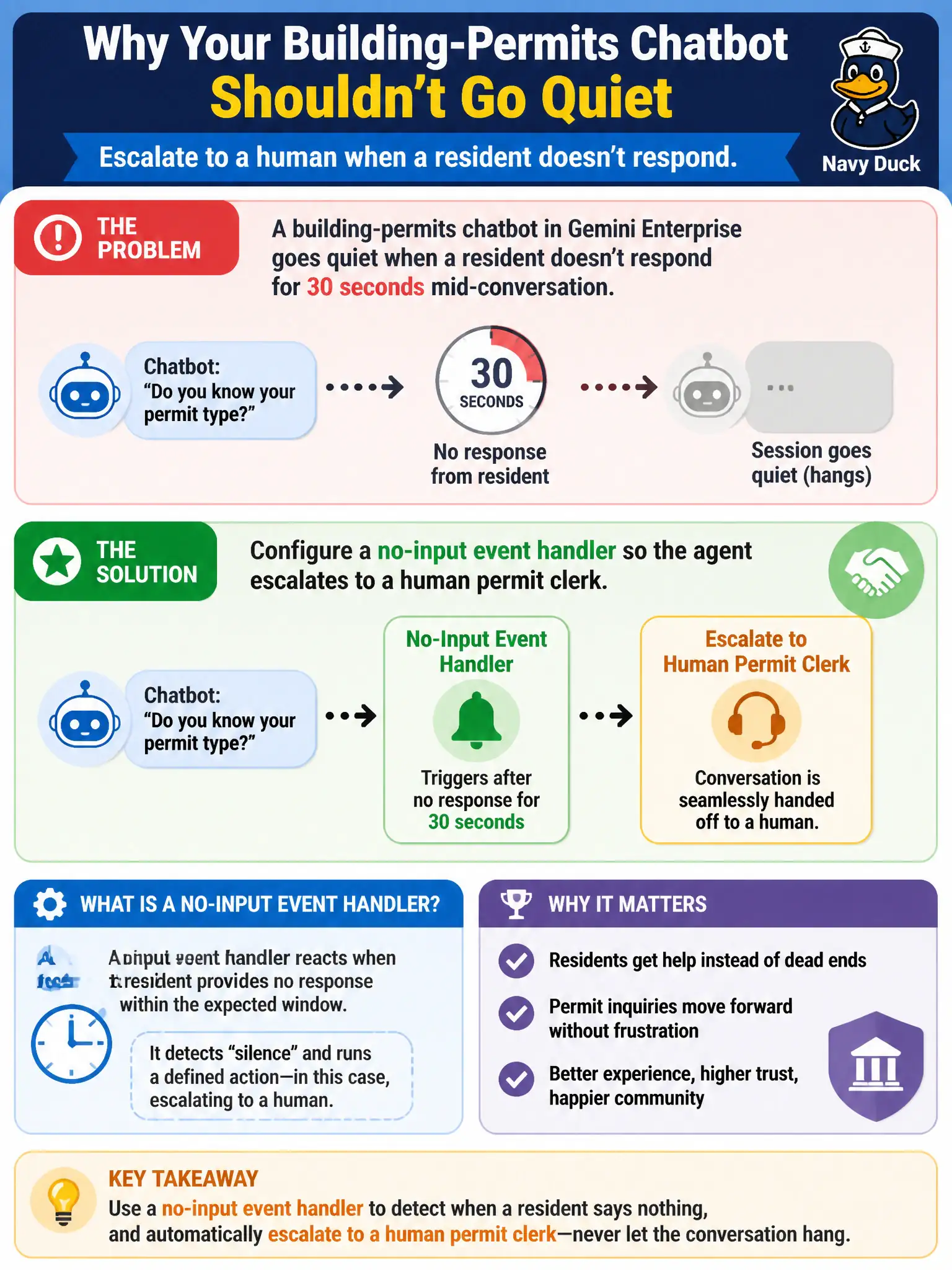
A building-permits chatbot in Gemini Enterprise goes quiet when a resident doesn't respond for 30 seconds mid-conversation. Which mechanism should the team configure so the agent escalates to a human permit clerk instead of letting the session hang?
Select an answer to reveal the explanation.
Short Explanation
Picture a clerk waiting at a counter — if nobody says anything for a while, that's a no-input situation, not a case of misunderstanding what was said. A no-input event handler is built exactly for that silence, letting the agent escalate the resident to a human clerk instead of freezing.
Full Explanation
Gemini Enterprise's state-based workflows separate two distinct failure modes on a page: no-match fires when the resident says something the agent can't classify into any defined intent, while no-input fires when the resident says nothing at all within the expected response window. A 30-second silence mid-conversation is squarely a no-input condition, so the correct fix configures that handler's fulfillment to route the session to a human permit clerk rather than re-prompting indefinitely. A transition route bound to an escalation intent depends on the resident saying something that maps to that intent — silence never produces one, so it can't fire. A no-match handler would only trigger if the resident spoke and the agent failed to classify it, which is a different failure entirely. A fixed-turn-count handoff in a system instruction addresses conversation length, not responsiveness, and could escalate an engaged resident too early or a silent one too late. Scope caveat: no-input handlers can be configured with escalating behavior across repeated triggers, so the first timeout might reprompt while a second confirms escalation. Operational check: simulate the flow and let the input field sit empty past the timeout to confirm the human handoff fires.