
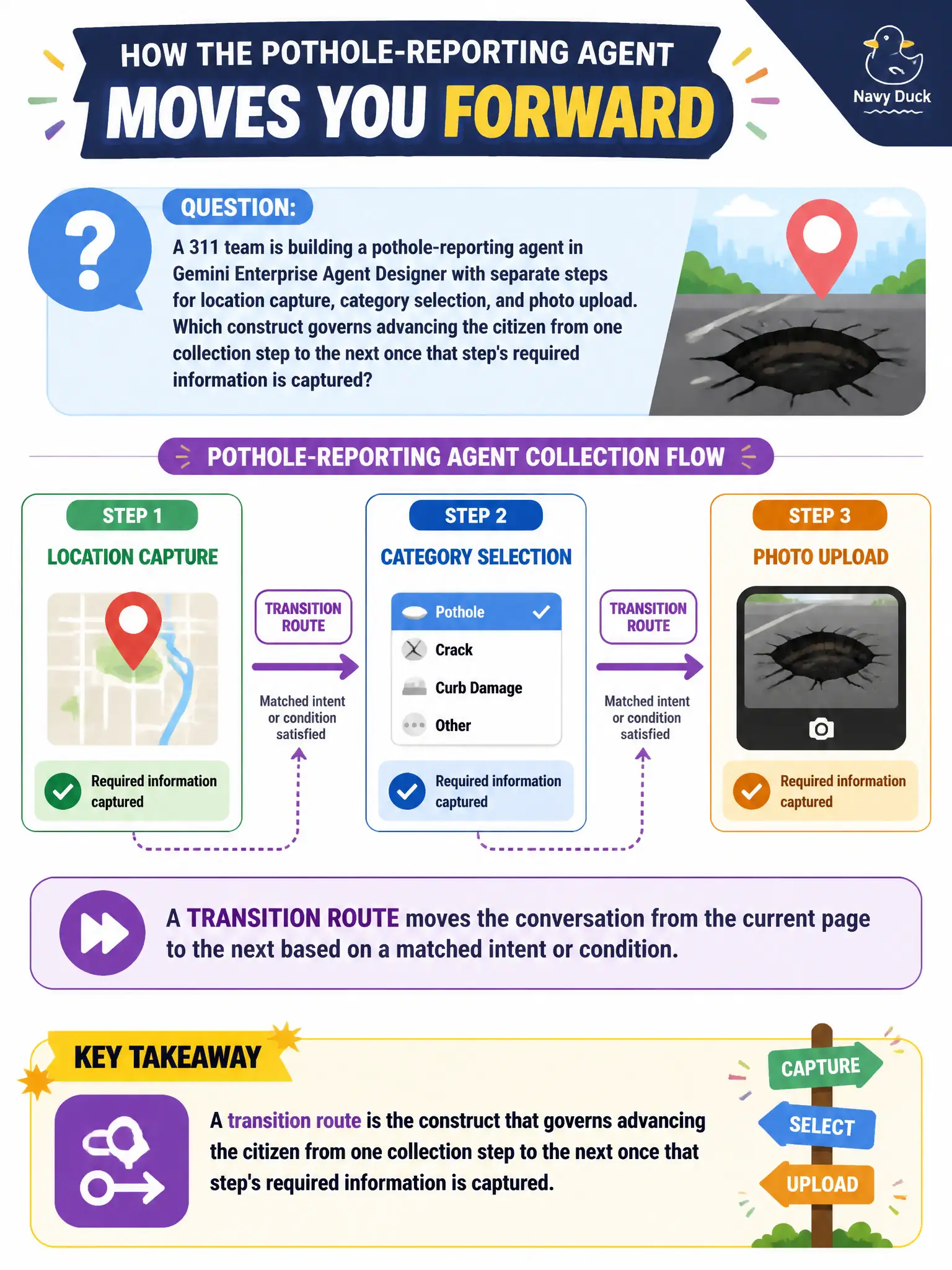
A 311 team is building a pothole-reporting agent in Gemini Enterprise Agent Designer with separate steps for location capture, category selection, and photo upload. Which construct governs advancing the citizen from one collection step to the next once that step's required information is captured?
Select an answer to reveal the explanation.
Short Explanation
Think of pages like rooms in a building and transition routes like the hallway doors between them — once a room's business is done, a transition route is what actually walks the citizen through to the next one. Event handlers are for when something goes wrong inside a room, not for moving between rooms on the happy path.
Full Explanation
In Gemini Enterprise Agent Designer, a state-based workflow models each step of a conversation as a page holding its own intents, parameters, and fulfillment logic; transition routes attached to that page evaluate matched intents or filled parameters and move the session to the next page once the step's conditions are satisfied — that's the mechanism that carries the pothole report from location capture into category selection and on to photo upload. Event handlers exist for a different job: they catch situations outside the normal flow, like no-input or no-match conditions, and are not what advances a completed step. System instructions shape tone, scope, and reasoning style across the whole agent, so they say nothing about which page comes next. Few-shot examples anchor how the agent interprets or phrases things within a single turn; they don't sequence the workflow either. Scope caveat: transition routes can carry conditions beyond simple intent matches, including parameter-fill state, so a route can also fire once a required field like location is populated. Operational check: open the location-capture page and confirm a transition route exists pointing at category selection, triggered by either the location intent or a filled location parameter.