
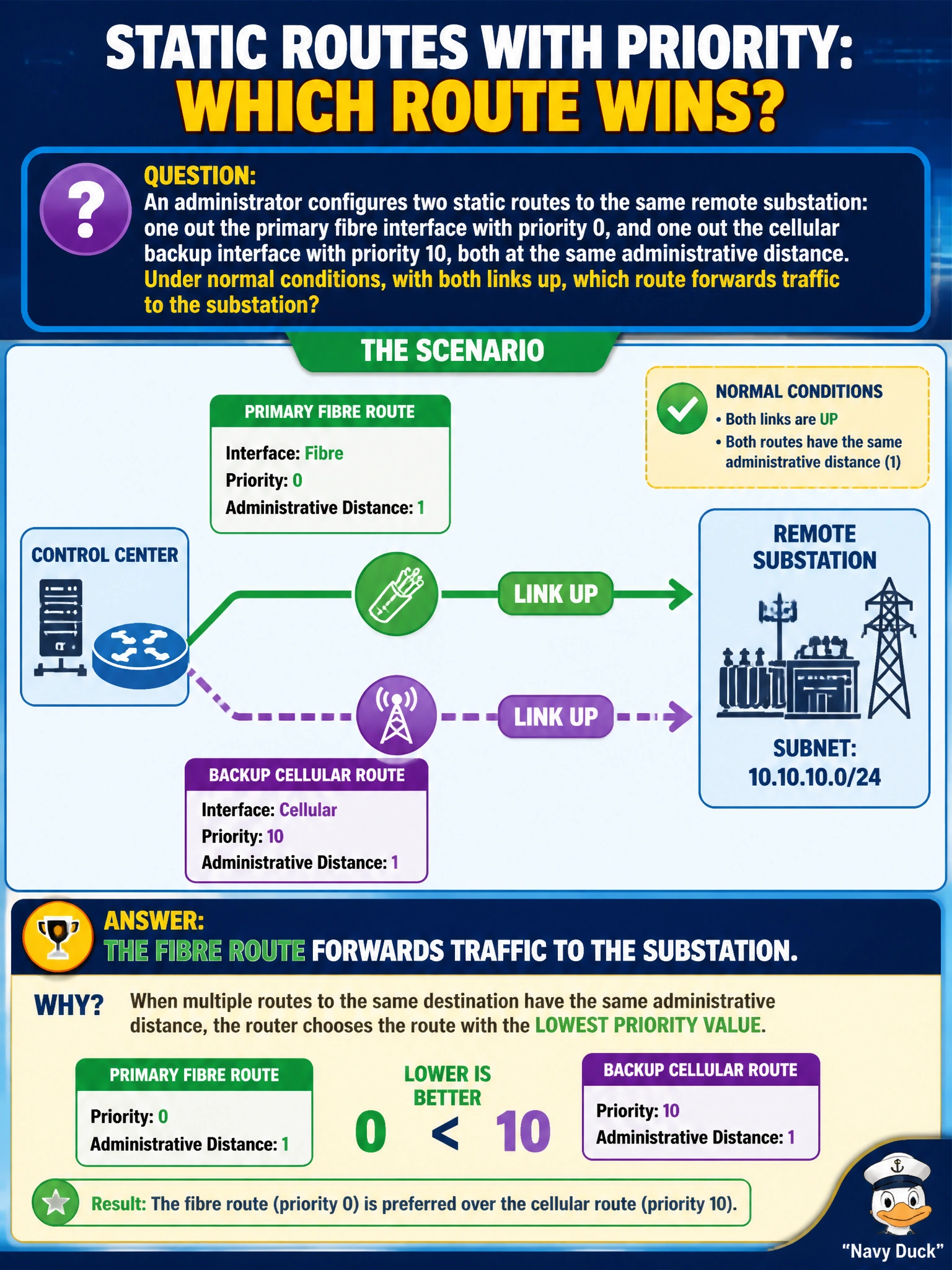
An administrator configures two static routes to the same remote substation: one out the primary fibre interface with priority 0, and one out the cellular backup interface with priority 10, both at the same administrative distance. Under normal conditions, with both links up, which route forwards traffic to the substation?
Select an answer to reveal the explanation.
Short Explanation
Priority works like golf scoring, not like a leaderboard rank: the lower number wins. Priority 0 beats priority 10, so fibre stays the everyday route and cellular waits on the bench as backup.
Full Explanation
When two static routes to the same destination share an administrative distance, FortiOS uses priority as the tiebreaker, and a lower priority value is preferred over a higher one — the opposite of how some other numeric rankings work, which is exactly why this pairing is a common point of confusion. With fibre at priority 0 and cellular at priority 10, fibre is the active route while both links are healthy, and cellular remains a standby route that only becomes active if fibre is withdrawn from the table, typically through dead gateway detection marking it unreachable. The second option inverts the actual preference rule. ECMP does not apply here because ECMP requires distance and priority to match exactly across the candidate routes; a priority difference is precisely what prevents load-balancing and instead establishes a clear primary/backup relationship. Differing priorities are a completely valid and common design pattern, not a conflict FortiOS rejects. To confirm this behavior, check the routing table with both links up and verify only the fibre route shows as selected, then simulate a fibre outage and confirm cellular becomes the active route.