
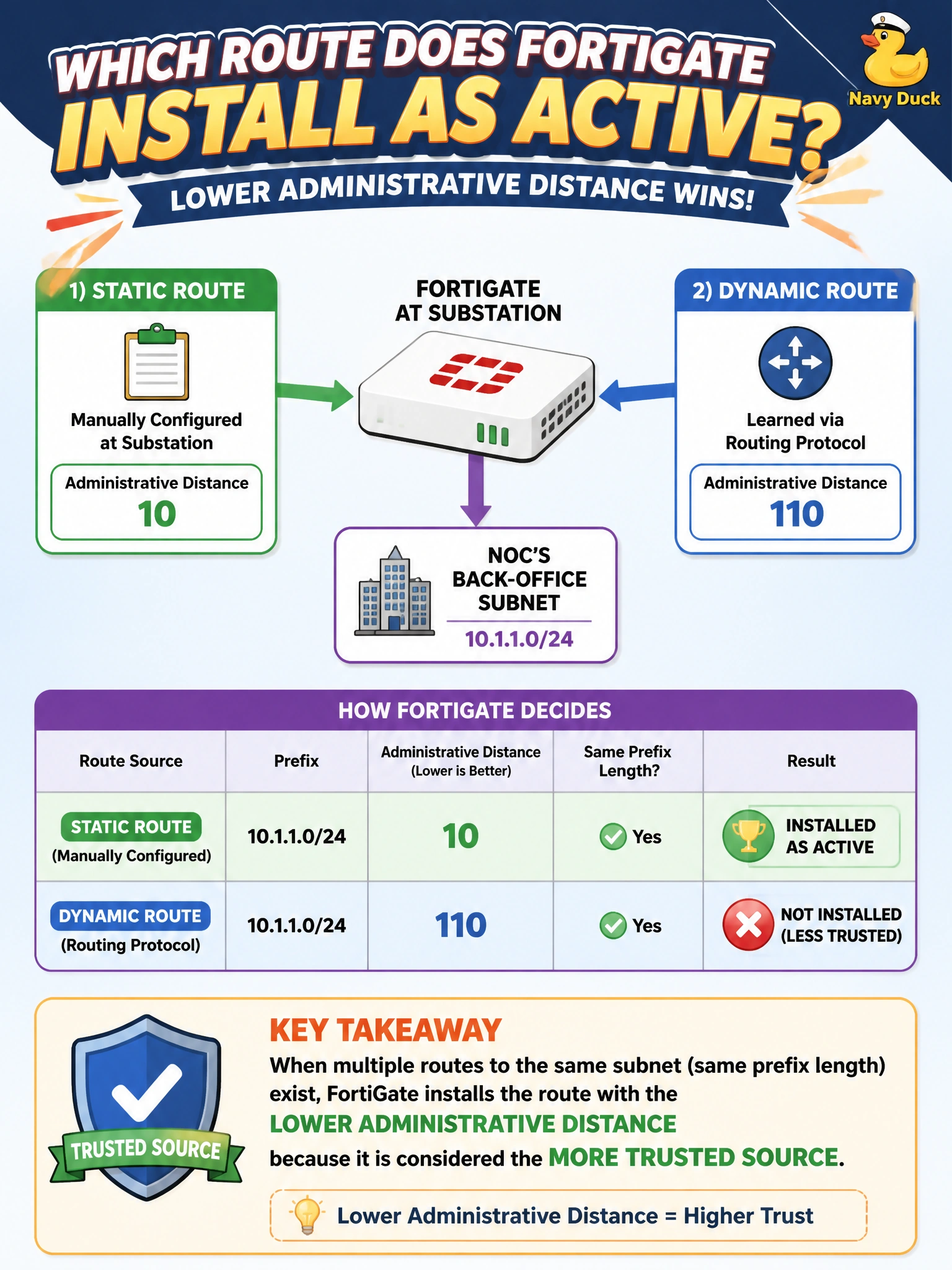
A FortiGate at a substation has a manually configured static route to the NOC's back-office subnet with administrative distance 10, and also learns a route to the same subnet dynamically with a higher administrative distance from a routing protocol. Assuming both routes have the same prefix length, which route does the FortiGate install as active in its routing table?
Select an answer to reveal the explanation.
Short Explanation
Administrative distance is basically a trust score for where a route came from. Given a choice between two competing directions to the exact same place, the FortiGate believes the source it trusts more — the one with the lower distance — and that's the static route here.
Full Explanation
When multiple routing sources offer a route to the identical destination prefix, administrative distance decides which one is installed as the active route in the table: the lowest distance wins, full stop, before priority or any other consideration is applied. A manually configured static route at distance 10 beats a dynamically learned route carrying a higher distance value, so the static entry becomes active and the dynamic route is retained only as a backup candidate that would take over if the static route were withdrawn. The claim that dynamic routes always override static ones gets the relationship backwards — dynamic protocols are typically assigned higher default distances than static routes precisely so a deliberately configured static path can take precedence when needed. ECMP is not in play here because ECMP requires equal distance between candidates, and ignoring distance entirely is not how ECMP eligibility works. Recency of when a route was learned has no bearing on route selection; FortiOS is not deciding based on a timestamp. To verify, check the routing table for that back-office subnet and confirm the static route, not the dynamic one, is flagged as the selected route.