
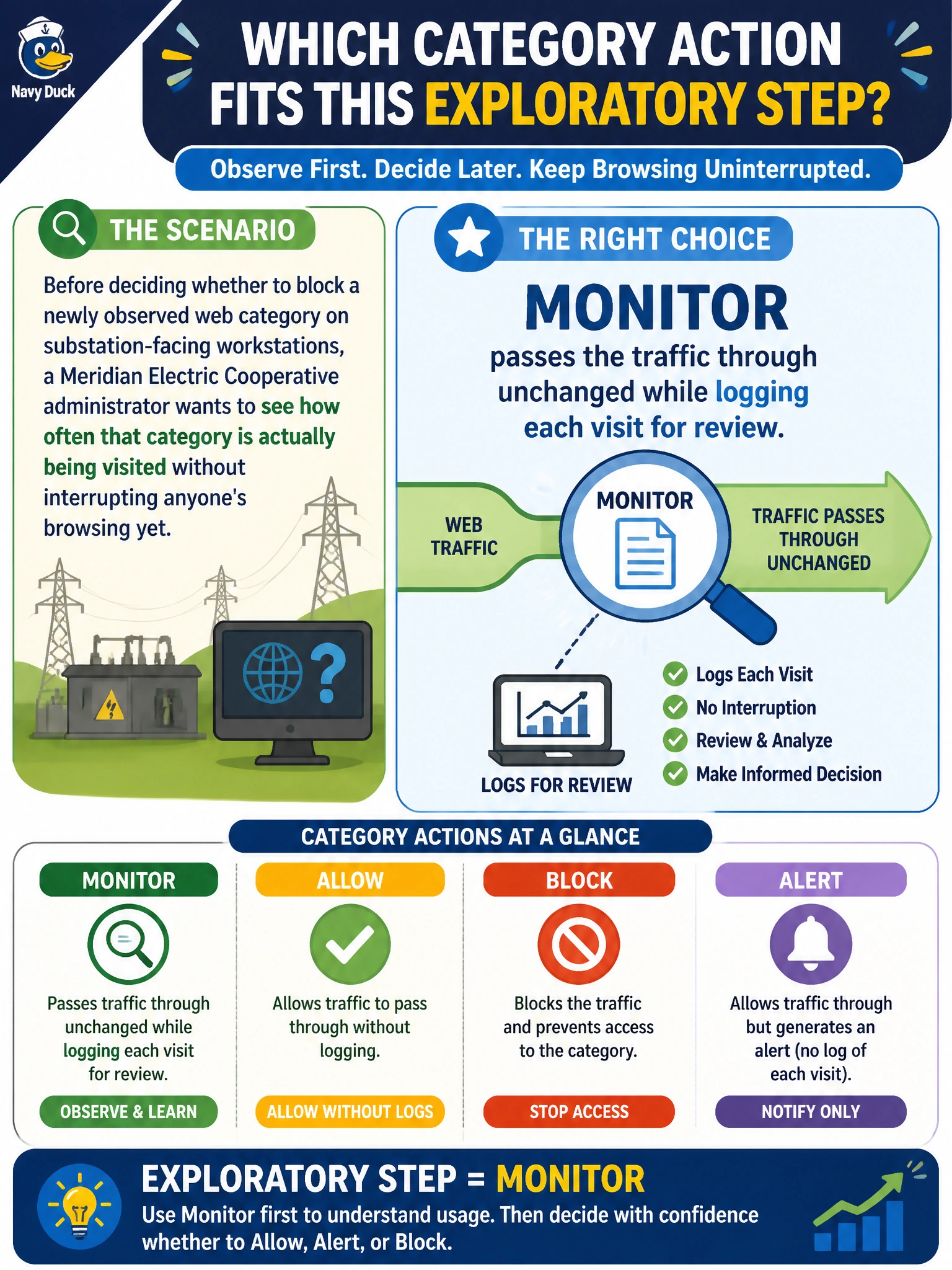
Before deciding whether to block a newly observed web category on substation-facing workstations, a Meridian Electric Cooperative administrator wants to see how often that category is actually being visited without interrupting anyone's browsing yet. Which category action fits this exploratory step?
Select an answer to reveal the explanation.
Short Explanation
You can't measure normal behavior if you've already changed it. Monitor just watches and logs — nothing gets slowed down or stopped — so the administrator can see the real pattern before deciding what to do about it.
Full Explanation
Monitor is the action designed for exactly this kind of exploratory step: it allows the category's traffic to proceed exactly as it would with no web filter action applied at all, while still generating a log entry for every matching request, which gives the administrator real usage data to evaluate. That data-gathering-without-interference property is what makes it fit a 'let's see what's actually happening first' situation. Block defeats the purpose outright, since stopping the traffic immediately means there's no ongoing usage left to observe or measure. Quota introduces an artificial daily cap before any baseline has been established, which would distort rather than reveal the category's natural usage pattern. Warning inserts a user-facing interruption on every visit, which both changes user behavior, since some will simply stop trying, and signals a decision that hasn't actually been made yet. A caveat: because Monitor doesn't restrict anything, it should be treated as a temporary diagnostic setting rather than a long-term control if the category does turn out to need enforcement. Confirm the baseline is being captured by pulling the web filter log filtered to that category over a representative time window before choosing a follow-up action.