
Immediately after a firmware upgrade completes on a remote substation FortiGate, what is the most important verification step before considering the maintenance window closed?
Select an answer to reveal the explanation.
Short Explanation
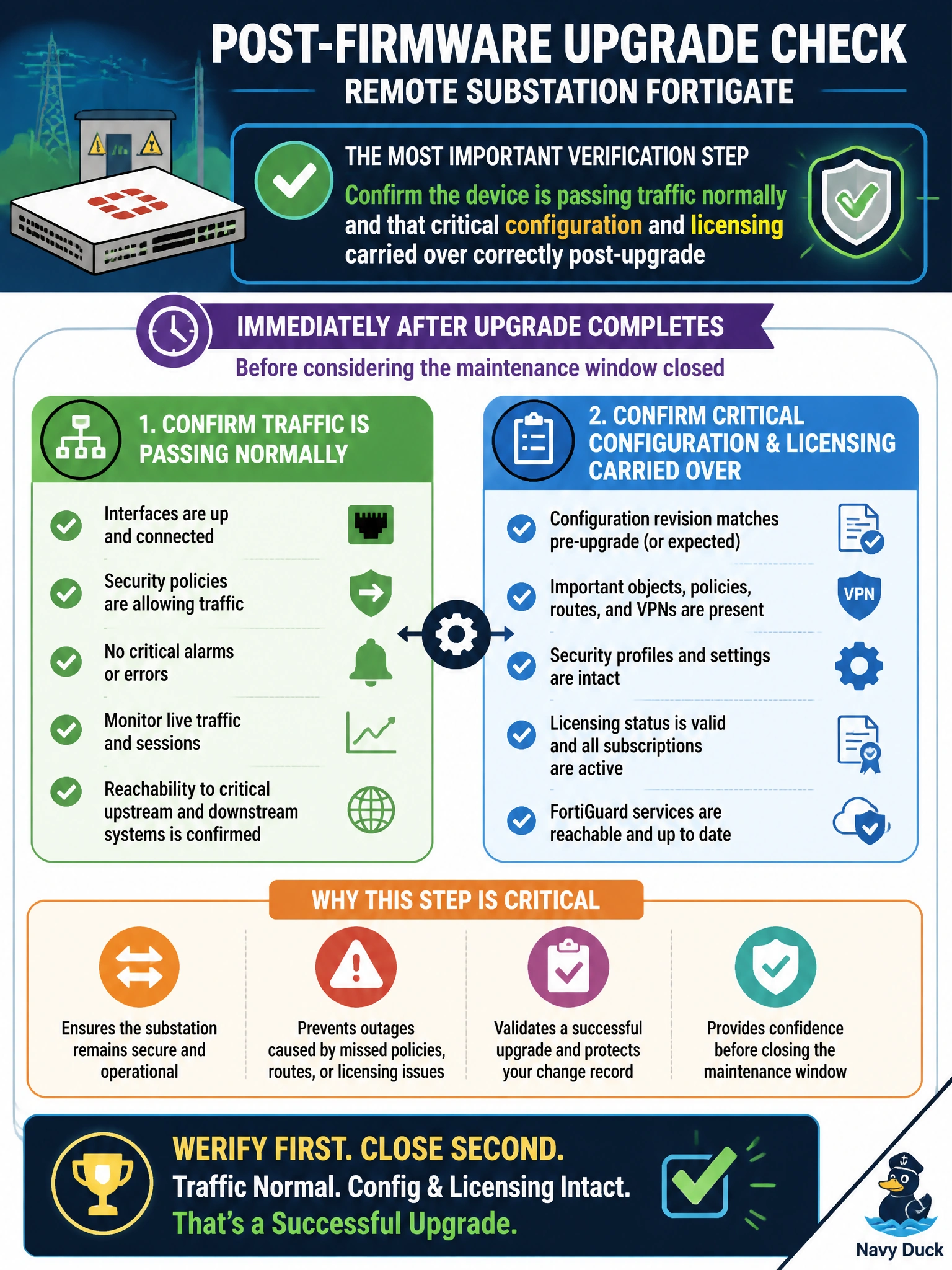
An upgrade that finishes without errors isn't automatically an upgrade that worked. The real confirmation is watching the device actually do its job afterward: passing traffic, keeping its configuration, and still holding a valid license. That's what closes out the maintenance window, not just the progress bar hitting 100%.
Full Explanation
A firmware upgrade completing without a visible error doesn't guarantee everything migrated correctly, so the meaningful verification step is confirming the device is actively passing traffic as expected and that configuration elements and license and FortiGuard status carried over intact, which actually confirms success at an unstaffed site where a subtle post-upgrade issue could otherwise go unnoticed for a long time. Immediately scheduling the next upgrade skips validation of the one that just happened and adds unnecessary risk before the current change has even been confirmed stable. Deleting the pre-upgrade backup throws away a still-useful rollback point before the new version has been proven reliable in production, exactly the wrong moment to remove that safety net. Adjusting SNMP polling interval is a monitoring-tuning decision unrelated to verifying whether the upgrade itself succeeded. The operational caveat: some issues, like a licensing or FortiGuard service hiccup introduced by the version change, may not surface in the first few minutes, so a brief follow-up check after the device has run for a while is a reasonable addition to the immediate post-upgrade validation.