
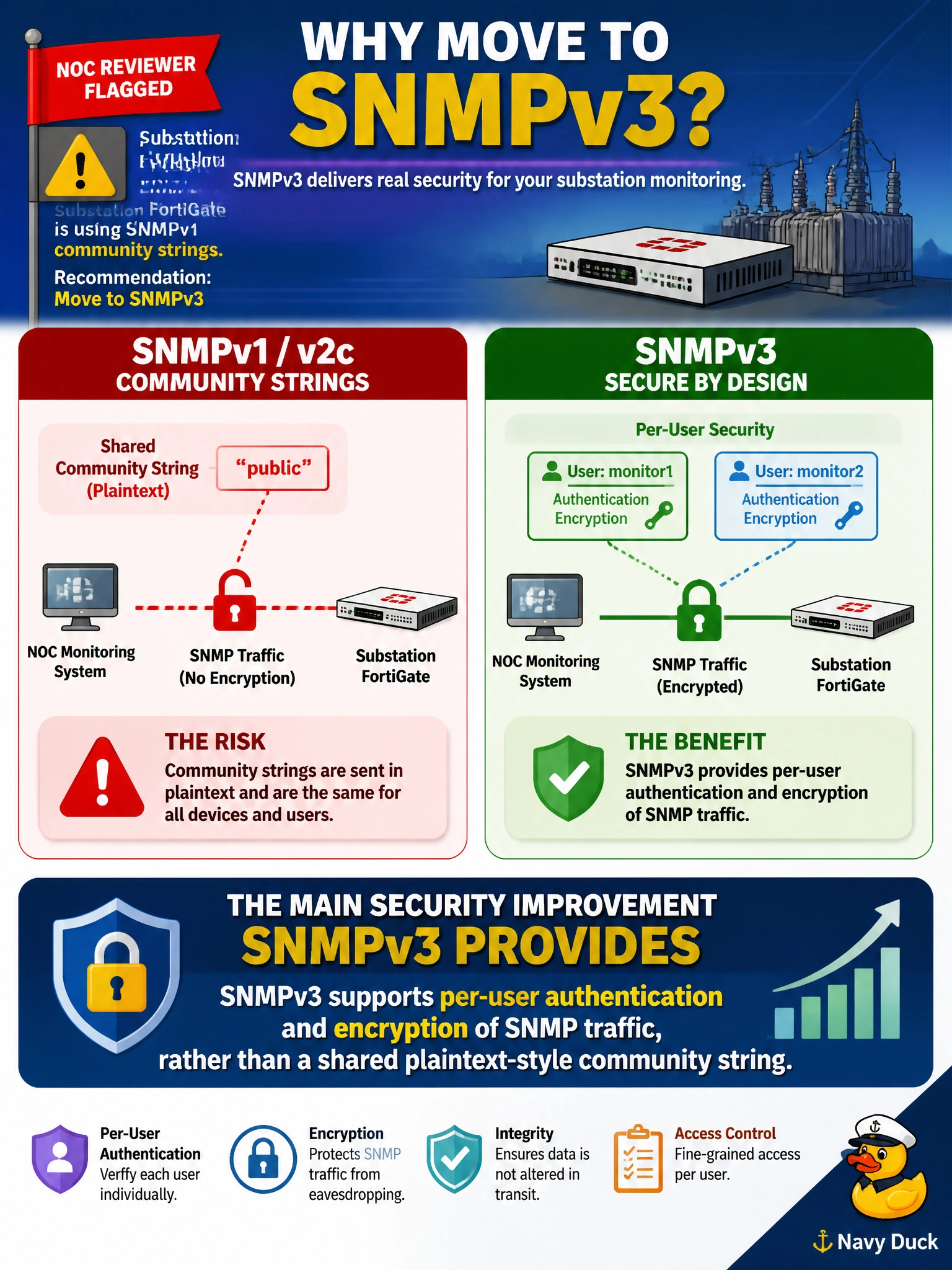
A NOC security reviewer flags that a substation FortiGate is using SNMPv1 community strings for monitoring and recommends moving to SNMPv3. What is the main security improvement SNMPv3 provides over SNMPv1/v2c community strings?
Select an answer to reveal the explanation.
Short Explanation
A community string is basically a shared password sent with minimal protection: anyone who captures it on the wire can use it. SNMPv3 swaps that for per-user credentials plus real authentication and encryption, which is the actual upgrade the reviewer is pointing at.
Full Explanation
SNMPv1 and SNMPv2c rely on community strings that function like a shared, weakly protected password with little to no encryption of the SNMP exchange itself, whereas SNMPv3 introduces per-user security credentials along with authentication and encryption options, meaningfully closing the gap between anyone who captures the string can query the device and a properly authenticated, protected monitoring channel. SNMPv3 doesn't eliminate credentials entirely; it still requires configured user credentials, just stronger ones than a shared string. It also doesn't touch firewall policy traffic, the actual data plane sessions users generate, since SNMP is a separate management-plane protocol used for polling device health metrics, not for securing or encrypting general network traffic. It has no relationship to FortiGuard subscription status either, which governs signature content updates, an entirely different service. The practical caveat: upgrading to SNMPv3 only improves security if the monitoring platform on the other end is also configured to use it, so a good check is confirming both ends negotiate SNMPv3 rather than silently falling back to an older, weaker version.