
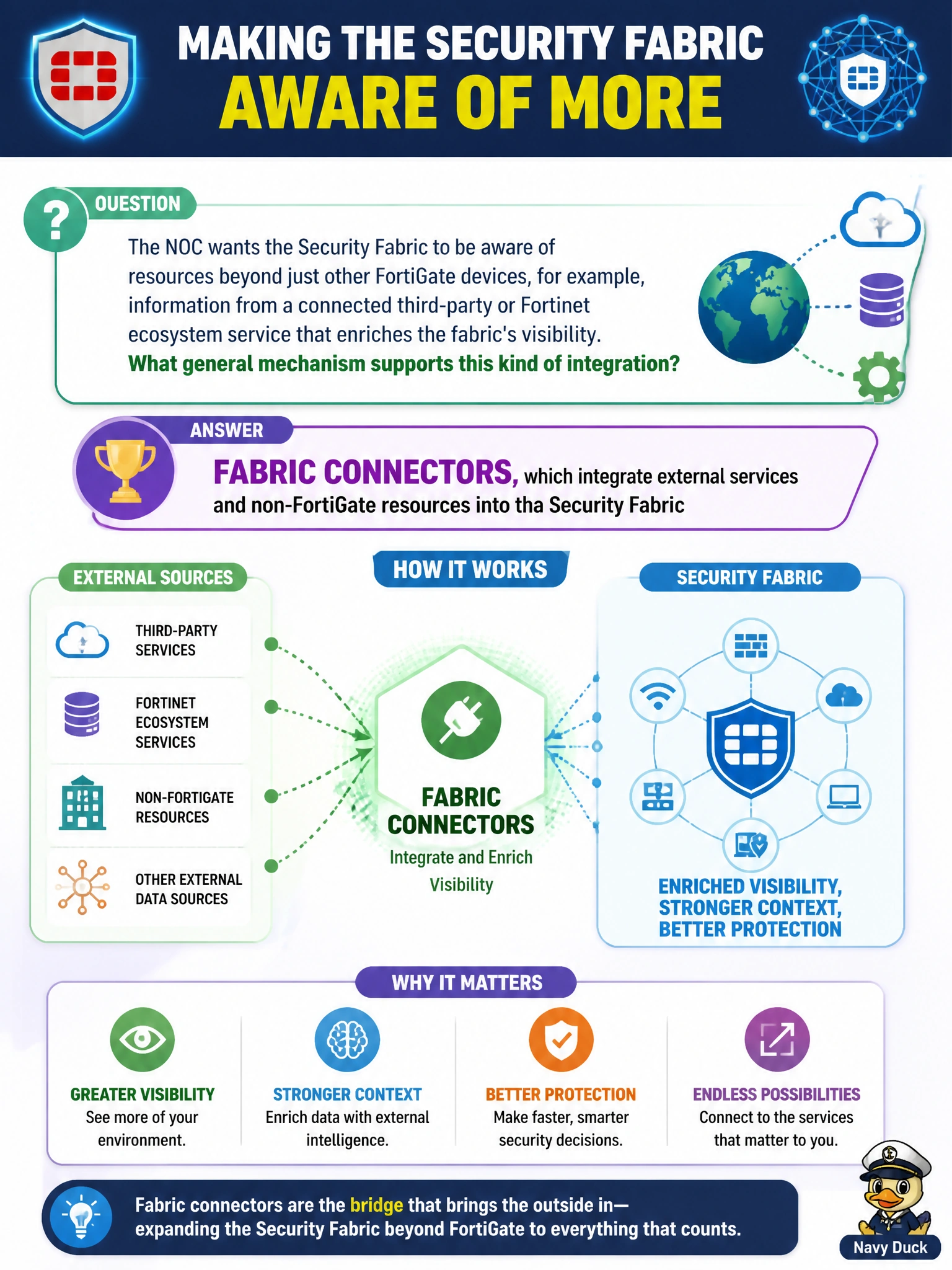
The NOC wants the Security Fabric to be aware of resources beyond just other FortiGate devices, for example, information from a connected third-party or Fortinet ecosystem service that enriches the fabric's visibility. What general mechanism supports this kind of integration?
Select an answer to reveal the explanation.
Short Explanation
Fabric connectors are the plug-in points that let the fabric reach beyond just FortiGate-to-FortiGate relationships and pull in awareness from other services, think of them as the fabric's way of extending its picture outward instead of staying limited to its own hardware family. That's a very different job from monitoring intervals or VDOM assignment.
Full Explanation
Fabric connectors are the mechanism Fortinet built specifically to let the Security Fabric integrate information from external services and resources beyond native FortiGate-to-FortiGate relationships, extending the fabric's visibility and automation reach into a broader ecosystem rather than limiting it to Fortinet firewalls alone. Manually re-typing external data into each device's local configuration is manual, doesn't scale, and isn't an integration mechanism at all; it's just data entry that would need to be repeated and kept in sync by hand. Increasing SNMP polling frequency affects how often performance counters are sampled, unrelated to integrating external ecosystem or third-party information into the fabric. Placing every fabric member in the same VDOM is a configuration-partitioning concept and has nothing to do with what data sources the fabric can draw on. The introductory-level caveat: not every external integration is equally deep, so a practical check when planning one is confirming what specific data or control the connector actually exposes for the fabric, rather than assuming any connector provides full two-way integration.