
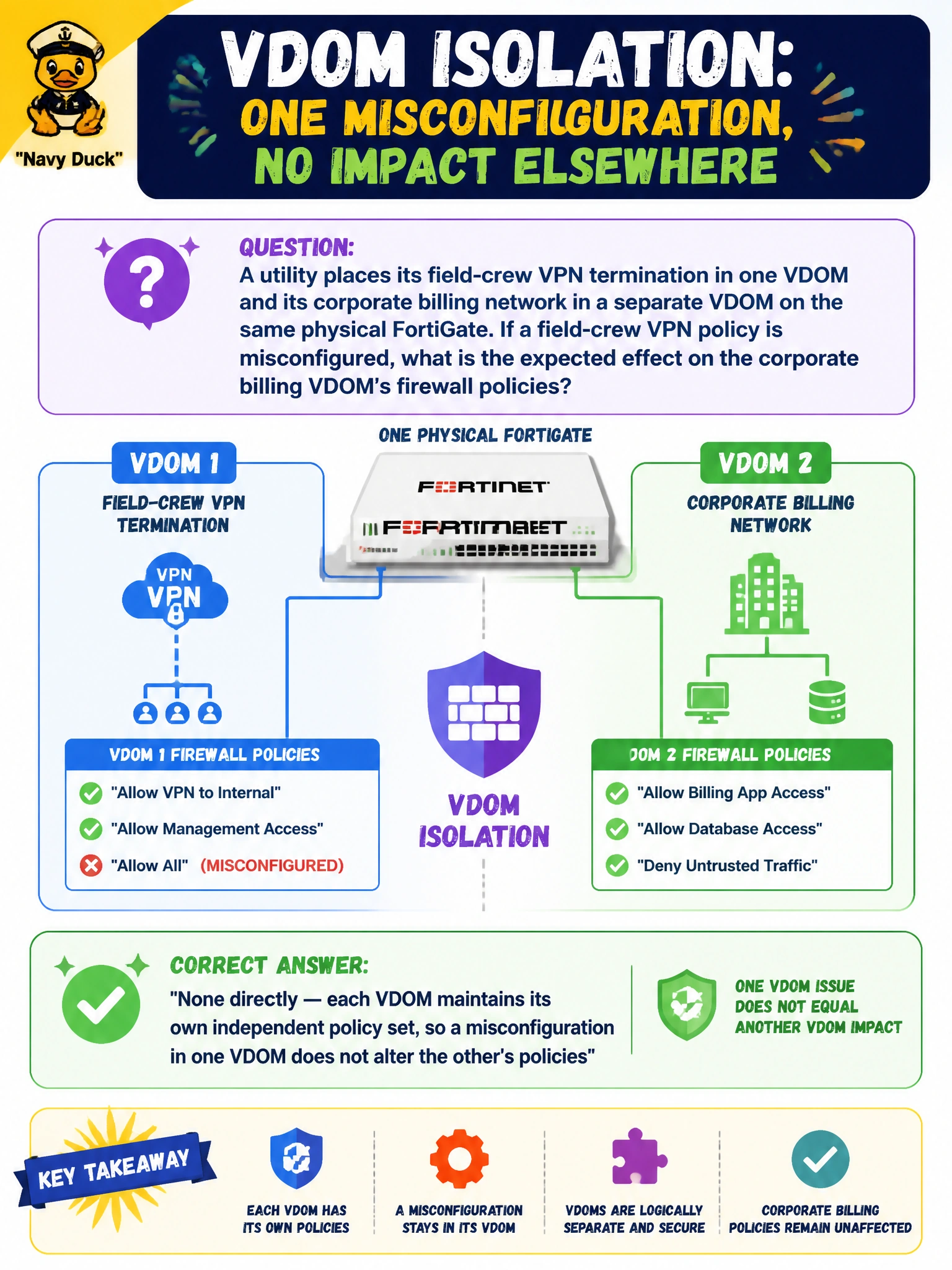
A utility places its field-crew VPN termination in one VDOM and its corporate billing network in a separate VDOM on the same physical FortiGate. If a field-crew VPN policy is misconfigured, what is the expected effect on the corporate billing VDOM's firewall policies?
Select an answer to reveal the explanation.
Short Explanation
Isolation is the whole point of VDOMs: a mistake in one VDOM's policy set stays contained there, because the other VDOM is working from its own independent set of rules and its own routing table entirely. It's not one shared rulebook split by labels.
Full Explanation
Because each VDOM maintains its own independent firewall policy set and routing table, a misconfiguration made within one VDOM has no direct effect on another VDOM's policies, and that separation is the core value VDOMs provide when isolating distinct networks like a field-crew VPN termination point and a corporate billing network on shared hardware. The claim that VDOMs share a single policy table is backwards; a shared table would defeat the entire purpose of the VDOM feature and isn't how VDOMs are designed to work. Policies don't get inherited across VDOMs on reboot or at any other time, since each VDOM's configuration persists independently and reboot doesn't trigger any cross-VDOM propagation. Shared routing table failure is also incorrect, since routing tables are likewise maintained per VDOM rather than pooled across the device. The caveat at this introductory level: while policy and routing are isolated per VDOM, some system-wide resources and settings on the physical device are still shared across all VDOMs, so a reasonable check when troubleshooting an unexpected cross-VDOM symptom is confirming whether the issue actually traces to one of those shared, device-level resources rather than assuming full isolation covers everything.