
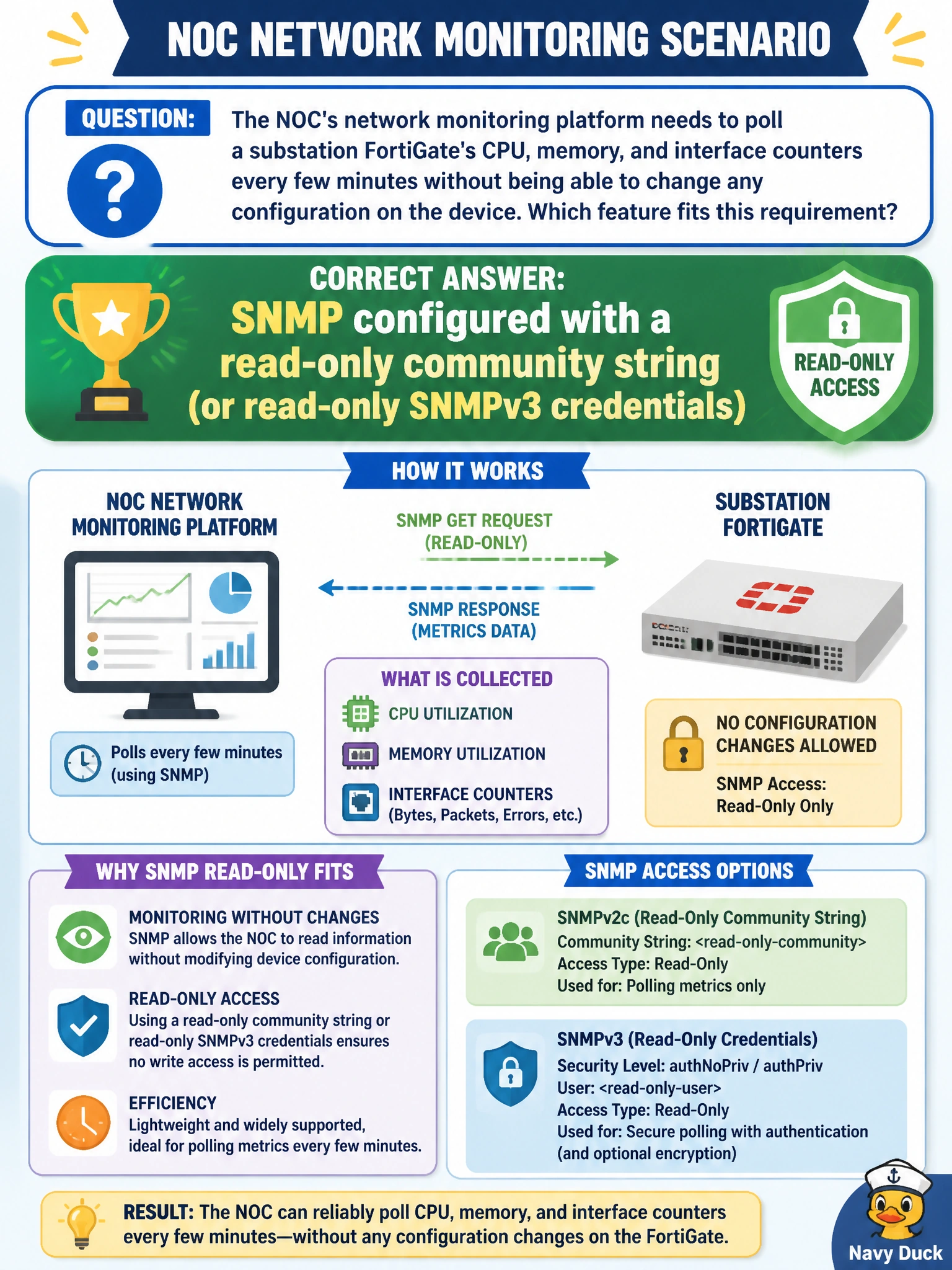
The NOC's network monitoring platform needs to poll a substation FortiGate's CPU, memory, and interface counters every few minutes without being able to change any configuration on the device. Which feature fits this requirement?
Select an answer to reveal the explanation.
Short Explanation
SNMP set up for read-only access is like giving the monitoring platform a window to look through, not a key to the door: it can see counters and health metrics on a schedule, but it can't reach in and change a single setting. That's exactly the separation the NOC wants here.
Full Explanation
SNMP lets a FortiGate expose standard health and performance counters, such as CPU load, memory, and interface statistics, to a network management station that polls them on an interval; scoping the community string or the SNMPv3 user credentials to read-only access means the monitoring platform can retrieve that data but has no path to modify configuration. A super_admin account grants full configuration control, the opposite of the least-privilege, read-only access the requirement calls for. An IPsec VPN tunnel provides an encrypted transport path between two networks; it doesn't by itself expose any monitoring counters or determine what the far end can do once connected. Enabling remote logging sends event and traffic log records to a destination, a different data stream from real-time performance counters and not what a polling-based monitoring platform typically consumes. The operational caveat: SNMPv1/v2c community strings travel with minimal protection, so where it's available SNMPv3 with authentication and encryption is the stronger choice for read-only polling, and a good check is confirming which SNMP version is actually configured before trusting it over an untrusted network segment.