
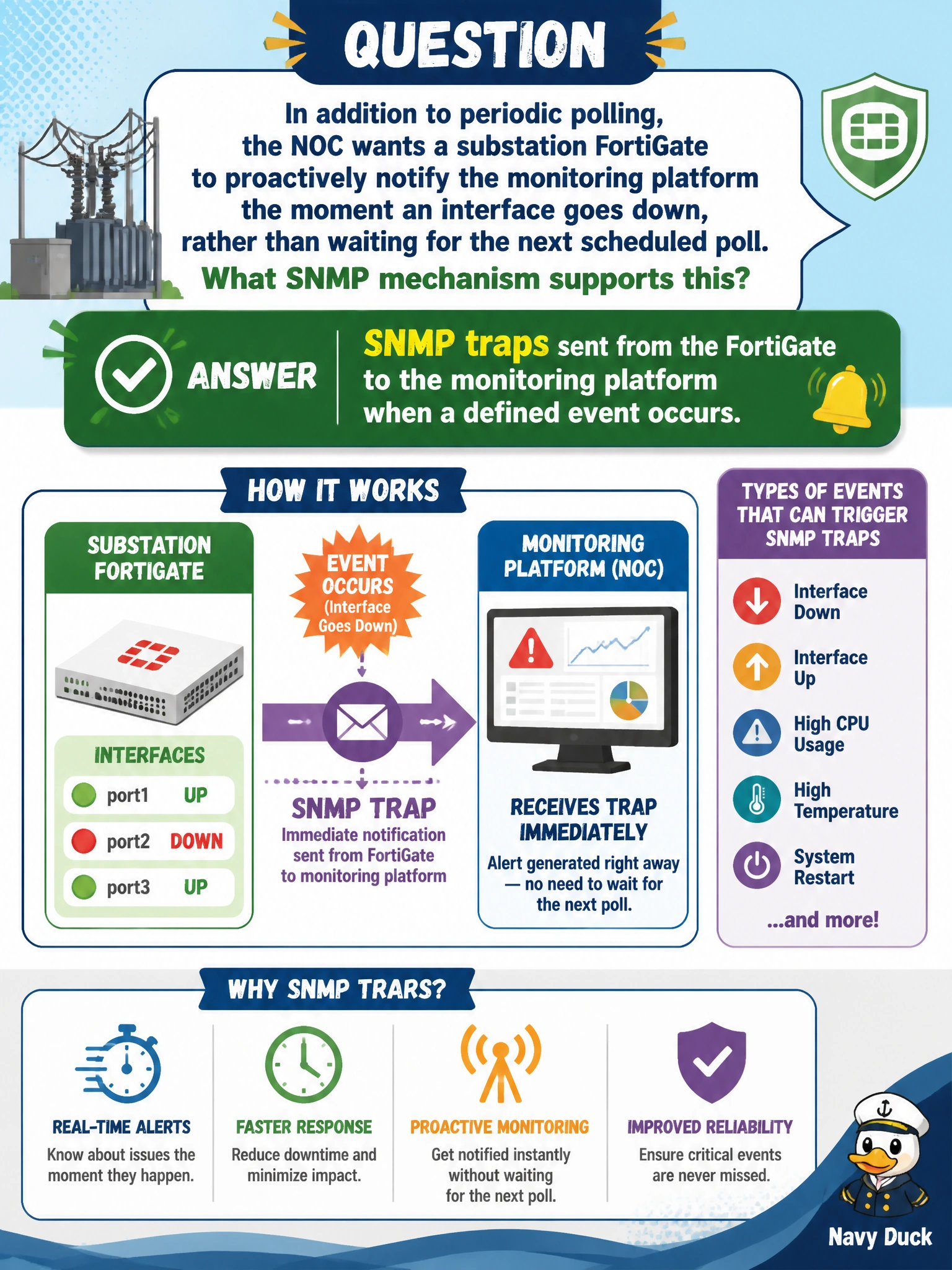
In addition to periodic polling, the NOC wants a substation FortiGate to proactively notify the monitoring platform the moment an interface goes down, rather than waiting for the next scheduled poll. What SNMP mechanism supports this?
Select an answer to reveal the explanation.
Short Explanation
Polling is the monitoring platform asking anything new on a timer, but a trap flips that around: the FortiGate itself speaks up the instant something like an interface going down happens, instead of waiting to be asked. That's the proactive notification the NOC is after.
Full Explanation
SNMP traps are unsolicited messages a device sends to a configured manager when a specific event occurs, which is the mechanism that closes the gap between scheduled polling intervals and real-time awareness; an interface-down event triggers an immediate trap rather than waiting for the next poll cycle to reveal it. Shortening the polling interval reduces the worst-case detection delay but still leaves a window and increases overhead; it doesn't provide the event-driven, immediate notification the scenario asks for. Routing SNMP traffic over a redundant WAN link is a path-resiliency consideration for delivering SNMP traffic, not a mechanism for triggering proactive event notifications in the first place. Raising local disk logging severity changes what gets written to the FortiGate's own log storage, a separate subsystem from SNMP notification delivery to an external manager. The caveat worth flagging operationally: traps are typically sent over UDP without delivery guarantees, so a good practice is keeping periodic polling active as a backstop in case a trap is lost in transit, and the check is confirming both trap delivery and baseline polling are functioning rather than relying on traps alone.