
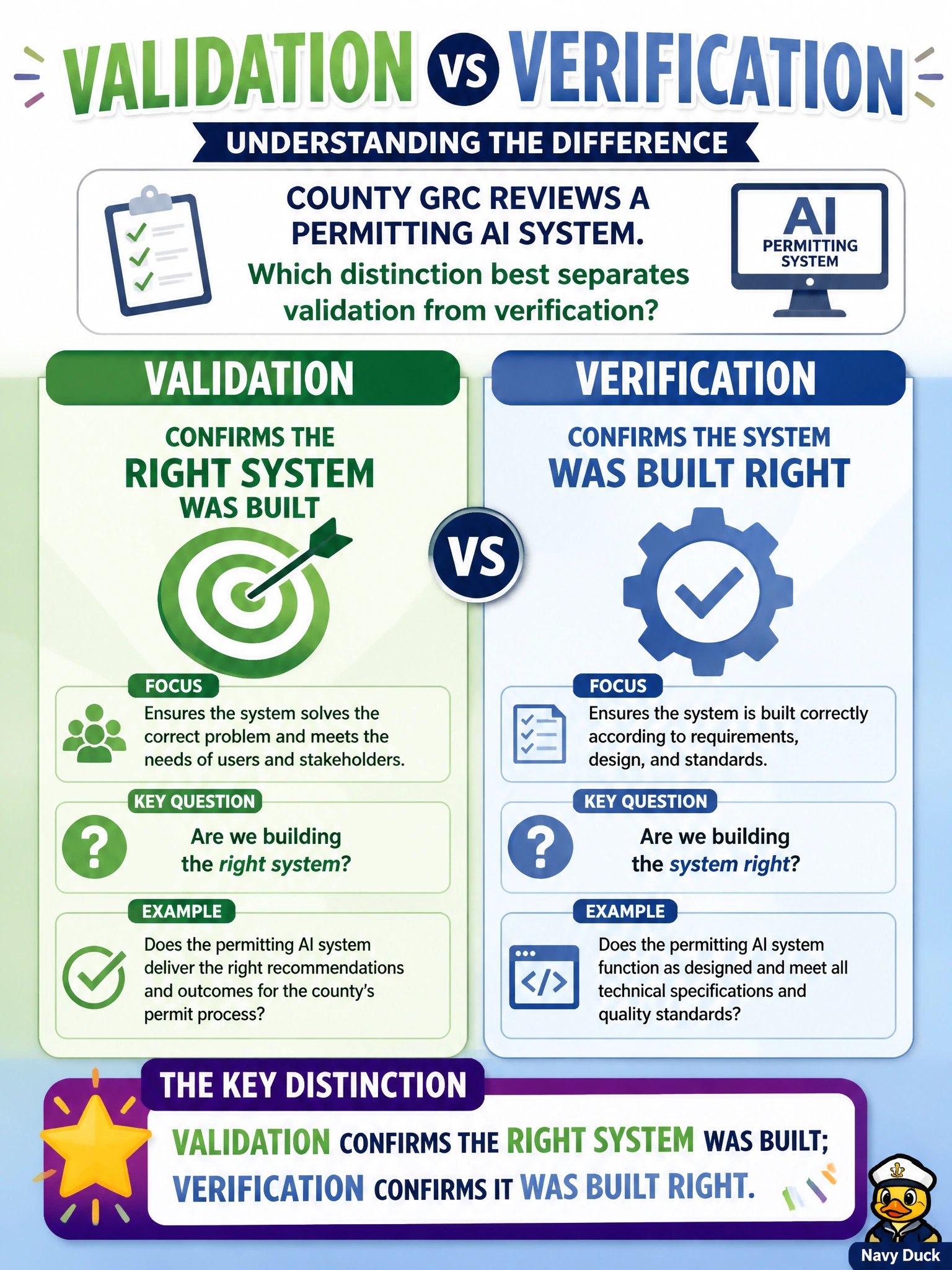
County GRC reviews a permitting AI system. Which distinction best separates validation from verification?
Select an answer to reveal the explanation.
Short Explanation
Validation asks ‘are we solving the right permitting problem?’ Verification asks ‘did we build that solution correctly?’ Different questions—both matter before residents feel the pain.
Full Explanation
County GRC reviewing a permitting AI system should separate validation from verification: validation confirms the right system was built for the intended permitting need (problem-solution fit, policy and user acceptance), while verification confirms it was built correctly to specifications (tests against requirements). Both are required; neither replaces the other before residents feel permitting delays or unfair outcomes.
Saying validation means prettier UI fonts and verification means faster load times only trivializes both concepts into cosmetic performance unrelated to civic policy fit. Claiming validation and verification are identical labels erases a foundational assurance distinction used in audits and stage gates. Asserting verification replaces any user or policy acceptance criteria drops validation and can ship a correctly built system that solves the wrong municipal permitting problem.
Exam caveat: in civic AI assurance, validation = right system; verification = system built right—treat them as complementary controls at every gate. Operational check: for the permitting AI, retain validation evidence (policy/user acceptance of intended outcomes) and verification evidence (requirement-linked tests); block promotion if either package is missing or stale.