
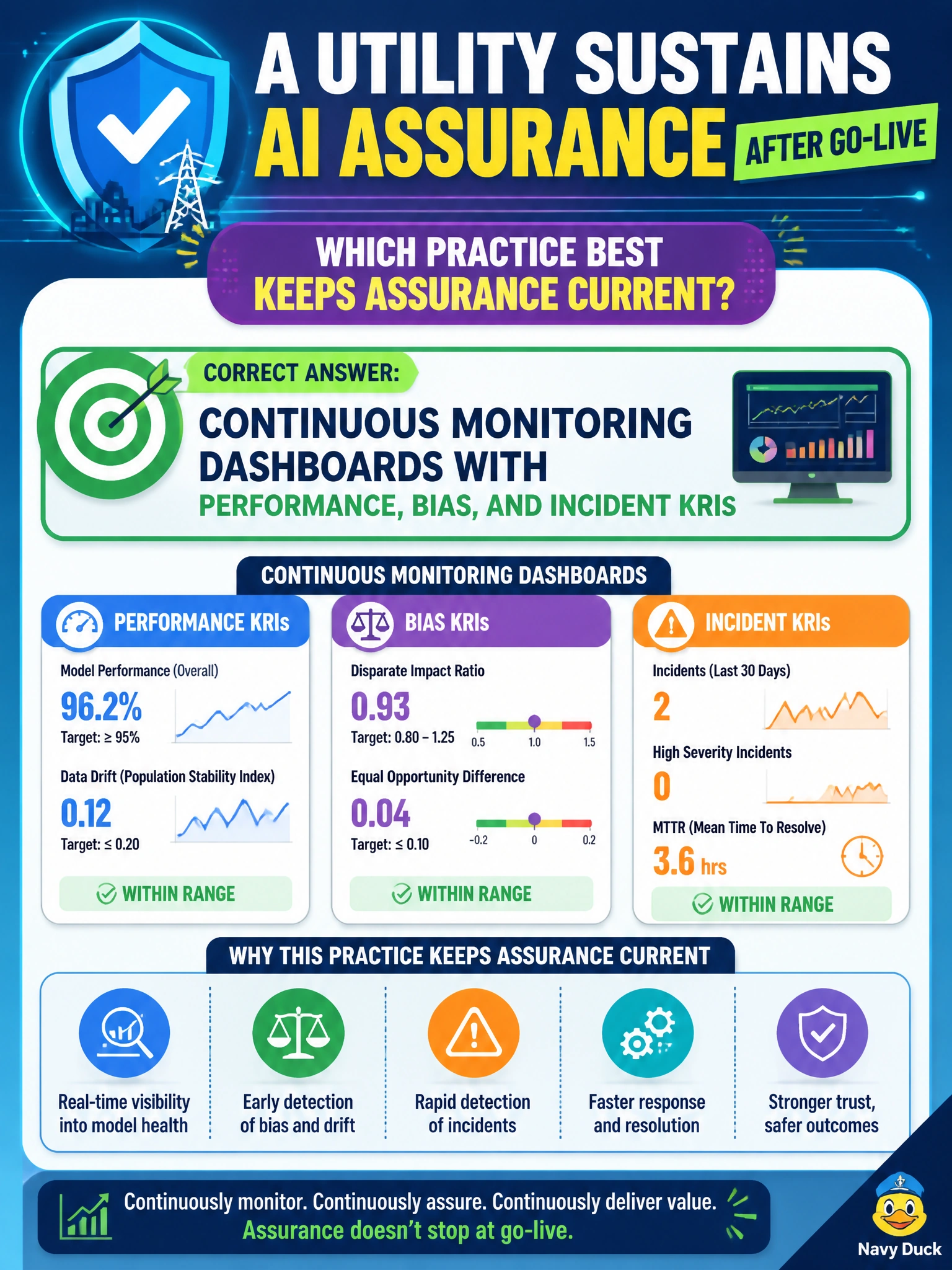
A utility sustains AI assurance after go-live. Which practice best keeps assurance current?
Select an answer to reveal the explanation.
Short Explanation
Launch day isn’t the finish line. Keep dashboards lit with performance, bias, and incident KRIs—like watching plant gauges after the ribbon cutting.
Full Explanation
A utility sustaining AI assurance after go-live should keep continuous monitoring dashboards with performance, bias, and incident KRIs. Live signals detect drift, disparate error, and emerging incidents early enough for operators and GRC to act—extending assurance beyond launch-day snapshots into the years when ratepayers actually depend on the models for reliability, equity, and safe operations.
Freezing all metrics permanently at launch-day baselines ignores population, sensor, weather, and model change that invalidate static references over time. Reviewing assurance only during rare multi-year strategy retreats leaves years of production risk unobserved between retreats. Turning off alerts so operators are not distracted by AI health signals deliberately blinds the organization to the conditions continuous assurance exists to catch.
Exam caveat: post-go-live civic AI assurance is continuous monitoring with actionable KRIs, not frozen baselines or silenced alerts. Operational check: confirm dashboards cover performance, bias/fairness, and incident KRIs; verify alert thresholds, on-call ownership, and monthly KRI review with GRC—and that production alerts remain enabled and periodically tested.